


ITIL Incident Management Explained: Process, Best Practices & Tools for Faster IT Service Recovery
Service disruptions place pressure on IT teams responsible for service reliability and user trust. As digital services expand across business units, incident handling requires structure, ownership, and speed. ITIL incident management provides a disciplined approach for restoring services while keeping operational impact contained. This framework supports repeatable responses across varied incident scenarios.
What Is ITIL incident management?
ITIL incident management refers to the practice of restoring disrupted services as quickly as possible after unexpected interruptions. The focus remains on minimizing business impact while keeping users informed throughout the incident lifecycle. Incidents include system outages, degraded performance, or service access issues affecting normal operations. This practice forms a core part of IT Service Management.
As organizations depend more heavily on digital services, incident handling becomes a daily operational responsibility. Unstructured responses often create confusion, delayed recovery, and frustrated users. ITIL incident management introduces clarity around ownership, escalation, and resolution paths. This approach supports predictable service recovery across teams and technologies.
Incident vs. problem management: What’s the difference?
Incident management and problem management serve related yet distinct purposes within ITSM. Incident Management addresses immediate service disruptions with the goal of rapid restoration. Problem Management focuses on identifying root causes behind recurring or high-impact incidents. Both practices work together to improve service reliability over time.
ITIL Incident Management Process
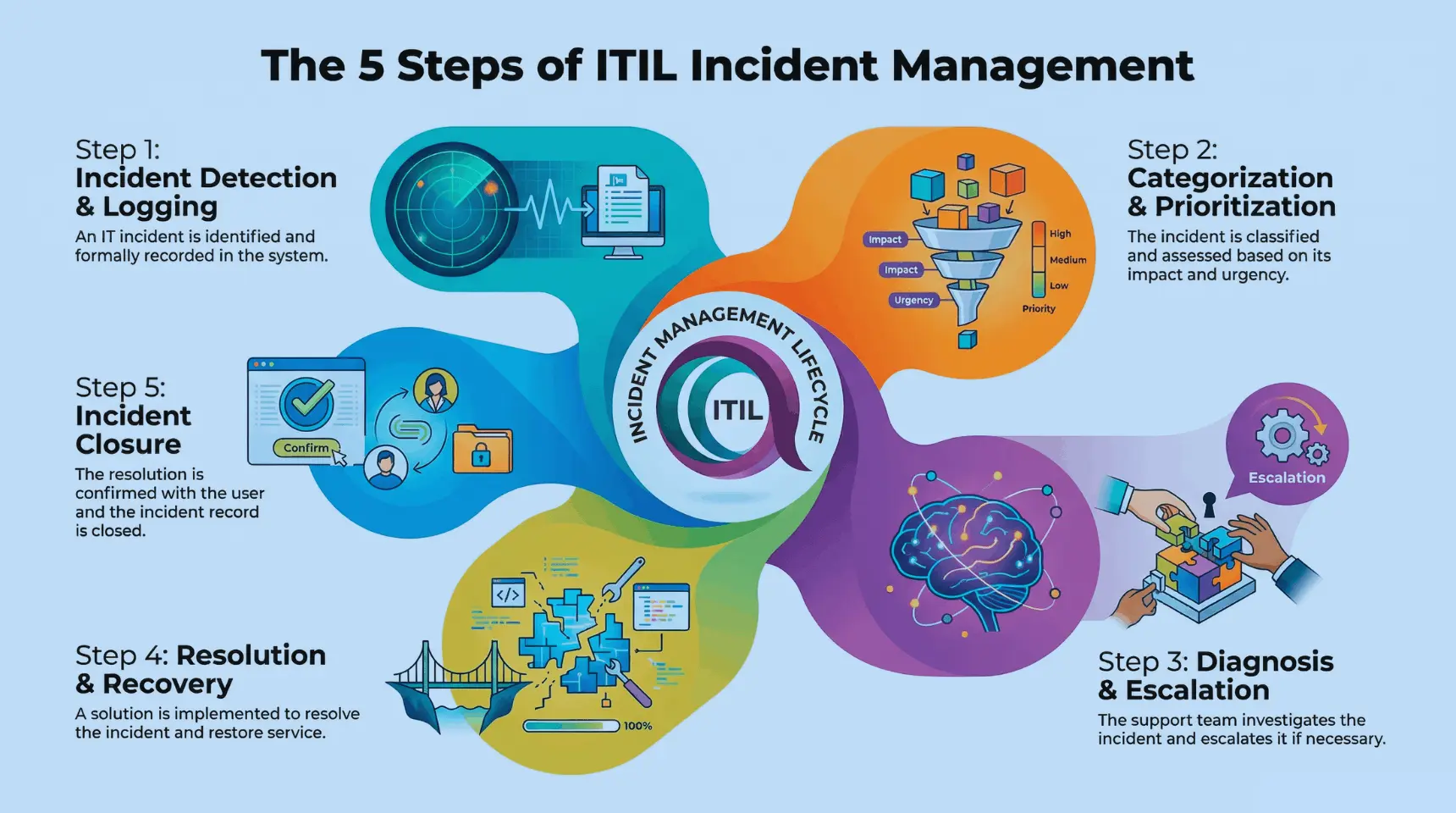
Step 1: Incident detection and logging
Incidents enter the system through user reports, monitoring alerts, or automated event detection. Accurate logging captures service impact, symptoms, and affected users from the start. This record forms the foundation for prioritization and response planning. Early visibility helps teams act before disruption spreads further.
Step 2: Categorization and prioritization
Once logged, incidents receive categories based on service type and impact scope. Priority reflects urgency combined with business impact rather than technical severity alone. This step ensures critical incidents receive attention ahead of routine requests. Consistent categorization improves reporting and future analysis.
Step 3: Diagnosis and escalation
Teams investigate incidents to identify probable causes and resolution paths. When resolution exceeds defined thresholds, escalation routes direct work to specialized groups. Escalation rules prevent unresolved incidents from lingering across shifts. Structured diagnosis reduces guesswork during high-pressure situations.
Step 4: Resolution and recovery
Resolution actions restore affected services to agreed service levels. Temporary fixes may support rapid recovery while permanent solutions follow later. Clear communication keeps stakeholders informed during recovery efforts. Service restoration marks the primary success measure for this step.
Step 5: Incident closure
Closure confirms service restoration and user acceptance. Records receive updates covering actions taken and resolution outcomes. Proper closure supports accurate metrics and future learning. Incomplete closure often weakens reporting accuracy.
Step 6: Post-incident review and reporting
Post-incident reviews examine response quality, timelines, and decision points. Reporting highlights trends, recurring patterns, and improvement opportunities. These insights support service improvement planning across teams. Reviews strengthen preparedness for future incidents.
ITIL Incident Management Best Practices
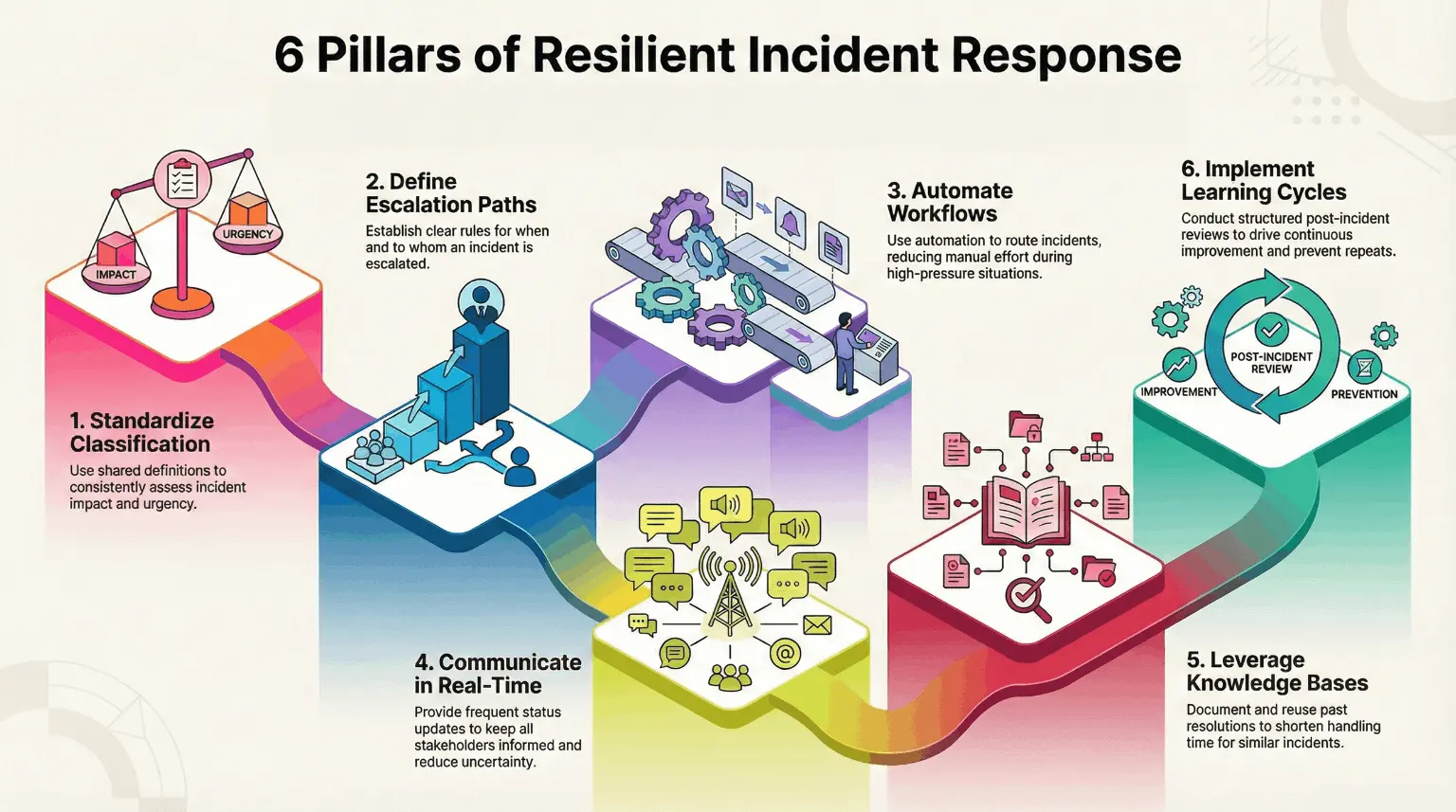
- Standardized categorization models: Consistent categories improve prioritization accuracy and reporting clarity across services. Teams benefit from shared definitions during triage and escalation.
- Defined escalation paths: Clear escalation rules prevent stalled incidents and confusion during ownership transfers. Escalation timing remains aligned with SLA thresholds.
- Automated workflow triggers: Workflow automation reduces manual coordination during diagnosis and resolution phases. Automation supports repeatable responses under pressure.
- Real-time communication updates: Timely updates reduce uncertainty for users and business stakeholders. Visibility builds confidence during recovery efforts.
- Knowledge-driven resolution support: Documented resolutions help teams resolve similar incidents faster. Knowledge reuse improves response maturity over time.
- Post-incident learning cycles: Structured reviews convert operational experience into improvement actions. Learning reduces recurrence rates across services.
Key KPIs and Metrics for Incident Success
Mean Time to Repair (MTTR)
MTTR measures the average duration required to restore services after incidents. Lower MTTR reflects faster coordination and clearer resolution paths. Tracking MTTR over time highlights process maturity improvements.
SLA compliance percentage
SLA compliance tracks adherence to agreed response and resolution timelines. This metric reflects operational discipline across teams and services. Sustained compliance builds stakeholder trust.
User satisfaction scores
User feedback captures perceived service quality during incident handling. Satisfaction scores reflect communication quality and resolution experience. These insights complement operational metrics.
Top ITIL Tools for Incident Management
| ITSM Tool | Best For | Automation | AI Features |
| Infraon ITSM | Unified ITSM operations | High | Gen AI workflows |
| ServiceNow | Large enterprises | High | Predictive analytics |
| Jira Service Management | DevOps-driven teams | Medium | Rule-based automation |
| Freshservice | Mid-sized IT teams | Medium | Workflow automation |
| ManageEngine | IT operations teams | Medium | Analytics dashboards |
How Infraon ITSM Supports ITIL Incident Management
Infraon ITSM supports ITIL Incident Management by structuring incident handling around fast service restoration, clear prioritization, and accountable ownership. The incident management capability within Infraon ITSM focuses on reducing resolution time while maintaining consistent service quality across complex IT environments.
Its Gen AI–driven workflows help identify incidents early, classify impact accurately, and route work to the right resolver groups based on urgency and business impact. This keeps incident handling aligned with ITIL principles while reducing manual overhead.
Quick logging and auto-ticketing
Infraon ITSM simplifies incident management through automated logging from multiple sources such as user requests and system-generated alerts. Incidents are categorized and prioritized using Gen AI logic that considers severity, service impact, and SLA commitments. Tickets are auto-assigned to agents based on skills and availability, reducing handoffs and delays during peak volumes.
Real-time dashboards and reporting
Infraon ITSM provides real-time incident visibility into status, volumes, and resolution progress through AI-powered dashboards. Teams gain insight into active incidents, SLA risks, and recurring patterns across services and time periods. These views support operational reviews and help leaders track MTTR, workload distribution, and service performance trends.
Automated workflows and AI-driven diagnosis
Incident workflows within Infraon ITSM guide teams through diagnosis, escalation, and resolution using predefined rules and Gen AI insights. The system supports automated escalation when SLA thresholds approach, along with recommendations drawn from historical incidents and the knowledge base. Self-service options further reduce ticket volume by resolving common issues early.
SLA enforcement and response governance
Infraon ITSM enforces SLA policies throughout the incident lifecycle, from prioritization through closure. Timers, alerts, and escalation rules help teams respond within agreed service targets and maintain accountability. Performance data collected during incident handling supports post-incident analysis and service reporting.
Case Studies from SEA & MENA
Empowering a South Asian manufacturing leader
A leading manufacturing enterprise operating across India and South Asia adopted ITIL incident management to regain control over growing service disruptions. Incident handling earlier relied on emails, spreadsheets, and informal escalations, which slowed response cycles and reduced visibility across plants and corporate offices. Infraon ITSM brought structured incident intake, automated routing, and SLA tracking into a single system.
This solution also came with dashboards for real-time tracking of incident volumes, response timelines, and agent utilization. This also made it easy to automate approvals, thereby reducing delays across teams.
- Faster incident response across manufacturing sites and corporate offices
- Higher agent productivity through automated assignment and workload balancing
- Improved SLA adherence supported by real-time tracking
Enabling a Middle East-based global life sciences organization
A multinational organization within the chemicals and life sciences sector faced challenges managing incidents across geographically distributed teams. Email-based approvals and limited reporting created delays during high-impact service disruptions. Infraon ITSM supported the shift toward ITIL incident management by introducing standardized workflows and structured escalation rules. Hence, incident ownership and resolution timelines became easier to track across regions.
Infraon ITSM also supported service teams through integrated knowledge articles and analytics-driven insights. Decision-makers gained visibility into recurring incidents, response patterns, and service risks.
- Shorter resolution timelines for high-priority incidents
- Better visibility into recurring service issues and resolution patterns
- Improved compliance reporting across regional operations
- Measurable gains in customer satisfaction and service reliability
FAQs
What is an ITIL incident?
An ITIL incident refers to any unplanned interruption or reduction in service quality. Incidents impact users or business operations.
How does the ITIL incident management process work?
The process follows structured steps from detection through closure. Each step supports service restoration and accountability.
What about ITIL tools vs. manual incident handling?
Incident management tools introduce automation, visibility, and reporting consistency. Manual handling increases response variability.
How can teams reduce MTTR?
Clear prioritization, automation, and knowledge reuse reduce recovery time across incidents.