


So, what is ESM in plain terms?
Think of Enterprise Service Management as taking the same efficient, structured approach that IT uses to manage tickets and applying it to the entire company. It’s the practice of using service management principles to support every business function, from HR and finance to facilities and procurement.
In essence, ESM creates a single, shared service model for the whole organization. Instead of navigating a maze of email inboxes and informal chats, employees have one clear place to go for any request. Behind the scenes, teams manage their work through transparent workflows, clear ownership, and consistent performance tracking.
The outcome is simple but powerful: coordinated, reliable service delivery across the entire enterprise, replacing scattered processes with a unified system that works for everyone.
Why Enterprise Service Management matters today
Modern organizations manage rising service demand across departments. Remote work, distributed teams, shared services, and higher employee expectations increase pressure on internal service teams.
Effective Enterprise Service Management brings order to this complexity. It replaces scattered request intake with standardized service catalogs. It provides visibility into service progress and ownership. It also supports automation for repeatable tasks, helping teams handle demand growth without adding operational friction.
How Enterprise Service Management Works Across Departments

Enterprise Service Management uses a shared service framework while each department controls its own services. Intake looks consistent. Execution remains department-led.
ESM for HR service delivery
HR teams handle onboarding, payroll queries, benefits questions, role changes, and policy requests. Service intake replaces scattered emails with structured forms.
Requests follow approval steps, document checks, and fulfillment tasks. HR leaders view request volumes and turnaround trends. Employees track progress without follow-ups.
ESM for facilities and admin teams
Facilities and admin teams manage maintenance issues, access requests, workspace needs, and asset problems. Enterprise Service Management brings these requests into a single service queue.
Ownership becomes clear. Requests gain priority rules. Status updates reduce repeated queries from employees and managers.
ESM for finance and procurement
Finance and procurement teams process purchase approvals, vendor queries, invoice handling, and reimbursement requests. Service workflows enforce approval paths and documentation checks.
Request records support audit needs and reporting. Teams gain clarity on demand peaks and approval delays.
ITSM vs. ESM: What’s the Real Difference?
ITSM vs. ESM comparison table
| Area | ITSM | ESM |
|---|---|---|
| Scope | Technology services | Enterprise-wide business services |
| Users | IT teams and employees | All business teams and employees |
| Goal | Reliable IT operations | Consistent service delivery across departments |
| Tools | IT service platforms | Enterprise Service Management software |
ITSM vs. ESM differs mainly in reach. ITSM supports technology services. Enterprise Service Management expands the same service discipline across the enterprise.
When ITSM is not enough
ITSM works well inside IT. Problems arise when HR, finance, or facilities rely on email or spreadsheets for service intake. Requests stall. Ownership blurs. Reporting stays fragmented.
Enterprise Service Management fills this gap by extending structured service delivery beyond IT, using shared models and department-led execution.
Benefits of Enterprise Service Management
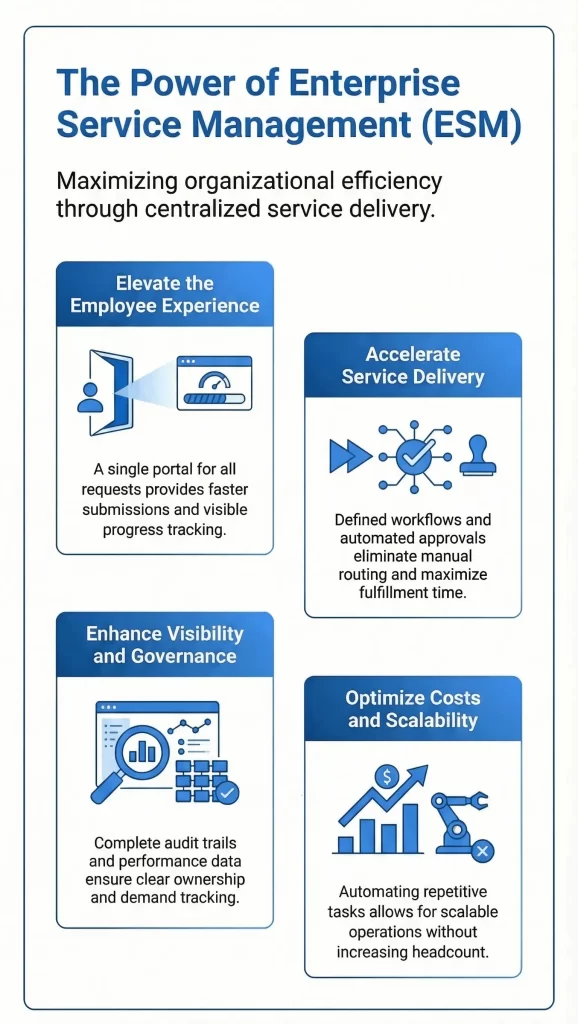
Improved employee experience
Employees use one service portal for all internal requests. Submission becomes faster. Progress remains visible. Status tracking reduces follow-up messages and delays.
Faster service delivery across teams
Defined workflows reduce manual routing. Approvals move in sequence. Teams spend less time coordinating and more time fulfilling requests.
Better visibility and governance
Service records provide audit trails, ownership clarity, and performance data. Leaders view service demand and delivery patterns across departments.
Cost optimization through automation
Automation handles high-volume requests and repetitive steps. Teams reduce manual effort while maintaining service consistency. These benefits of ESM support operational scale without added overhead.
Enterprise Service Management Best Practices

Start with one department, then scale
Enterprise Service Management works best when rollout begins with a single business function that already handles a high volume of internal requests. HR, facilities, or finance often serve as strong starting points because their services follow repeatable patterns and involve clear ownership.
Early rollout should focus on learning, not perfection. Teams refine intake forms, approval steps, and response expectations based on real usage. Once workflows run reliably and employees adopt the portal, expansion into additional departments becomes easier and faster.
Scaling happens department by department, using proven patterns rather than reinventing service models each time.
Standardize service catalogs
A shared service catalog provides structure to how employees request help. Standardization reduces confusion and prevents each department from presenting services in different formats.
Effective catalogs use:
- Clear service names written from the employee perspective
- Short descriptions that explain when to use the service
- Defined request fields tied to workflow needs
Regular catalog reviews remove outdated services and merge overlapping requests. This keeps the catalog usable as more teams join Enterprise Service Management.
Automate high-volume requests first
Automation delivers early momentum when applied to repeatable requests. Password access, onboarding tasks, approval routing, and document collection benefit quickly from workflow automation.
High-volume automation reduces manual handoffs and approval delays. Teams spend less time coordinating work and more time completing requests. This also creates consistent outcomes across similar requests, which supports reliability at scale.
Measure experience, not just SLAs
Service metrics extend beyond response times. Employee satisfaction, request completion clarity, and ease of submission provide deeper insight into service quality.
Tracking experience signals helps teams improve service design. Feedback identifies where forms confuse users, where approvals slow progress, and where communication gaps appear.
The Future of Enterprise Service Management
AI-driven service automation
AI-driven capabilities play a growing role in Enterprise Service Management. Intelligent routing, request categorization, and response suggestions reduce manual effort for service teams.
Automation guided by historical request data helps teams handle demand growth while maintaining service consistency. AI also supports faster resolution by surfacing relevant knowledge and next-step recommendations.
Employee experience as the new KPI
Organizations increasingly evaluate internal services through the employee experience lens. Ease of request submission, visibility into progress, and predictable outcomes matter as much as turnaround time.
Enterprise Service Management aligns service delivery with this expectation by giving employees one place to raise requests and track outcomes across departments.
ESM as a digital workplace backbone
Enterprise Service Management supports the digital workplace by connecting services, workflows, and internal teams through a shared operating model. As organizations expand remote work and shared services, ESM becomes central to how work flows internally.
Why Invest in Enterprise Service Management Software?
Challenges of email and manual ticketing
Email-based service handling creates delays, missed ownership, and limited visibility. Requests get buried in inboxes, approvals happen offline, and progress tracking depends on follow-ups.
Manual ticketing lacks consistency. Each department uses its own methods, making reporting and coordination difficult. Enterprise Service Management software replaces these gaps with structured intake, routing, and tracking.
What to look for in an ESM platform
Enterprise Service Management software should support cross-department service delivery while keeping ownership within teams.
Key capabilities include:
- No-code workflows for building and updating service processes
- Multi-department support through shared portals and catalogs
- SLA and analytics tools for tracking service performance
- AI and automation features that reduce manual coordination
The right platform supports growth without forcing departments into rigid models.
Getting Started with Enterprise Service Management Software
Step-by-step ESM adoption roadmap
Adoption begins with understanding where service demand concentrates. Service-heavy teams provide early learning opportunities.
A practical rollout follows these steps:
- Identify teams with frequent internal requests
- Define workflows, approvals, and ownership rules
- Launch internal self-service through a shared portal
- Expand services and departments based on usage patterns
Enterprise Service Management software supports this phased approach, helping teams introduce structure without disrupting daily operations. Soft capability alignment with Infraon supports unified service visibility and workflow coordination.
Real-World Enterprise Service Management Use Cases
Employee onboarding coordination
Employee onboarding often spans HR documentation, IT access, equipment provisioning, and facilities readiness. Enterprise Service Management brings these activities into one connected request so tasks progress in sequence. Managers see ownership at each step, dependencies remain visible, and new hires begin work with fewer delays and handoffs.
Procurement approval management
Purchase requests move through defined approval paths tied to budgets, vendors, and authorization levels. Each request carries context, supporting documents, and decision history in one place. Teams gain visibility into approval queues, while finance leaders track turnaround trends and recurring approval slowdowns.
Facilities service request handling
Workplace issues such as maintenance, access permissions, space changes, and equipment problems flow through a centralized request system. Requests include priority levels, assigned owners, and completion updates. Facilities teams plan work based on real demand instead of reactive follow-ups.
HR employee service delivery
Policy questions, benefits requests, role changes, and employee lifecycle actions enter through standardized service requests. This structure reduces repeated clarifications and manual tracking. Employees see progress clearly, while HR teams manage workload through predictable service flows.
Finance and invoice processing
Vendor queries, invoice submissions, reimbursements, and financial approvals move through tracked workflows with recorded decisions and document history. This creates traceability for audits and reduces delays caused by missing information or unclear ownership during review cycles.
Cross-department workflow coordination
Requests involving multiple teams, such as onboarding, office moves, or role transitions, remain within one shared record. Each department completes assigned steps in order, removing reliance on email chains and reducing breakdowns during handoffs.
Request progress visibility for employees
Employees track request progress, pending approvals, and completed steps through a shared portal. This visibility reduces status-chasing messages and gives confidence that work moves forward through defined stages.
Service demand and workload insight
Request data reveals volume patterns, peak periods, recurring bottlenecks, and fulfillment timelines. Leaders use this insight to plan capacity, adjust workflows, and prioritize improvements across internal service teams.
Enterprise Service Management FAQs
What is ESM in simple terms?
Enterprise Service Management means using one structured way to handle internal requests across all business teams. Employees raise requests through a shared service portal. Behind the scenes, each department uses workflows, ownership rules, and tracking to deliver its services.
Instead of switching between email threads, forms, or chat messages depending on the team, employees follow one consistent request experience. Business teams keep control over how their services run while benefiting from shared visibility and reporting.
Is ESM only for large enterprises?
Enterprise Service Management works for organizations of different sizes, but value increases as internal service complexity grows. Companies with multiple departments, approval-heavy workflows, or distributed teams see faster returns.
Smaller organizations often start with one or two departments such as HR or facilities. As service demand grows, ESM provides a scalable way to manage requests without relying on informal coordination or manual tracking.
How is ESM different from ITSM tools?
IT Service Management tools focus on technology services owned by IT teams. Enterprise Service Management uses the same service discipline, then extends it to non-IT teams such as HR, finance, procurement, and facilities.
The difference shows up in scope and users. ITSM supports IT operations. ESM supports enterprise-wide service delivery. Many organizations run both through the same platform so employees interact with one service portal while departments manage their own workflows.
What industries benefit most from ESM?
Industries with structured internal processes and high employee interaction benefit most from Enterprise Service Management. These include manufacturing, healthcare, financial services, education, technology, and professional services.
Any organization managing onboarding, approvals, compliance processes, facilities operations, or shared services across teams benefits from a unified service approach.
How long does it take to implement ESM?
Implementation time depends on scope and rollout approach. Teams that start with a single department and a small set of services often launch within weeks.
Enterprise-wide rollout happens in phases. Organizations expand services based on adoption, usage patterns, and operational readiness. This phased approach helps teams build confidence while delivering measurable improvements early.