


IT service management tools help IT teams control incidents, requests, changes, service data and support workflows from one operating system. ServiceNow suits enterprise scale, while Freshservice gives mid-market teams a faster route into mature service management. Infraon fits teams that want ITSM, ITAM and CMDB in one place.
Let’s compare 15 tools using six criteria, with pricing shown in USD and INR equivalents where vendors disclose rates. The comparison covers process depth, AI and automation, CMDB and asset awareness, rollout demands, pricing transparency and regional fit.
We’ll also separate enterprise-heavy platforms from options built for smaller teams, DevOps groups and Indian buyers with local data requirements.
IT Service Management Tools Compared: Quick Picks
Best ITSM tools by scenario
- Best for enterprise scale – ServiceNow
- Best for mid-market IT teams – Freshservice
- Best for SMBs on a tight budget – ManageEngine ServiceDesk Plus
- Best for DevOps and Atlassian-native teams – Jira Service Management
- Best for unified ITSM, ITAM and CMDB – Infraon ITSM
- Best for AI-native service operations – Atomicwork
IT Service Management Tools List: Full Comparison Table
| Tool | Best For | Starting Price USD / INR | Free Trial | AI Capability | ITIL Coverage | Deployment Speed | Region Fit | G2 Rating |
|---|---|---|---|---|---|---|---|---|
| Infraon ITSM | Unified ITSM, ITAM and CMDB | $19 / ~₹1,710 user/mo | Trial available | AI-assisted service workflows | Broad ITIL-aligned coverage | Fast to medium | India, APAC, Middle East | Rating omitted: count unverified |
| ServiceNow ITSM | Large enterprise service operations | Quote-based | Demo / sales-led | Agentic AI and Now Assist | Deep enterprise ITIL coverage | Longer | Global, India presence | 4.5/5 (1,822) |
| Freshservice | Mid-market IT teams | $19 / ~₹1,710 agent/mo | Free trial | Freddy AI | Broad ITIL coverage | Fast | Global, India hosting | 4.6/5 (1,329) |
| Jira Service Management | DevOps and Atlassian teams | $20 / ~₹1,800 agent/mo | Free for 3 agents | Rovo and automation | Core-to-broad ITIL coverage | Fast | Global, India residency | 4.3/5 (975) |
| ManageEngine ServiceDesk Plus | Budget-conscious SMB and mid-market | $13 / ~₹1,170 tech/mo | Free edition + 30-day trial | AI and workflow automation | Broad ITIL coverage | Fast | Strong India fit | 4.2/5 (248) |
| BMC Helix ITSM | Complex enterprise ITSM | Quote-based | Trial available | Agentic and predictive service AI | Deep enterprise ITIL coverage | Longer | Global, enterprise | 3.7/5 (293) |
| Ivanti Neurons for ITSM | ITSM tied to endpoint and asset operations | Quote-based | 30-day trial | AI and self-healing in higher packages | Broad ITIL coverage | Medium | Global | Rating omitted |
| SolarWinds Service Desk | Cloud-first mid-market teams | $39 / ~₹3,510 tech/mo | 30-day trial | AI summaries, guidance and virtual agent | Core ITIL coverage | Fast | Global | Rating omitted |
| SysAid | Lean teams prioritizing AI automation | $89 / ~₹8,010 agent/mo | Free trial | Copilot and prebuilt AI agents | Core ITIL coverage | Fast | Global | Rating omitted |
| Zendesk Suite | Support-led service teams | $55 / ~₹4,950 agent/mo | Trial available | AI agents and automation | ITSM-adjacent | Fast | Global | Rating omitted |
| InvGate Service Management | Mid-market service management | $1,499 / ~₹134,910 yr for 5 agents | Free trial | AI Hub and AI Service Agent | Core ITIL coverage | Fast | Global | Rating omitted |
| HaloITSM | Teams wanting configurable ITSM without legacy scale | Quote-based | Demo / trial by request | AI-assisted workflows | Broad ITIL coverage | Fast to medium | Global | Rating omitted |
| TOPdesk | Service teams prioritizing usability | £51 / ~₹6,120 agent/mo* | Quote / demo | AI categorization, search and writing | Core-to-broad ITIL coverage | Fast | Global, regional hosting | Rating omitted |
| Atomicwork | AI-native IT and employee service | $25,000 / ~₹22.5 lakh yr | Trial by request | AI Workforce and AI coworkers | Modern ITSM coverage | Fast to medium | India-founded, global | Rating omitted |
| Motadata ServiceOps | Indian teams combining service and operations | Quote-based | Free trial reported | AI/ML routing, suggestions and analytics | ITIL-aligned coverage | Fast to medium | Strong India fit | Rating omitted |
What Changed in ITSM Tools in 2026
AI buying decisions have become harder to justify on feature claims alone. Gartner expects over 40% of agentic AI projects to be canceled by the end of 2027. A separate Gartner survey of 782 infrastructure and operations leaders found that only 28% of AI use cases fully succeeded and met ROI expectations, while 20% failed outright. At the same time, Gartner projects that 40% of enterprise applications will include task-specific AI agents by the end of 2026, up from under 5% in 2025. Buyers therefore need proof that AI works inside real service workflows rather than a long list of AI labels.
How We Evaluated These ITSM Tools
The comparison uses six criteria that affect buying decisions after the demo: process depth, AI and automation capability, CMDB and asset awareness, deployment speed and admin overhead, pricing transparency, and regional availability and data residency. Core service-management depth carried the greatest weight because incident, request, change and knowledge workflows still determine daily usability.
AI capability was weighted against evidence rather than feature count: Gartner’s 2026 I&O research found that only 28% of AI use cases fully succeeded and met ROI expectations. Pricing and regional fit received added weight where two products offered similar operating depth.
Evaluation criteria
- Core ITSM process depth – coverage for incident, request, problem, change, knowledge and service-level work
- AI and automation capability – useful automation inside service workflows, assessed against evidence rather than labels
- CMDB and asset awareness – service context that connects tickets with devices, configurations and dependencies
- Deployment speed and admin overhead – the work required to configure, govern and maintain the platform
- Pricing transparency – published entry pricing, trial terms and visibility into likely add-on costs
- Regional availability and data residency – hosting choices, India relevance and procurement support
Disclosure
Infraon ITSM is Infraon’s own product. It was assessed against the same six criteria as every other tool, and its placement reflects fit for specific use cases rather than a universal ranking.
What Are IT Service Management Tools?
These platforms help IT teams manage incidents, requests, changes, knowledge, service levels and related records. They connect service work with ownership, automation and shared context so teams can manage the lifecycle around each ticket from intake through resolution and review.
Core modules inside ITSM tools
- Incident management – records service disruption, sets priority and produces a traceable recovery record
- Service request management – captures standard requests, approvals and fulfillment tasks, producing a visible request history
- Change management – assesses service risk, approvals and implementation activity, producing an auditable change record
- Asset and configuration management – links devices and configuration items with ownership and dependencies, producing service context for support and change decisions
- Knowledge management – stores reusable fixes and service guidance, producing searchable answers for agents and users
ITSM tools vs. help desk software vs. ITOM tools
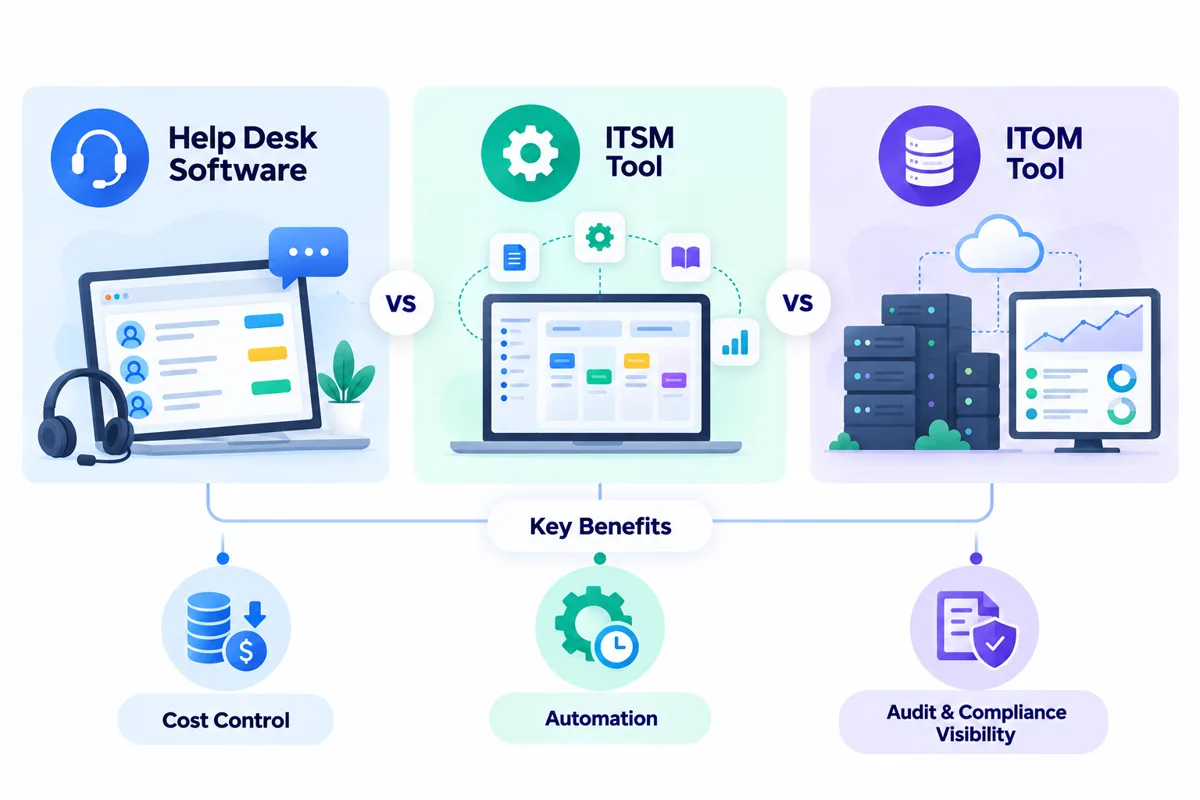
A help desk tool handles tickets and user support interactions. An ITSM tool manages the service lifecycle around those tickets, including requests, changes, knowledge, SLAs and service context. An ITOM tool watches the infrastructure underneath; Infraon’s ITSM vs ITOM comparison covers the category difference in depth.
- Cost control improves when recurring work, service demand and asset context expose where time and budget are being consumed
- Automation reduces repetitive routing, approvals, notifications and status updates that otherwise absorb service-desk time
- Audit and compliance visibility improves when approvals, changes, ownership and service history remain in traceable records
The 15 Best ITSM Tools in 2026
1. Infraon ITSM
Best for
Mid-sized and enterprise IT teams that want service, asset and configuration data in one system without the rollout burden associated with the largest enterprise suites.
Key features
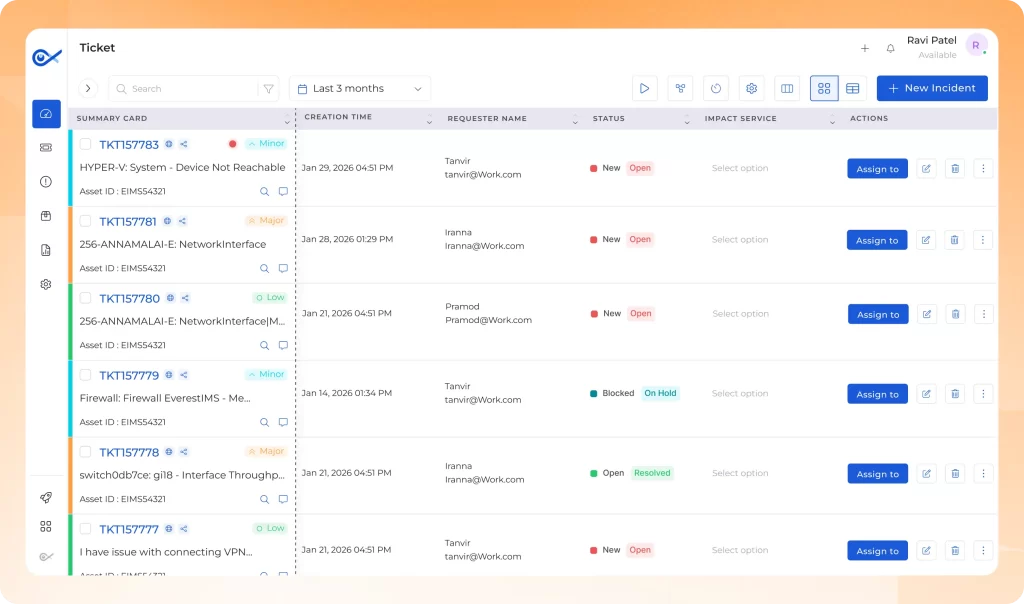
- Connected ITSM, ITAM and CMDB give agents service and asset context in the same workflow
- Visual workflow controls automate routing, approvals and escalations without forcing every change through code
- AI-assisted ticket handling supports triage and service-desk work while retaining human ownership
- Regional positioning and deployment choices suit teams operating in India, APAC and the Middle East
Pricing
$19 per user/month for the entry paid tier, with higher tiers at $47 and $57 per user/month, or roughly ₹1,710, ₹4,230 and ₹5,130 at the comparison exchange rate used here.
Strengths and limitations
- Strength – Unified service, asset and configuration context
- Strength – Published entry pricing
- Strength – Customer proof includes 18,000+ employees under managed access at Tata Electronics
- Limitation – Smaller partner ecosystem than ServiceNow
- Limitation – Fewer third-party integrations than Jira
2. ServiceNow ITSM
Best for
Large enterprises running high-volume service operations, complex governance and multi-department workflows where platform scale outweighs rollout speed.
Key features
- Deep incident, request, problem and change workflows support complex enterprise operating models
- A shared platform and CMDB connect service records with configuration context
- Now Assist and agentic workflows bring AI into service operations
- A broad ecosystem supports large transformation programs and specialized implementation work
Pricing
Quote-based – no public ITSM rate card. ServiceNow asks buyers to request a custom quote. The cost model should include implementation, configuration and ongoing administration as well as subscription fees.
Strengths and limitations
- Strength – Enterprise scale and process depth
- Strength – Large implementation and partner ecosystem
- Strength – Strong workflow and platform breadth
- Limitation – Steep learning curve
- Limitation – Implementation and administration can be heavy for smaller teams
3. Freshservice
Best for
Mid-market IT teams that want mature ITSM, asset context and automation with a shorter path from purchase to daily use.
Key features
- Incident and knowledge management start in the $19 Starter tier
- Growth adds service catalog, SLA and on-call management
- Pro adds problem, change and major incident management
- Freddy AI adds service automation and agent assistance, with some AI capabilities sold separately
Pricing
$19 per agent/month for Starter when billed annually, roughly ₹1,710. Growth is $49 and Pro is $99 per agent/month; Enterprise is custom. Freshworks offers a free trial.
Strengths and limitations
- Strength – Clear public pricing
- Strength – Fast adoption and approachable administration
- Strength – India hosting is available for Freshservice data
- Limitation – Full ITSM depth requires higher paid tiers
- Limitation – Some AI features add separate per-agent cost
4. Jira Service Management
Best for
DevOps and software-centric teams already using Jira that want service management tied closely to engineering work and Atlassian workflows.
Key features
- Request, incident and change workflows connect naturally with Jira work items
- Free plan supports up to three agents for small teams testing the service model
- Automation and Atlassian platform services reduce handoffs between service and development teams
- India data residency can pin in-scope Jira Service Management data to the Mumbai region
Pricing
$20 per agent/month is the published Standard reference on G2, roughly ₹1,800, while the Free plan supports up to three agents. Atlassian pricing varies by team size and billing term.
Strengths and limitations
- Strength – Strong Atlassian ecosystem fit
- Strength – Free entry point for three agents
- Strength – Good bridge between service and DevOps work
- Limitation – Advanced setups can demand ongoing configuration
- Limitation – Cost rises as agent count and higher-tier needs grow
5. ManageEngine ServiceDesk Plus
Best for
SMBs and mid-market teams that need broad service-desk coverage at a lower entry price, with strong relevance for Indian IT operations.
Key features
- Standard starts with help-desk workflows at a low per-technician price
- Professional adds asset management for teams that need device context
- Enterprise adds change, project and broader service-management functions
- Cloud and on-premises choices support different hosting and control requirements
Pricing
$13 per technician/month for Standard, roughly ₹1,170. Professional starts at $27 and Enterprise at $67 per technician/month. The Standard edition can be free for up to five technicians, and a 30-day trial is available.
Strengths and limitations
- Strength – Low entry price
- Strength – Strong India presence and local support numbers
- Strength – Broad ITSM and asset options in multiple editions
- Limitation – Some capabilities sit in higher editions or add-ons
- Limitation – Cloud and on-premises feature cadence can differ
6. BMC Helix ITSM
Best for
Large organizations with mature ITIL processes, complex change governance and a need for enterprise service management tied to configuration data.
Key features
- Incident, problem, change and request management support mature enterprise service processes
- CMDB-driven context helps teams assess service and change impact
- AI-driven service capabilities target high-volume enterprise operations
- SaaS and current on-premises deployment options support different control models
Pricing
Quote-based – no public pricing. BMC provides sales-led pricing, and a free trial page is available. Buyers should model implementation and related modules alongside subscription cost.
Strengths and limitations
- Strength – Deep enterprise ITSM coverage
- Strength – Strong CMDB and service-process heritage
- Strength – Cloud and on-premises options
- Limitation – Setup and customization can take substantial time
- Limitation – Cost and platform complexity can be difficult to justify for smaller teams
Nine more ITSM tools worth shortlisting
Ivanti Neurons for ITSM
Best for – Organizations already invested in Ivanti endpoint, asset or security products and looking to connect service management with that operating stack.
Pricing – Quote-based; per-analyst subscriptions support named or concurrent licensing. A 30-day trial is available.
Verdict – A strong fit where Ivanti is already part of the estate. Professional includes core ITSM plus ITAM and discovery, while higher packages add AI and self-healing.
SolarWinds Service Desk
Best for – Cloud-first mid-market teams that want service management, CMDB and asset capabilities with public pricing.
Pricing – Essentials starts at $39 per technician/month, roughly ₹3,510, billed annually. A fully functional 30-day trial is available.
Verdict – One of the easier products to budget before a sales call. Essentials includes incident, knowledge, portal, asset, catalog, change, CMDB and SLA functions; higher plans add advanced automation, virtual-agent and AI capabilities.
SysAid
Best for – Lean IT teams that want AI embedded into request, incident and automation work without building a separate AI layer.
Pricing – Professional is $89 per agent/month, roughly ₹8,010. Enterprise is custom and starts at 20 agents. A free trial is available.
Verdict – The current Professional plan includes Copilot, prebuilt AI agents, asset management and core service processes. The trade-off is a relatively high public entry price compared with budget-oriented service desks.
Zendesk Suite
Best for – Support-led organizations whose service operation is closer to employee or customer support than a deep ITIL program.
Pricing – Suite Team starts at $55 per agent/month, roughly ₹4,950, billed annually. Trial availability is published by Zendesk.
Verdict – Strong omnichannel support, knowledge and AI make Zendesk easy to understand for support teams. Buyers needing deep change, configuration and IT asset processes should compare the ITSM depth carefully before treating it as a direct enterprise ITSM substitute.
InvGate Service Management
Best for – Mid-market teams seeking service management with public annual pricing and an approachable rollout.
Pricing – Starter is $1,499/year for five agents, roughly ₹134,910. Pro is $500 per agent/year, and Enterprise starts at $12,000/year. A free trial is available.
Verdict – Public pricing makes early budgeting easier. Starter includes unlimited end users, SSO and AI Hub; Pro adds workflow building and an AI Service Agent, while Enterprise adds options such as on-premises hosting.
HaloITSM
Best for – Teams that want a configurable service-management platform and prefer a lighter commercial model than the largest enterprise suites.
Pricing – Quote-based – no public price used in this comparison.
Verdict – HaloITSM is commonly shortlisted by teams seeking broad ITSM workflows without the operating weight of a large platform program. Pricing needs a vendor quote, so buyers should compare implementation services, integrations and required modules alongside license cost.
TOPdesk
Best for – Service teams prioritizing usability, incident handling and asset context with transparent package pricing.
Pricing – The entry package is £51 per agent/month, about ₹6,120 at the comparison rate. Higher packages are £72 and £101 per agent/month.
Verdict – TOPdesk publishes package prices and includes unlimited assets, tickets and end users. Engaged adds change, problem and SLA management plus AI functions.
Atomicwork
Best for – IT teams exploring AI-native employee service and service operations, including organizations that want AI workers layered over an existing platform first.
Pricing – Professional starts at $25,000/year, about ₹22.5 lakh, with 25,000 AI credits. Sales-led outcome pricing is also offered.
Verdict – Atomicwork can run its AI Workforce over ServiceNow or Jira Service Management before a full platform move. That creates an unusual migration path, but the entry price puts it outside the low-cost end of this list.
Motadata ServiceOps
Best for – Indian and regional teams that want ITSM connected with asset, patch and operations functions in one product family.
Pricing – Quote-based; a free trial is reported by current software directories.
Verdict – ServiceOps combines ITIL-aligned service management with AI-driven routing, suggestions, analytics, asset lifecycle functions and MSP support. Its India roots and broad operations scope make it worth including for regional shortlists, though buyers need a direct quote for current commercial terms.
Best ITSM Tools by Company Size, Use Case and Region
Which ITSM tool fits your situation
Use this grid to narrow the field before comparing workflow depth, commercial terms and regional requirements.
| Scenario | Recommended tool and one-line reason |
|---|---|
| BY COMPANY SIZE – ITSM platforms | |
| Startup | Jira Service Management – free for up to three agents and easy to connect with development work |
| SMB | ManageEngine ServiceDesk Plus – low entry price with a free Standard edition for small technician teams |
| Mid-market | Freshservice – public pricing, quick adoption and broader ITSM depth as teams grow |
| Enterprise | ServiceNow ITSM – deep process and platform scale for complex service organizations |
| BY USE CASE – ITSM platforms | |
| AI-powered | Atomicwork – AI Workforce can operate over an existing ServiceNow or Jira environment before a platform move |
| Open-source or low-cost | ManageEngine ServiceDesk Plus – a practical low-cost commercial option; open-source products require a separate support and hosting assessment |
| Built-in ITAM and CMDB | Infraon ITSM – service, asset and configuration context are positioned together |
| MSP | Motadata ServiceOps – supports multiple support portals and MSP operating models |
| DevOps | Jira Service Management – strongest fit where Jira already anchors engineering work |
| Cloud versus on-premise | BMC Helix ITSM – supports both SaaS and current on-premises deployment models |
Best ITSM tools for Indian IT teams
Data residency and which vendors host in India
Indian buyers should verify the hosting region at contract stage rather than infer it from a vendor’s local office. Freshworks lists India among the AWS regions used for Freshservice, ManageEngine publishes an India data-center option for ServiceDesk Plus Cloud, and Atlassian lets Jira Service Management customers on supported cloud plans pin in-scope data to its India location in AWS Mumbai. ServiceNow also operates Indian data-center capacity, but exact tenancy and product-region terms should be confirmed in the order form. BMC and other vendors with sales-led enterprise hosting should be checked against the proposed deployment rather than treated as locally hosted by default.
DPDP Act 2023 and service desk data
Service tickets can contain employee names, contact details, device information and other digital personal data. India’s DPDP framework requires organizations to have a lawful basis for processing and gives individuals rights that include access, correction and erasure. A service desk therefore needs controls for who can view ticket data, how long records are retained, how corrections or deletion requests are handled, and how processing activity can be evidenced. Procurement teams should map those controls to their own role as data fiduciary rather than treat a vendor’s security certificate as the whole compliance answer.
CERT-In six-hour incident reporting
CERT-In’s cyber-security directions require specified reportable incidents to be reported within six hours of noticing them. An incident workflow used for that purpose needs reliable detection and notification timestamps, an audit trail that preserves actions taken, and escalation that can reach the responsible security team outside business hours. Platforms with configurable incident routing, SLA timers, audit history and integrations can support that operating model, but the reporting obligation remains with the organization. ServiceNow, Freshservice, Jira Service Management, ManageEngine, Infraon and BMC all offer the workflow building blocks; buyers still need to test the exact six-hour path in their own process.
INR pricing and local support
ManageEngine has a strong local footprint, India support numbers and local partner purchasing. Freshworks is India-founded and operates Indian infrastructure for Freshservice, while Atlassian supports India data residency even though commercial billing can still follow global plan structures. Infraon is positioned for India and APAC buyers with published USD tiers and regional sales coverage. ServiceNow and BMC are enterprise sales-led, so INR invoicing, tax treatment, support hours and local implementation partners should be written into the commercial evaluation rather than assumed from global availability.
How to Choose an ITSM Tool: 5-Point Checklist
- Match process depth to team size and IT maturity – buying enterprise workflow depth for a six-person team can leave administrators maintaining controls the team never uses
- Test AI and automation claims against your own tickets before signing – automating a weak process can reproduce the same routing and data problems at greater speed, while Gartner expects over 40% of agentic AI projects to be canceled by the end of 2027
- Check CMDB, asset linkage and integration coverage – otherwise the service desk can receive an incident without knowing which device, service or dependency the issue affects
- Verify compliance, audit trails and data residency – otherwise a team can discover after go-live that it cannot reconstruct the timestamps or evidence needed for a CERT-In reporting path
- Model three-year total cost rather than license cost – an inexpensive entry tier can become costly after paid modules, migration, implementation and administration are included
Why IT Teams Shortlist Infraon ITSM
Tool consolidation becomes relevant when service, asset, configuration and monitoring data are split between several products. Every connection between those systems needs ownership when APIs, fields or vendor releases change. Infraon ITSM brings service management together with ITAM and CMDB context, which can reduce the number of handoffs required to understand a ticket or asset.
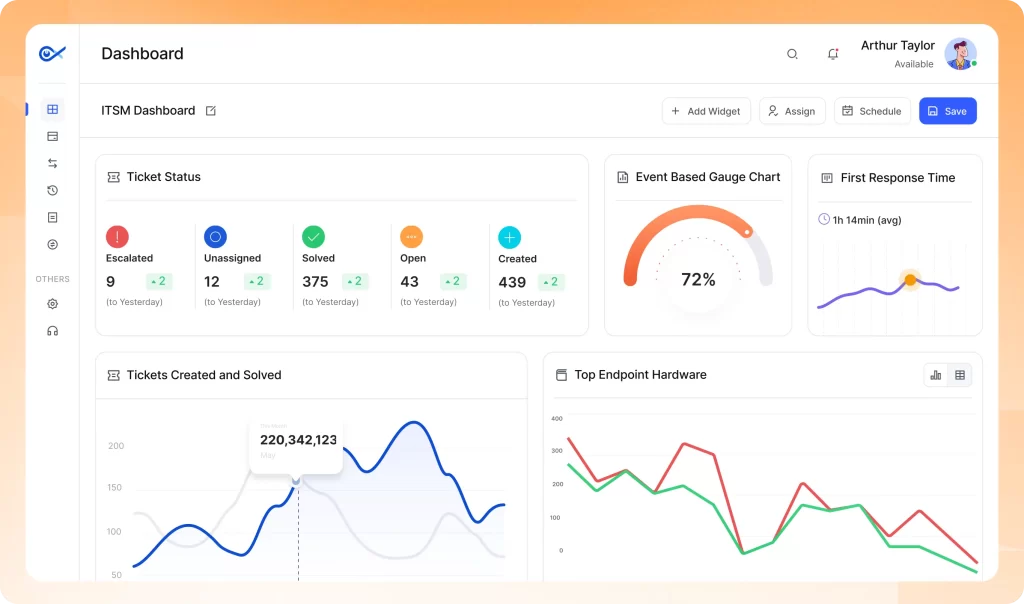
Tata Electronics uses Infraon ITSM for managed access covering 18,000+ employees, while SMET reports a 75%+ reduction in annual IT spend after replacing email-based approvals and spreadsheets with automated service and asset workflows.
The fit still depends on the buyer’s ecosystem. Teams deeply committed to ServiceNow or Jira may value their larger partner or integration networks, while teams seeking a connected regional platform may place greater weight on Infraon’s consolidation model.
Frequently Asked Questions
What are IT service management tools?
These platforms are used to manage incidents, requests, changes, knowledge, service levels and related service records. They give IT teams a common place to route work, track ownership, automate repeatable steps and measure service delivery. Many products also connect tickets with assets and configuration data.
What is the best ITSM tool in 2026?
The answer changes by segment. ServiceNow fits large enterprises with complex service operations, Freshservice fits many mid-market teams, ManageEngine ServiceDesk Plus suits budget-conscious SMBs, Jira Service Management fits Atlassian-centered DevOps teams, and Infraon fits teams seeking ITSM, ITAM and CMDB together. The shortlist should follow operating needs rather than one universal winner.
How much do IT service management tools cost?
Published entry prices in this comparison run from about $13 per technician per month for ManageEngine ServiceDesk Plus to $89 per agent per month for SysAid, while several enterprise products use custom quotes. Freshservice starts at $19 per agent per month. Implementation, add-ons and administration can change the three-year cost materially.
What is the difference between ITSM tools and help desk tools?
Help desk tools focus mainly on tickets and user support. ITSM tools cover the wider service lifecycle around those interactions, including service requests, changes, problems, knowledge, SLAs and service context. Some platforms also connect assets and configuration records so agents can see what a ticket affects before acting.
Which ITSM tools are most used in India?
Indian buyers commonly encounter global products such as ServiceNow, Freshservice, Jira Service Management and ManageEngine ServiceDesk Plus alongside regional products such as Infraon, Atomicwork and Motadata. Usage alone should never decide the shortlist. India hosting, DPDP controls, CERT-In workflows, INR commercial terms and local support can change the practical fit.
Are there free or open-source ITSM tools?
Yes. Jira Service Management has a free plan for up to three agents, while ManageEngine ServiceDesk Plus offers a free Standard edition for small technician teams. Open-source service-management products also exist, but license cost is only one part of the decision because hosting, upgrades, security work and administration still require resources.