

What Is ITSM (IT Service Management)?
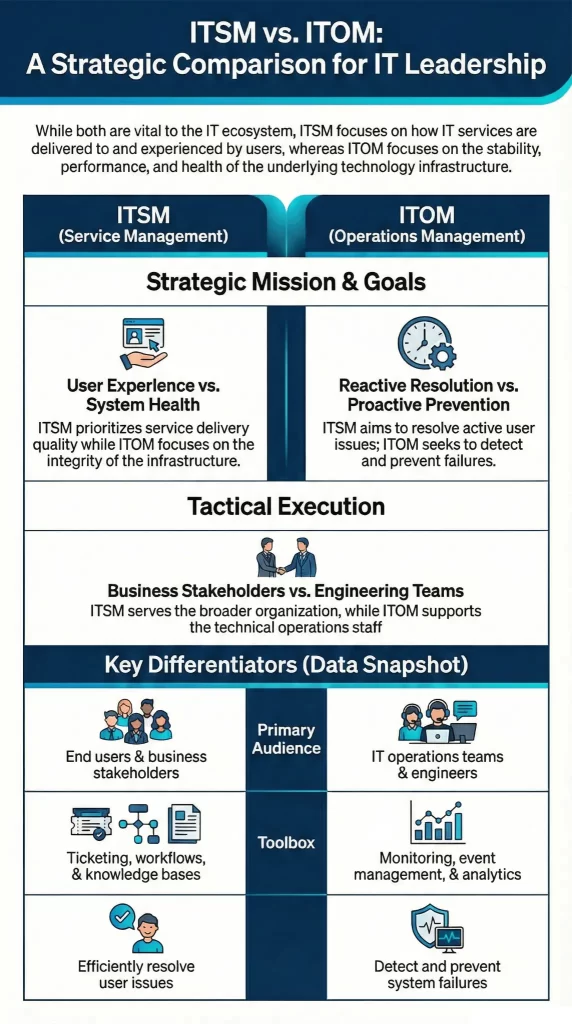
ITSM VS ITOM IT Service Management (ITSM) focuses on delivering and managing IT services for end users. It provides frameworks and processes that ensure users receive the support they need while IT teams maintain consistency and quality. ITSM is about the service experience rather than the underlying infrastructure.
Core ITSM processes
- Incident management focuses on restoring normal service as quickly as possible after an interruption. When a user cannot access an application or a printer stops working, incident management gets them back to work.
- Change management ensures that modifications to IT infrastructure are performed with minimal risk. Changes are reviewed, approved, and scheduled to prevent disruptions.
- Problem management investigates the root causes of incidents. While incident management fixes symptoms, problem management prevents recurrence by addressing underlying issues.
- Service request management handles user requests for new services, access, or information. Password resets, software installations, and hardware provisioning all fall under service requests.
When ITSM is enough
Small to mid-sized IT teams often find ITSM sufficient for their needs. When the primary focus is user support and infrastructure complexity is manageable, ITSM provides structure without overhead.
User-focused support environments benefit most from ITSM. Schools, professional services firms, and corporate offices where the main IT function is employee support can operate effectively with ITSM alone.
What Is ITOM (IT Operations Management)?
IT Operations Management (ITOM) focuses on the health and performance of the technology infrastructure itself. It monitors servers, networks, applications, and cloud resources to ensure they are running optimally. ITOM is about keeping the underlying systems stable and available.
Core ITOM capabilities
- Infrastructure monitoring tracks the status of all technology components. CPU usage, memory consumption, disk space, and network latency are continuously measured. When metrics exceed thresholds, alerts are triggered.
- Event and alert management processes the flood of notifications from monitoring tools. Events are correlated, deduplicated, and prioritized so teams focus on what matters most.
- Root cause analysis helps identify why failures occurred. By examining logs, metrics, and dependencies, ITOM tools accelerate troubleshooting and reduce mean time to resolution.
- Dependency mapping reveals how infrastructure components relate to each other. When a database server fails, dependency mapping shows which applications will be affected.
Where ITOM becomes critical
Large infrastructure environments cannot be managed manually. ITOM provides the automation and visibility needed to maintain stability at scale.
Cloud and hybrid environments add complexity that demands ITOM. Resources are dynamic, ephemeral, and distributed across multiple providers. Traditional monitoring approaches fall short.
24/7 uptime requirements make ITOM essential. E-commerce sites, financial services, and healthcare systems cannot afford extended outages. Proactive monitoring and automated response keep services running.
ITSM vs. ITOM: Key Differences at a Glance
| Aspect | ITSM | ITOM |
|---|---|---|
| Focus | Service delivery and user experience | Infrastructure health and performance |
| Audience | End users and business stakeholders | IT operations teams and engineers |
| Tools | Ticketing systems, workflow automation, knowledge bases | Monitoring tools, event management, analytics platforms |
| Primary Goal | Resolve user issues efficiently | Prevent and detect infrastructure failures |
ITSM vs. ITOM vs. AIOps: How AI Changes the Game
What is AIOps?
AIOps applies machine learning and analytics to IT operations data. It ingests vast amounts of monitoring data, logs, and events to identify patterns that humans would miss. AIOps platforms learn normal behavior and detect anomalies before they become incidents.
AIOps in ITOM
Alert correlation is one of the most valuable AIOps capabilities in ITOM. During a major incident, monitoring tools may generate hundreds of alerts. AIOps groups related alerts together so teams see one issue rather than a noisy dashboard.
Predictive outage detection helps teams prevent failures. By analyzing trends in metrics like disk usage or response times, AIOps can forecast when a resource will be exhausted and trigger proactive remediation.
AIOps in ITSM
Auto-ticket creation bridges the gap between operations and service management. When ITOM detects an issue, AIOps can automatically create an incident ticket in ITSM with all relevant context attached.
Intelligent assignment routes tickets to the right team based on content, expertise, and workload. First-year support staff receive appropriate tickets while complex issues go to senior engineers.
Faster MTTR results from the combination of automated detection, intelligent routing, and contextual information. Teams spend less time investigating and more time resolving.
Why ITSM and ITOM Work Better Together
From alert to resolution: End-to-end flow
- ITOM detects an anomaly in database server performance. Response times have degraded beyond acceptable thresholds.
- AIOps correlates related events from application servers and network devices. A pattern emerges showing a network configuration change triggered the degradation.
- ITSM auto-creates an incident ticket. The ticket contains all correlation data, affected services, and a preliminary impact assessment.
- SLA tracking begins immediately. The incident is assigned to the database team with priority based on business impact. Resolution steps are logged and knowledge articles are updated.
This flow transforms a manual, chaotic response into a coordinated, efficient process.
Real-world collaboration examples
- E-commerce outage scenario: During a flash sale, a retail site experiences slowdowns. ITOM detects increasing latency and packet loss. AIOps correlates these with a sudden traffic spike from a specific region. ITSM automatically creates an incident and pages the network team. They scale capacity in minutes, preventing a full outage. The support team is informed and can proactively communicate with affected users.
- Manufacturing plant downtime: A factory’s production line stops because SCADA systems lose connectivity. ITOM identifies the network switch failure and its impact on connected devices. AIOps maps dependencies to show exactly which production cells are affected. ITSM creates a critical incident, dispatches the nearest technician with the correct replacement hardware, and tracks resolution against production SLAs.
- MSP handling multiple clients: A managed service provider monitors infrastructure for dozens of clients. ITOM aggregates alerts across all environments. AIOps filters noise and identifies genuine issues. ITSM creates client-specific tickets with appropriate branding, SLAs, and reporting. The MSP team works efficiently without context switching between tools.
Which One Should You Implement First?
Decision matrix
- Start with ITSM if you face service chaos and ticket overload. When users are unhappy because requests go unanswered and incidents are poorly tracked, ITSM brings order. Process standardization reduces friction and improves satisfaction.
- Start with ITOM if you have monitoring blind spots and frequent outages. When infrastructure fails without warning and troubleshooting takes hours, ITOM provides visibility. Proactive monitoring prevents incidents before users notice.
- Adopt both if scale and uptime matter to your business. Organizations with complex environments, regulatory requirements, or customer-facing services need integrated ITSM and ITOM. The combination delivers user satisfaction and infrastructure reliability.
ITSM vs ITOM: ITSM Tools That Support ITOM and AIOps
Modern IT teams prefer platform approaches rather than siloed tools. A unified platform offers several advantages.
Unified dashboards provide visibility across services and infrastructure. Support teams see user tickets while operations teams monitor system health. Both groups understand the complete picture.
Native monitoring integrations eliminate manual data transfer. Events from infrastructure tools automatically create tickets with full context. No custom scripting or middleware required.
AI-powered workflows connect detection to resolution automatically. Incidents are created, prioritized, assigned, and escalated based on business rules. Teams focus on fixing rather than administering tools.
Common Myths About ITSM vs. ITOM
“ITOM replaces ITSM”
This is false. ITSM and ITOM solve different layers of the IT challenge. ITOM ensures infrastructure runs. ITSM ensures users get support. Both are necessary for complete IT management.
“AIOps is only for large enterprises”
Small and medium businesses benefit the most from automation. Lean teams cannot afford to monitor infrastructure manually or process tickets individually. AIOps provides leverage that helps SMBs operate like larger organizations without the headcount.
How Infraon Helps ITSM and ITOM Work Together
Infraon brings service management and operations management into a unified platform called Infraon Infinity.
- Teams gain complete visibility across user requests and infrastructure health without switching between tools.
- AI-driven automation connects monitoring alerts to incident workflows automatically. When infrastructure issues arise, tickets are created with full context. Response teams have immediate access to dependency maps, change history, and resolution recommendations.
- Faster mean time to resolution becomes achievable because information flows freely between service and operations teams.
- Tool sprawl is eliminated. A single platform handles ITSM processes, ITOM monitoring, and AIOps analytics. Teams work efficiently, data remains consistent, and costs stay manageable.
FAQs: ITSM vs. ITOM
Can ITSM work without ITOM?
Yes, ITSM can function independently. Many small organizations use service desks and ticketing systems without infrastructure monitoring. However, as environments grow, the lack of operational visibility creates blind spots and increases risk.
Is ITOM only for enterprises?
No, ITOM benefits organizations of all sizes with significant infrastructure. Educational institutions, healthcare providers, and growing businesses all need monitoring and event management. Cloud-based ITOM tools make implementation accessible for smaller teams.
Does AIOps replace human teams?
No, AIOps augments human capabilities. It handles data volume, pattern detection, and routine correlations. Human teams provide context, make decisions, and perform complex troubleshooting. The combination is more effective than either alone.
Which industries benefit most from integrated ITSM and ITOM?
Industries with high uptime requirements and regulatory oversight benefit significantly. Financial services, healthcare, e-commerce, manufacturing, and managed service providers all gain competitive advantage from integrated service and operations management.