


IT teams today face mounting pressure: more service requests, tighter SLAs, growing infrastructure complexity, and rising expectations from employees who want consumer-grade support experiences at work. ITSM solutions exist to meet that pressure head-on.
These platforms give IT departments the structure, automation, and visibility they need to deliver services reliably, efficiently, and at scale. Whether you are evaluating your first ITSM platform or reassessing an existing one, here’s everything you need to make a confident decision in 2026.
What Is IT Service Management (ITSM)?
IT service management is the discipline of designing, delivering, managing, and improving the IT services an organization provides to its users and customers. Rather than treating IT as a collection of technologies to maintain, ITSM frames IT as a set of services to be delivered with defined quality, accountability, and measurable outcomes.
ITSM focuses on the people, processes, and tools that govern how IT services are planned, operated, and continually improved. It gives IT teams a shared language, a common framework, and the operational discipline to deliver consistent service experiences across the business.
ITSM vs. Traditional IT Support
Traditional IT support is reactive and informal. A user reports a problem, a technician fixes it, and the interaction ends there. There are few records, little analysis, and almost zero visibility into patterns or recurring issues.
ITSM takes a fundamentally different approach. Every interaction is logged, categorized, prioritized, and tracked through to resolution. Workflows are standardized. SLAs define expected response and resolution times. Data from every ticket feeds into reports that drive continuous improvement. The shift from traditional IT support to ITSM is the shift from firefighting to service management.
Why ITSM Matters for Modern IT Teams
Modern IT environments are complex, distributed, and deeply integrated with business operations. A single unresolved incident can cascade across systems, disrupt revenue-generating processes, and damage customer trust. ITSM platforms give IT teams the control, structure, and automation they need to stay ahead of that complexity rather than constantly responding to it.
Beyond operational efficiency, ITSM matters because it aligns IT with business objectives. When IT services are managed to agreed standards, the business can plan around IT rather than working around its limitations.
What Are ITSM Solutions?
ITSM solutions are software platforms that operationalize IT service management processes. They provide the tools IT teams use to log incidents, manage service requests, control changes, track assets, and build a knowledge base, all within a single unified environment.
A well-designed ITSM platform replaces fragmented ticketing systems, spreadsheets, and manual workflows with a structured, automated, and data-rich service management engine.
Core Capabilities of ITSM Platforms
- Incident management: Log, categorize, prioritize, and resolve unplanned service disruptions with full audit trails and SLA tracking built in.
- Service request management: Provide users with a structured, self-service channel to submit requests for access, equipment, onboarding support, and other standard services.
- Change management: Plan, approve, schedule, and review changes to IT infrastructure and services with risk assessment workflows that reduce unplanned disruptions.
- Asset management: Maintain a complete, accurate inventory of hardware and software assets, with lifecycle tracking, cost visibility, and compliance reporting.
- Knowledge management: Build and maintain a searchable library of solutions, how-to guides, and FAQs that empower users to resolve issues independently and help agents resolve tickets faster.
ITIL and ITSM: How They Work Together
ITIL (Information Technology Infrastructure Library) is the world’s most widely adopted framework for IT service management. It provides a set of best practices, definitions, and process guidelines that help organizations design and deliver high-quality IT services. ITSM solutions are the platforms that put ITIL best practices into operation.
Think of ITIL as the blueprint and your ITSM platform as the construction equipment. ITIL tells you what good IT service management looks like; your ITSM platform gives you the tools to build and run it. Organizations that implement ITSM solutions aligned with ITIL processes gain a proven, structured approach to service delivery that is recognized and understood globally.
Popular ITIL Processes
- Incident management: The process for restoring normal service operation as quickly as possible after an unplanned disruption, minimizing business impact.
- Problem management: The process for identifying and eliminating the root causes of recurring incidents, reducing the frequency and impact of future disruptions.
- Change management: The process for ensuring that all changes to IT services and infrastructure are assessed, approved, and implemented with minimal risk to service continuity.
- Service request fulfillment: The process for handling standard user requests through a predefined, often automated workflow that delivers consistent, timely outcomes.
What Is Service Request Management?
Service request management is the ITSM process responsible for handling user requests for standard services. These are pre-approved, repeatable requests that follow a defined resolution workflow rather than requiring the investigation and diagnosis associated with incident management.
Examples of Service Requests
Service requests span a broad range of everyday IT needs, including password resets, software access and license provisioning, new employee onboarding setup, hardware requests such as laptops or peripherals, account permission changes, and VPN access requests. Because these requests are predictable and repeatable, they are ideal candidates for automation and self-service delivery.
Benefits of Service Request Management
- Faster request resolution: Standardized workflows and automation eliminate the back-and-forth of ad hoc request handling, reducing resolution times significantly.
- Improved user satisfaction: Users get a clear, consistent experience with visibility into the status of their request at every stage.
- Standardized workflows: Every request follows the same process, reducing variation, errors, and the risk of requests falling through the cracks.
- Reduced manual work: Automation handles routing, approvals, and resolution steps that previously required manual intervention from IT staff.
Service Request Management Process
A well-structured service request management process moves through five stages. First, the user submits a request through the self-service portal or service catalogue. Second, the platform classifies the request by type and assigns it to the appropriate resolution team. Third, any required approvals are routed automatically to the relevant approvers. Fourth, the resolution team completes the requested action. Fifth, the ticket is closed and the interaction is recorded for reporting and continuous improvement.
Types of Service Requests
- Access requests: Permissions, credentials, and system access.
- Hardware requests: Physical equipment procurement and provisioning.
- Information requests: Questions about policies, processes, or service availability.
- Service catalogue requests: Any pre-defined service offering available through the organization’s service catalogue.
Best Practices for Service Request Management
- Automate repetitive requests wherever possible to free IT staff for higher-value work.
- Provide a self-service portal that gives users a clear, structured way to submit and track their requests.
- Use a well-maintained service catalogue so users can browse available services and understand what to expect.
- Track SLA performance for every request category and use the data to identify bottlenecks.
- Integrate AI chatbots to handle common requests instantly, at any time of day, without agent involvement.
AI Solutions for ITSM
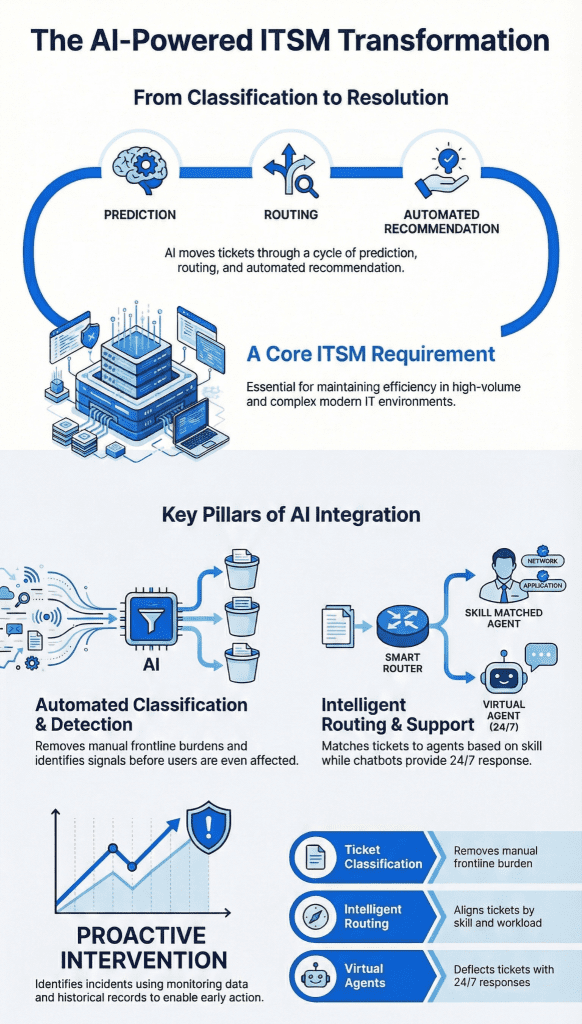
Artificial intelligence is changing what ITSM platforms can do. Where earlier generations of ITSM tools automated simple workflows, today’s AI-powered ITSM solutions can classify tickets, predict incidents, route requests, and recommend resolutions with minimal human input. For IT teams managing large volumes of requests and complex environments, AI is rapidly becoming a core platform requirement.
How AI Improves ITSM
- Automated ticket classification: AI analyses incoming tickets and classifies them by category, priority, and likely resolver group in seconds, removing a significant manual burden from frontline agents.
- Predictive incident detection: By analyzing patterns in monitoring data and historical incident records, AI can identify signals of an impending incident before users are affected, enabling proactive intervention.
- Intelligent routing: AI-driven routing matches incoming tickets to the best available agent or team based on skill, workload, and historical resolution performance, improving both speed and quality of resolution.
- Virtual service agents: AI-powered chatbots handle common requests and queries directly, providing instant responses at any time of day and deflecting a substantial proportion of tickets away from human agents.
Examples of AI-Powered ITSM Features
- AIOps: AIOps capabilities ingest data from across the IT environment, correlate events, reduce alert noise, and surface actionable insights that help IT teams resolve issues faster and prevent future incidents.
- Predictive analytics: Advanced ITSM platforms use machine learning to forecast incident volumes, identify at-risk services, and predict SLA breach risks before they materialize.
- Automated root cause analysis: Rather than requiring agents to manually investigate the chain of events leading to an incident, AI-powered root cause analysis surfaces probable causes automatically, cutting investigation time significantly.
Types of ITSM Solutions
- Cloud ITSM platforms: Delivered as SaaS, these platforms offer fast deployment, automatic updates, and flexible pricing. They are well-suited to organizations that want to avoid infrastructure management overhead and scale quickly.
- Enterprise ITSM tools: Designed for large, complex organizations with demanding requirements around customization, integration, and governance. Enterprise ITSM platforms typically offer deeper workflow configuration, advanced reporting, and robust access controls.
- AI-powered ITSM solutions: Platforms with embedded AI capabilities that go beyond workflow automation to deliver intelligent classification, prediction, and resolution assistance.
- Open-source ITSM software: Community-developed platforms that offer flexibility and low licensing costs. They require more internal expertise to deploy and maintain but can be a good fit for technically capable teams with specific customization requirements.
Best ITSM Tools and Platforms Compared
Infraon ITSM
Infraon ITSM is a fully integrated software for enterprises that require both service management depth and operational visibility in a single solution. Its standout strength is the integration of ITSM with AI-powered observability and IT asset management, giving teams a single pane of glass across service delivery and infrastructure operations.
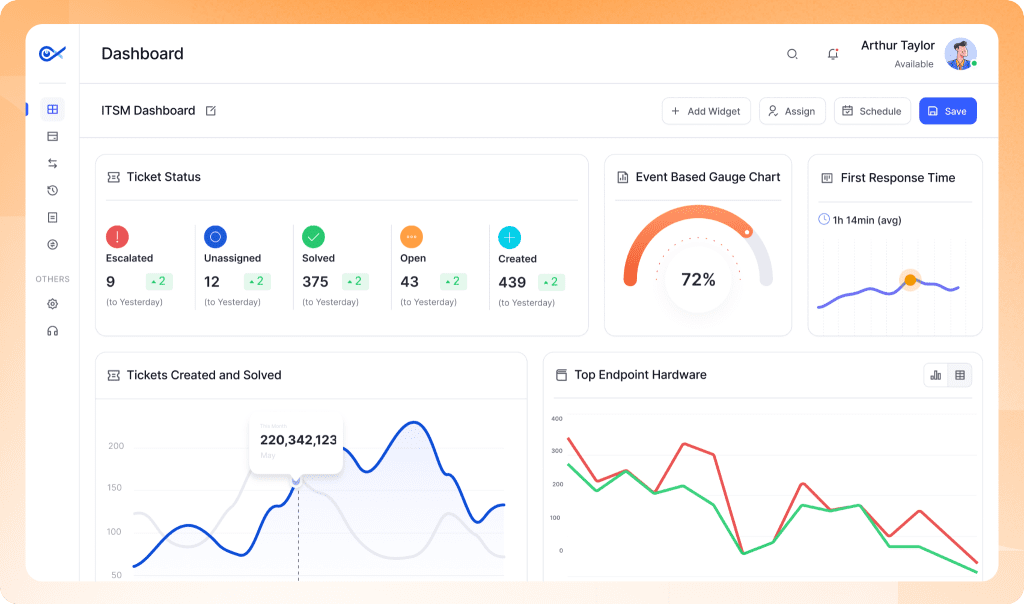
- Key strengths: AI-driven incident correlation, end-to-end service lifecycle management, integrated IT asset management, intelligent workflow automation, enterprise-grade reporting and analytics, and multi-region deployment with compliance-ready architecture.
- Best for: Enterprises seeking a unified platform that combines ITSM, ITOM, and AI-driven operations without the complexity and cost of stitching together multiple point solutions.
Explore Infraon ITSM and see how it transforms enterprise IT operations.
ServiceNow
ServiceNow ITSM offers a suite of modules covering ITSM, ITOM, HR service delivery, and more, all built on a single platform. Its breadth and ecosystem make it a strong choice for large organizations with complex, cross-functional service management needs.
- Best for: Large enterprises with substantial budgets and dedicated platform teams who need a highly customizable, broadly scoped service management environment.
Freshservice
Freshservice is a cloud-native ITSM platform with a strong focus on ease of use and fast time to value. It covers the core ITIL processes and includes AI features for ticket classification and response suggestions. Its interface is clean and intuitive, making it popular with mid-market IT teams.
- Best for: Mid-market organizations looking for an ITIL-aligned platform that is fast to deploy and straightforward to administer.
Jira Service Management
Jira Service Management from Atlassian is widely used by technology and development teams. Its native integration with Jira Software makes it a natural choice for organizations that use Agile development workflows and want to align IT service management with their engineering processes.
- Best for: Technology-forward organizations and development teams that want ITSM tightly integrated with their software delivery pipeline.
ManageEngine ServiceDesk Plus
ManageEngine ServiceDesk Plus is a feature-rich ITSM platform that covers incident, problem, change, and asset management with strong ITIL alignment. It is available in both cloud and on-premise deployments, making it a flexible option for organizations with specific hosting requirements.
- Best for: Organizations that require strong asset management capabilities alongside ITSM, or those that prefer an on-premise deployment option.
Key Benefits of ITSM Solutions
- Improved service delivery: Standardized workflows and SLA tracking ensure that every service interaction meets a defined quality standard, delivering consistent experiences to users across the organization.
- Reduced downtime: Faster incident detection, intelligent routing, and automated escalation cut mean time to resolution, reducing the business impact of every outage or disruption.
- Better collaboration: A centralized platform gives every stakeholder, from frontline agents to IT leadership, shared visibility into service performance, active incidents, and change schedules, reducing communication gaps and duplicated effort.
- Improved compliance: Structured workflows, complete audit trails, and configurable approval processes make it far easier to demonstrate compliance with internal policies, industry standards, and regulatory requirements.
- Cost optimization: Automation reduces the manual effort required to handle high-volume, repetitive tasks. Self-service capabilities deflect a meaningful proportion of tickets away from human agents, allowing IT teams to do more with their existing headcount.
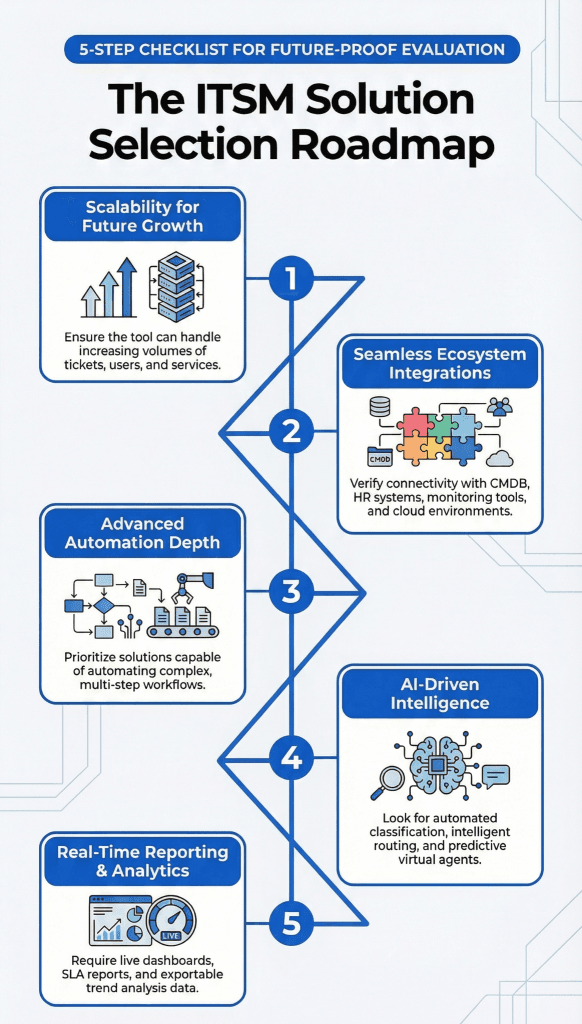
How to Choose the Right ITSM Solution
- Scalability: Will the platform grow with your organization? Assess how it handles increasing ticket volumes, expanding user bases, and additional service lines without requiring costly re-implementations.
- Integrations: Your ITSM platform should integrate seamlessly with your monitoring stack, CMDB, communication platforms, HR systems, and cloud infrastructure.
- Automation capabilities: Evaluate the depth and flexibility of the platform’s workflow automation engine. The best platforms allow you to automate complex, multi-step processes across teams and systems.
- AI features: Look beyond marketing claims and assess specific AI capabilities: automated classification, intelligent routing, predictive analytics, and virtual agent functionality.
- Reporting and analytics: Ensure the platform provides the reporting depth your team and leadership require. Real-time dashboards, SLA performance reports, trend analysis, and exportable data are baseline requirements for any enterprise-grade platform.
Final Thoughts
IT service management has moved far beyond ticketing. Today’s best ITSM solutions combine ITIL-aligned process frameworks with AI-driven automation, deep integrations, and real-time analytics to give IT teams the capabilities they need to deliver exceptional service at scale.
Choosing the right ITSM platform means finding a solution that fits your current environment, scales with your growth, and gives your team the tools to work smarter rather than just harder. For enterprises that want a unified approach combining ITSM, IT operations, and AI-powered intelligence on a single platform, Infraon is a compelling place to start.
Book a demo and see what modern enterprise ITSM looks like in practice.