


What Is IT Operations Management in ITIL?
IT Operations Management ITIL (ITOM) refers to the activities, processes, and tools used to manage and maintain an organization’s IT infrastructure. In the ITIL framework, ITOM focuses on ensuring that technology components like servers, networks, applications, and data centers run reliably and efficiently on a day-to-day basis.
Definition of IT Operations Management (ITOM)
ITOM encompasses all tasks required to keep IT infrastructure operational. This includes monitoring system health, managing incidents, scheduling maintenance, and automating routine tasks. The goal is to deliver stable, secure technology services that meet business needs.
IT Operations Management vs. ITSM
IT Service Management (ITSM) focuses on delivering end-to-end services to users. It includes processes like service desk, request fulfillment, and service level management. ITOM focuses specifically on the infrastructure that powers those services.
· ITSM asks: Are users getting the support they need?
· ITOM asks: Are the servers, networks, and applications running properly?
Both are essential. ITSM ensures good user experience. ITOM ensures the underlying technology stays healthy.
Where ITOM fits in the ITIL framework
In ITIL 4, ITOM is part of the service value chain. It supports multiple practices, including incident management, problem management, and monitoring. ITOM provides the operational foundation that enables all other ITIL practices to function effectively.
Understanding the ITIL Framework
Overview of ITIL 4 service value system
ITIL 4 introduces the Service Value System, which describes how components and activities work together to create value. The system includes:
- Guiding principles
- Governance
- Service value chain
- Practices
- Continual improvement
ITIL 4 moves away from rigid processes toward flexible practices that adapt to modern technologies like cloud, DevOps, and AIOps.
Key ITIL practices supporting IT operations
- Incident management focuses on restoring normal service as quickly as possible after disruptions. ITOM provides the monitoring and alerting that feeds incident detection.
- Problem management investigates root causes of incidents to prevent recurrence. ITOM data helps problem managers understand what failed and why.
- Event management monitors all events occurring across the infrastructure. Events can be informational, warnings, or exceptions requiring action.
- Change enablement ensures modifications to infrastructure are performed with minimal risk. ITOM provides visibility into infrastructure before and after changes.
- Monitoring and event management continuously observe IT services and components. This practice identifies potential issues before they impact users.
- Service request management handles user requests for new services or access. ITOM automates provisioning and fulfillment where possible.
Why Is ITIL Important for IT Operations Management?
Standardization of IT processes
Without standardization, every incident is handled differently. Every change follows a different approval path. ITIL provides a common language and consistent processes that all team members follow. New hires ramp up faster. Teams across different locations work the same way.
Improved SLA compliance
Service level agreements define what the business expects from IT. ITIL processes ensure incidents are logged, prioritized, and resolved according to SLAs. Monitoring provides evidence of compliance. Regular reporting shows where improvements are needed.
Risk reduction and governance
Uncontrolled changes cause most IT incidents. ITIL change management reduces this risk by ensuring proper review and approval. Access management prevents unauthorized configuration changes. Event management catches issues early before they become failures.
Alignment with business outcomes
ITIL shifts focus from technology for its own sake to technology that enables business goals. IT operations teams understand how their work supports revenue, customer experience, and employee productivity. This alignment improves communication between IT and business stakeholders.
Compliance for regulated industries
Banks in the UAE and Saudi Arabia must comply with strict regulations from central banks and authorities like NCA. ITIL provides auditable processes that demonstrate control over IT operations. Evidence of change approval, incident resolution, and access reviews satisfies auditors.
Core IT Operations Management Processes in ITIL
Event management
Event management monitors all the IT infrastructure for significant occurrences. Events include:
- Informational events like scheduled jobs completing successfully
- Warning events like disk space reaching 80 percent capacity
- Exception events like services failing or devices going offline
Effective event management filters noise so teams focus on what matters. Correlated events reveal patterns that indicate emerging problems.
Incident management
Incident management restores normal service after disruptions. The process includes:
- Incident detection and logging
- Categorization and prioritization
- Investigation and diagnosis
- Resolution and recovery
- Closure with communication to affected users
ITOM provides the monitoring that detects many incidents automatically. Integration between monitoring and incident tools creates tickets with full context.
Problem management
Problem management investigates why incidents happen. While incident management fixes symptoms, problem management addresses root causes. The process includes:
- Problem identification from incident trends
- Root cause analysis
- Workarounds documented in known error records
- Permanent fixes through change management
ITOM data reveals patterns across multiple incidents, helping problem managers identify underlying issues.
Access management
Access management ensures only authorized users can access IT services and infrastructure. The process includes:
- Granting access based on approved requests
- Reviewing access rights regularly
- Revoking access when no longer needed
- Maintaining audit trails for compliance
For IT operations, access management controls who can modify infrastructure configurations.
IT Infrastructure monitoring
IT infrastructure monitoring continuously observes the health and performance of all infrastructure components. Key metrics include:
- CPU utilization
- Memory usage
- Disk space consumption
- Network latency and packet loss
- Application response times
Thresholds trigger alerts when metrics indicate potential problems.
Job scheduling and automation
Many IT operations tasks run on schedules. Backups, patch installations, report generation, and batch processing follow defined schedules. Automation ensures these tasks run consistently without manual intervention. Failed jobs trigger alerts for investigation.
ITIL 4 + Modern ITOM: Cloud, DevOps and AIOps
ITIL in cloud-native environments
Cloud computing changes how IT operations work. Resources are dynamic and ephemeral. Traditional monitoring approaches struggle with environments that constantly change.
ITIL 4 adapts by focusing on outcomes rather than rigid processes. Cloud-native operations require faster change cycles and automated responses. ITIL practices become guidelines that ensure control without slowing innovation.
Observability and AIOps
Observability goes beyond traditional monitoring. It provides deep visibility into system internals through logs, metrics, and traces. Teams can understand not just what failed, but why.
AIOps applies machine learning to operations data. It correlates events across thousands of sources, detects anomalies, and predicts potential failures. For IT operations teams in India and Southeast Asia where headcount is limited, AIOps provides leverage to manage complex environments.
Integration with DevOps and SRE
DevOps emphasizes speed and collaboration between development and operations. Site Reliability Engineering applies software engineering principles to operations problems.
ITIL 4 integrates with these approaches by providing governance that enables speed rather than blocking it. Change management becomes lighter for low-risk changes. Incident management coordinates response across teams. Monitoring feeds both operations and development with production data.
ITIL-Based ITOM Implementation Roadmap
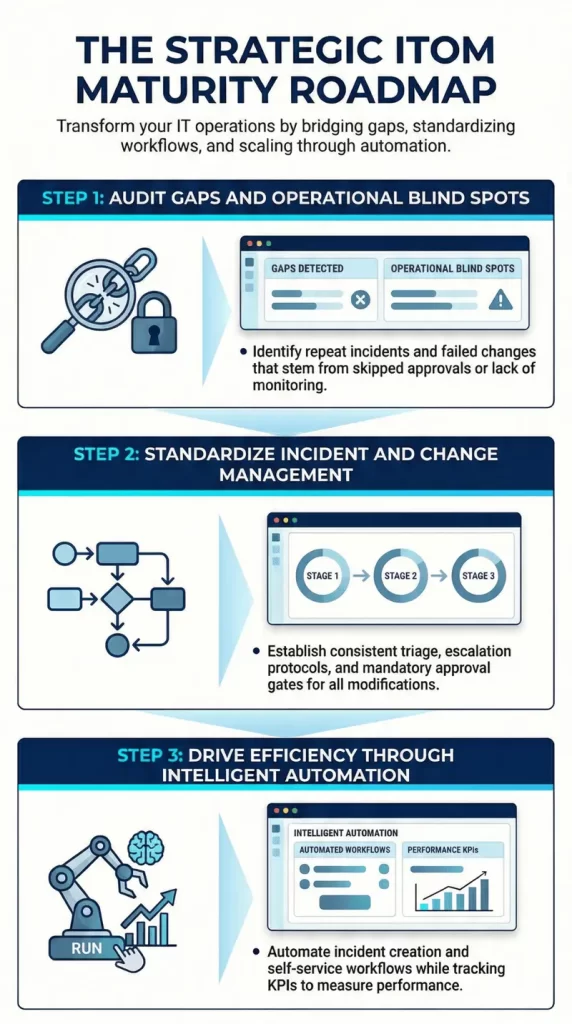
Assessment and gap analysis
Start by understanding the current state. Document existing processes, tools, and team capabilities. Compare against ITIL practices to identify gaps. Which incidents repeat because problems are never resolved? Which changes cause failures because approval processes are skipped? Which monitoring gaps leave the team blind to emerging issues?
Process standardization
Address the most critical gaps first. Standardize incident management so every issue follows consistent triage, escalation, and resolution steps. Implement change management for infrastructure modifications. Establish monitoring for core systems with clear alert thresholds.
Document processes simply. Complex documentation gathers dust. Clear workflows that teams actually use drive improvement.
Automation and KPI tracking
With standardized processes in place, automate repetitive tasks. Auto-create incidents from monitoring alerts. Automate routine maintenance and user provisioning. Implement self-service for common requests.
Define KPIs that matter to your organization. Track them consistently and review with teams. Use data to identify further improvements.
KPIs to Measure IT Operations Management Success
- Mean Time to Detect (MTTD) measures how quickly you identify issues after they occur. Shorter detection times mean less impact on users. Target benchmarks for enterprise IT in GCC regions range from 2 to 5 minutes for critical systems.
- Mean Time to Resolve (MTTR) measures how quickly you restore service after detection. This includes investigation, diagnosis, and resolution time. Enterprise targets typically range from 30 minutes for critical incidents to 4 hours for standard issues.
- Change Success Rate measures the percentage of changes that achieve their objectives without causing incidents. Industry benchmarks target 95 percent or higher. Lower rates indicate problems with change planning or approval.
- Incident Volume Trend tracks whether incidents are increasing or decreasing over time. Rising volumes may indicate infrastructure degradation, insufficient problem management, or monitoring generating excessive noise.
- SLA Compliance Percentage measures how often IT meets agreed service levels. Enterprise targets typically range from 95 to 99%, depending on criticality. Regional financial services regulators may mandate specific compliance levels.
IT Operations Management Tools: Evaluation Framework
- Monitoring capability should cover all infrastructure types: servers, networks, storage, applications, and cloud resources. Support for both agent-based and agentless monitoring provides flexibility.
- Automation features reduce manual effort. Look for runbook automation, job scheduling, and integration with incident workflows. The best tools automate responses to common scenarios.
- AI-based alerts filter noise and correlate related events. Machine learning identifies patterns humans would miss and predicts potential failures before they occur.
- CMDB integration maintains accurate configuration data. The tool should discover assets automatically and track relationships between components. This dependency mapping accelerates troubleshooting.
- Cloud support is essential for hybrid environments. The tool must monitor AWS, Azure, and Google Cloud resources alongside on-premises infrastructure.
- Multi-site support matters for enterprises across the UAE, Saudi Arabia, and India. Centralized visibility across distributed locations reduces management overhead.
Real-World Example: ITIL-Based ITOM in a Middle East Telecom Company
Challenge
A telecommunications provider in Dubai supported millions of customers across the UAE. Their network operations center received thousands of alerts daily. Teams struggled to identify genuine issues among the noise. Incident response was reactive. Mean time to resolve averaged 4 hours for critical network incidents. Customer complaints were rising.
The company also faced regulatory requirements from the Telecommunications and Digital Government Regulatory Authority (TDRA). Auditors demanded evidence of change controls and incident resolution timelines.
Solution
The telecom implemented ITIL-based ITOM with a unified platform. They started with event management, configuring thresholds to reduce noise by 70 percent. Remaining alerts were correlated to show related events together.
Incident management was standardized. All incidents followed consistent triage, escalation, and communication workflows. Integration with monitoring automatically created tickets with full context.
Change management was strengthened. All network changes required approval with an impact assessment. Emergency changes followed expedited but controlled processes.
Results
- All required evidence was available on the platform
- Regulatory submissions were completed ahead of deadlines
- Customer complaints about network issues dropped by 45 percent within six months
Metrics Improved
- MTTD: 15 minutes → 3 minutes
- MTTR: 4 hours → 75 minutes
- Change success rate: 89% → 97%
- Alert noise: Reduced by 70%
- Audit preparation: 60% faster
How Infraon Supports ITIL-Based IT Operations Management
Infraon helps IT teams implement ITIL practices without complexity. The platform combines monitoring, automation, and service management in a unified solution.
- Real-time visibility across infrastructure shows teams exactly what is happening at all times. Event management filters noise and correlates related alerts. Teams focus on genuine issues rather than chasing false alarms.
- Automated workflows connect monitoring to incident response. When events trigger alerts, incidents are created automatically with full context. Assignment, escalation, and communication follow ITIL-aligned processes.
- Change management ensures modifications are controlled and approved. Dependency maps show what will be affected by proposed changes. Post-change reviews capture lessons learned.
- Compliance evidence is generated as part of daily operations. Audit trails for changes, incidents, and access reviews are always available. When regulators ask questions, answers are ready.
The platform also scales from small teams to large enterprises across multiple locations. For organizations in India, the UAE, Saudi Arabia, and Southeast Asia, Infraon provides the capabilities needed for mature IT operations management.
Frequently Asked Questions
What is IT Operations Management in ITIL?
IT Operations Management in ITIL refers to the practices and processes used to manage and maintain IT infrastructure. It includes monitoring, event management, incident management, and change management focused on keeping technology running reliably.
Why is ITIL important for enterprises?
ITIL provides standardized processes that reduce risk, improve efficiency, and align IT with business goals. For regulated industries, ITIL demonstrates the control and governance required by auditors and regulators.
Is ITOM part of ITSM?
Yes, ITOM is one component of overall IT Service Management. ITSM covers the full lifecycle of services from strategy to retirement. ITOM specifically focuses on the operational layer that keeps infrastructure running.
How does ITIL 4 improve IT operations?
ITIL 4 adapts to modern technologies like cloud, DevOps, and AIOps. It provides flexible practices rather than rigid processes. This allows IT operations teams to move quickly while maintaining control and governance.
What tools are used in ITOM?
ITOM tools include monitoring platforms, event management systems, automation tools, and CMDB solutions. Modern platforms combine these capabilities with AI-driven analytics and integration with service management.

Visualize Your IT Operations with Infraon
Ready to implement ITIL-based IT operations management? See how Infraon helps teams across India, UAE, Saudi Arabia, and Southeast Asia improve uptime, governance, and service delivery.
Request a Demo