


IT Service Management Tools have become essential for today’s IT teams, which act as the central nervous system of the modern enterprise. They’re expected to keep the lights on across a sprawling digital landscape, from cloud environments and on-premise data centers to hybrid setups and thousands of remote endpoints. Every day, the request volume climbs, while user expectations for speed and simplicity grow even faster. And patience for delays? It’s practically nonexistent.
So, in this high-stakes environment, your IT service management (ITSM) platform is the very fabric of how work gets done (or doesn’t).
However, when your systems are fragmented and your workflows are held together by manual handoffs and tribal knowledge, your team spends its energy managing the tool instead of delivering value. The cost of that friction is all too real: missed SLAs, a growing backlog of unresolved issues, and mounting pressure from leadership wondering why “keeping the lights on” feels so dim.
This is the moment where service management must evolve.
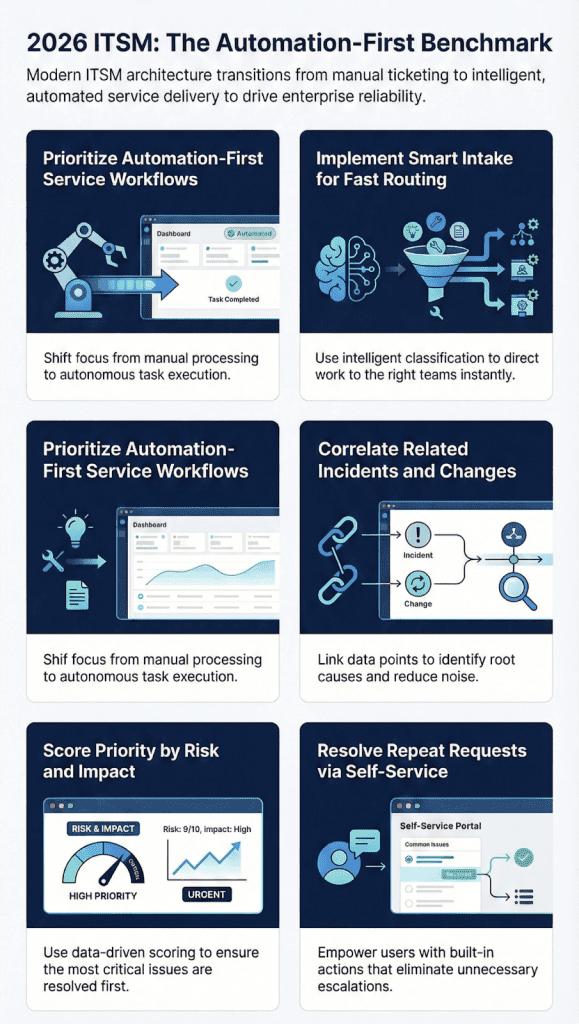
In 2026, the best ITSM tools also carry a higher bar around automation and intelligence. Teams expect routing, correlation, and prioritization to scale with demand rather than rely on headcount growth. Platforms that combine service workflows with automation and AI capabilities help teams focus attention where it matters most, while keeping day-to-day operations predictable.
The choice of ITSM tool increasingly decides whether IT operates reactively or with direction.
What are IT Service Management Tools?
IT Service Management tools act as the operating layer for how IT work gets requested, tracked, resolved, and reviewed. They translate demand from employees and business teams into structured workflows that service teams can execute at scale. As environments grow more distributed, these tools anchor consistency across service delivery.
At their core, ITSM solutions connect people, processes, and systems through a shared service model. Requests enter through portals or channels, flow through defined stages, and resolve with traceability. Over time, the best ITSM tools build operational memory through records, metrics, and historical patterns that guide future decisions.
Core modules inside ITSM tools
- Incident management: Handles service interruptions and degradations with structured intake, prioritization, and resolution tracking.
- Problem management: Focuses on recurring issues, linking incidents to root causes and long-term corrective actions.
- Change management: Governs planned modifications to systems and services, balancing speed with risk awareness.
- Asset and configuration management: Tracks infrastructure, software, and dependencies to support impact analysis and service accountability.
ITIL alignment and modern usage
The best ITSM tools align with ITIL practices, though real-world usage often adapts those frameworks to operational reality. Teams pick workflows that match maturity levels, staffing models, and business urgency. The platform acts as a reference point rather than a rigid rulebook.
Where automation and AI come in
Modern ITSM solutions extend beyond workflow tracking. Automation handles routine routing, approvals, and status updates. AI capabilities support triage, pattern recognition, and service insights across growing data volumes. Together, automation and AI reduce manual coordination and help teams respond with greater intent as demand continues to rise.
How We Evaluated IT Service Management Tools
Evaluation focused on how IT Service Management tools support real operating conditions rather than feature volume. Each tool was reviewed through the same lens to keep comparisons grounded and consistent.
Service management coverage
We assessed how well each of the Top 10 ITSM tools support core ITSM workflows such as incident, problem, change, and request handling. Emphasis stayed on depth of execution, workflow continuity, and operational usability rather than checkbox breadth.
Automation and AI
Tools were reviewed on how automation and AI capabilities support day-to-day service work. This includes routing logic, correlation, prioritization, and workflow triggers that scale as ticket volume grows. AI-powered workflows received attention where they showed practical use in service operations.
CMDB and asset awareness
Configuration and asset handling were evaluated based on relationship mapping, update reliability, and how well service records connect back to underlying infrastructure. Top 10 ITSM tools that support impact awareness across services scored higher.
Deployment speed and onboarding
We looked at how quickly teams can move from setup to operational use. This covers initial configuration effort, workflow readiness, and how much adaptation teams need before the tool fits daily operations.
Scale and enterprise readiness
Each tool was reviewed for its ability to support growing teams, multiple business units, and expanding infrastructure. This includes role models, workflow separation, reporting depth, and support for large environments.
Regional presence
Tools were reviewed for visibility and usage across India, Southeast Asia, UAE, and Saudi Arabia. Regional sections list IT Service Management tools directly based on market presence and adoption patterns.
Pricing posture
Pricing tiers reflect how vendors position their solutions in the market. This includes SMB-focused offerings, mid-market platforms, enterprise-first ITSM solutions, and usage-based models, based on published positioning and documentation.
External validation
Where available, we referenced one external signal per IT Service Management tool. This could be a customer rating, a Gartner review, or a G2 review, used to supplement product-level analysis rather than replace it.
Top IT Service Management Tools in 2026
Infraon ITSM
Best for: Fast-growing IT teams and mid-enterprise organizations
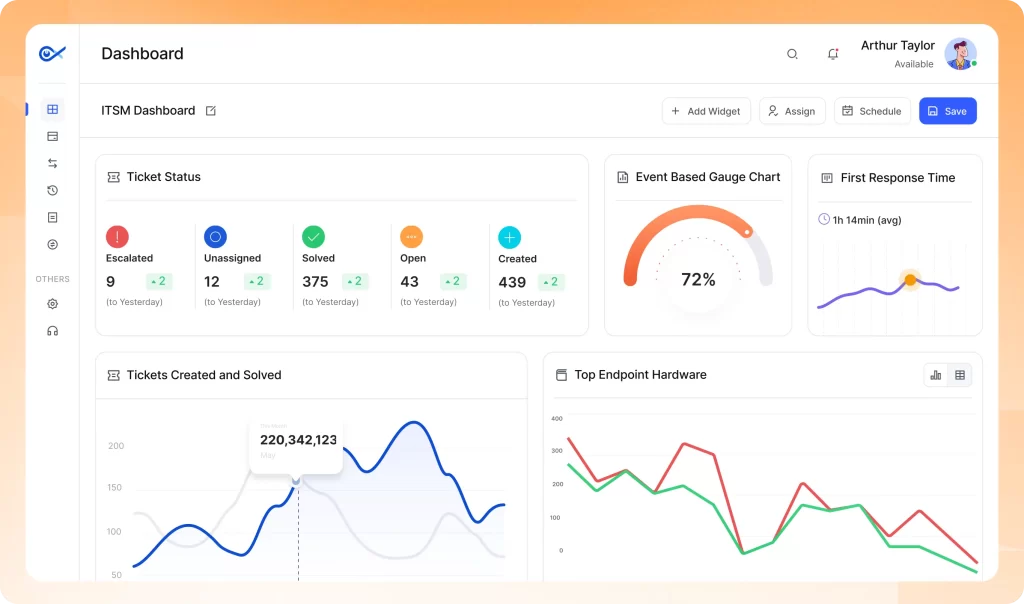
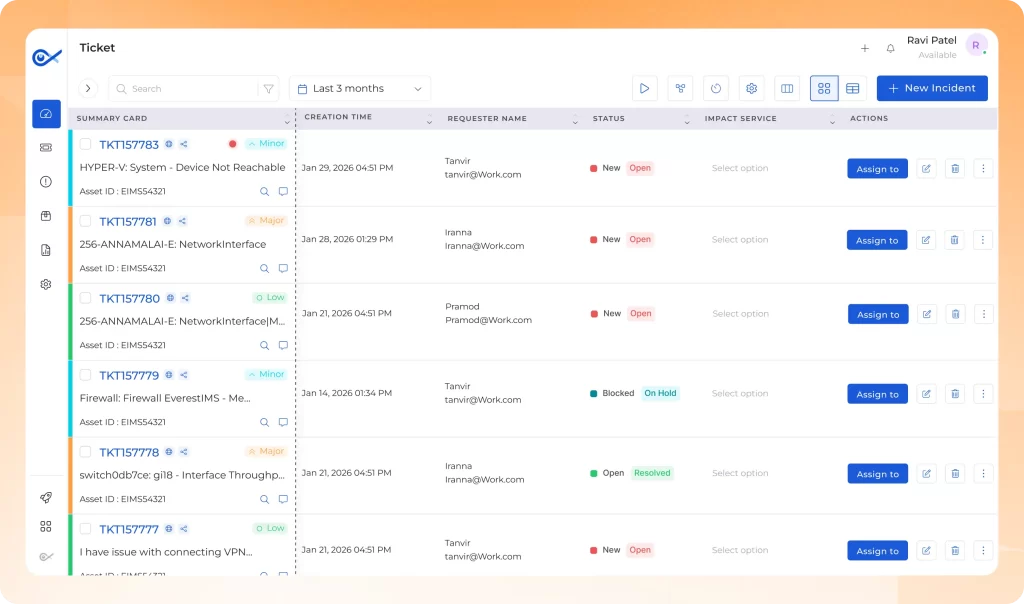
Infraon ITSM positions itself as a unified service management platform that brings ITSM, ITAM, and CMDB together in a single operational layer. The focus stays on deployment speed, regional readiness, and workflow depth rather than heavy customization overhead.
Features & Benefits:
- Unified ITSM, ITAM, and CMDB reduce handoffs between service, asset, and configuration workflows
- AI-powered workflows support automation across incidents, requests, and operational tasks
- ITIL-aligned processes cover incident, problem, change, and service request management
- Regional fit supports operational models across India, Southeast Asia, UAE, and Saudi Arabia
Ratings
- Gartner Review: 4.6/5
- G2 Review: 4.6/5
“Infraon ITSM has a faster implementation process compared to similar products in this category. It started providing quick support on the second day itself.” – Head of ITSM, Leading US-based Company
ServiceNow
Best for: Large enterprises with complex service environments
Key Features
- Broad ITSM and ESM coverage across IT and business functions
- Deep configuration and workflow customization options
- Enterprise-scale service modeling and reporting
Limitation:
- Steep learning curve
Ratings
- Gartner Review: 4.3/5
- G2 Review: 4.2/5
Jira Service Management
Best for: DevOps-heavy and Atlassian-centric teams
Key Features
- Native integration with Jira, Confluence, and Bitbucket
- Agile-first service workflows
- Lightweight service desk configuration
Limitation:
- Limited ITIL depth (out-of-the-box)
Ratings
- Gartner Review: 4.4/5
- G2 Review: 4.3/5
ManageEngine ServiceDesk Plus
Best for: Small and mid-sized businesses
Key Features
- Cost-conscious licensing models
- Integrated asset and service management
- Broad ITSM feature coverage for SMB environments
Ratings
- Gartner Review: 4.4/5
- G2 Review: 4.2/5
Zendesk Suite
Best for: Customer-centric IT support teams
Key Features
- Strong ticketing and omnichannel support
- Service desk optimized for customer experience
- Limited native ITIL workflow depth
Limitation:
· Limited ITIL-native workflows
Ratings
- Gartner Review: 4.2/5
- G2 Review: 4.3/5
Ivanti
Best for: Endpoint-driven service environments
Key Features
- Endpoint management integrated with ITSM
- Security-focused service workflows
- Hybrid deployment options
Ratings
- Gartner Review: 4.3/5
- G2 Review: 3.9/5
SysAid
Best for: Teams seeking straightforward ITSM deployment
Key Features
- Core ITSM functionality with automation support
- Fast setup for service desk operations
- Suitable for lean IT teams
Ratings
Gartner Review: 4.5/5
G2 Review: 4.5/5
SolarWinds Service Desk
Best for: Cloud-first IT operations teams
Key Features
- Cloud-native ITSM delivery
- Reporting and visibility aligned with operations teams
- Integration with broader SolarWinds ecosystem
Ratings
- Gartner Review: 4.4/5
- G2 Review: 4.3/5
Invgate
Best for: Mid-market teams prioritizing deployment speed
Key Features
- User-focused interface
- Rapid onboarding and configuration
- Structured ITSM workflows
Ratings
- Gartner Review: 4.8/5
- G2 Review: 4.6/5
ITSM Tools Comparison: A Detailed Look
| Tool | Best For | AI & Automation | ITIL Alignment | Deployment Speed | Ideal Region | Pricing Tier |
|---|---|---|---|---|---|---|
| Infraon ITSM | Fast-growing IT teams, mid-enterprise | AI-powered workflows, automated routing | Incident, Problem, Change, Request | Fast | India, SEA, UAE, Saudi Arabia | Mid-market, enterprise |
| ServiceNow | Large enterprises | Advanced automation, AI capabilities | Full ITIL suite | Slow | Global, enterprise-heavy regions | Enterprise |
| Jira Service Management | DevOps-led teams | Rule-based automation, limited AI | Partial ITIL | Fast | Global | SMB, mid-market |
| ManageEngine ServiceDesk Plus | SMBs | Basic automation | Core ITIL processes | Medium | India, SEA | SMB |
| Zendesk Suite | Customer-centric IT support | Workflow automation | Limited ITIL coverage | Fast | Global | Mid-market |
| Ivanti | Endpoint-driven IT teams | Automation tied to endpoint actions | Core ITIL modules | Medium | North America, EMEA | Mid-market, enterprise |
| SysAid | Lean IT teams | Automation-focused workflows | Core ITIL | Fast | Global | SMB |
| SolarWinds Service Desk | Cloud-first IT teams | Workflow automation | Core ITIL | Medium | Global | Mid-market |
| Invgate | Mid-market IT teams | Workflow automation | Core ITIL | Fast | Global | Mid-market |
| Zluri | SaaS management-led teams | Access and approval automation | ITSM-adjacent | Fast | Global | Mid-market |
Best IT Service Management Tools by Region
India & Southeast Asia
Teams in this region tend to prioritize rollout speed, pricing fit, and operational breadth across growing environments.
- Infraon
Suits teams seeking unified ITSM, ITAM, and CMDB with regional alignment and faster onboarding. - ManageEngine ServiceDesk Plus
Fits SMB and mid-sized teams looking for broad ITSM coverage with pricing aligned to regional budgets.
UAE & Saudi Arabia
Enterprises here focus on scale, governance, and platforms that support complex service environments.
- Infraon
Supports regional deployments with ITIL-aligned workflows and AI-powered operations across service and asset layers. - ServiceNow
Chosen by large enterprises running multi-department service operations and long-term transformation programs.
How to Choose the Right ITSM Tool
Based on company size
When it comes to top 10 ITSM tools, smaller teams usually value fast onboarding, manageable licensing, and core service workflows that cover incidents, requests, and assets. Mid-sized organizations start to prioritize reporting depth, automation coverage, and tighter links between service and asset data. Large enterprises tend to focus on platform breadth, cross-team workflows, and long-term scalability across business units.
Based on IT maturity
Teams early in their service journey benefit from tools that provide ready workflows and guided setup. More mature IT organizations look for ITSM solutions that support advanced change processes, deeper automation, and AI capabilities across service operations. Maturity also influences how much configuration effort teams can sustain over time.
Based on industry
Industries with high compliance or uptime expectations often choose top ITSM tools with structured change control and audit-friendly workflows. Product-led and engineering-heavy organizations gravitate toward platforms that align closely with DevOps practices. Service-heavy industries focus on request handling, visibility, and consistent user experience across channels.
Why Infraon Is a Smart Choice in 2026
Infraon ITSM is perfect teams that want service workflows, asset visibility, and configuration data working together as one system. Instead of splitting service delivery across separate tools, it keeps incidents, requests, changes, assets, and CMDB records tied to the same operational view. That matters when volume rises and multiple teams touch the same service outcomes.
- Unified ITSM, ITAM, and CMDB in one operating layer: Service tickets connect directly to assets and configuration items, so diagnosis and impact assessment move faster.
- Automation and AI-powered workflows for daily service flow: Routing, prioritization, and repeatable operational actions run with less manual coordination as demand grows.
- ITIL-aligned processes that scale with team maturity: Core workflows stay structured while teams expand service catalogs, approvals, and change governance.
- Regional fit shows up when deployments need fast onboarding and practical execution across distributed teams. Infraon ITSM aligns well with service environments across India, Southeast Asia, UAE, and Saudi Arabia, where teams prioritize rollout speed alongside enterprise features.
- Fast rollout for growing environments: Teams get operational sooner, while still running structured workflows.
- Balanced platform depth for mid-enterprise and enterprise: Enough breadth for scale, while avoiding heavy admin overhead as teams grow.
FAQs
Which ITSM tool fits a large enterprise in 2026?
Large enterprises usually need breadth across incident, problem, change, request, and asset workflows, plus multi-team governance. The key is a platform that handles scale across business units and supports long program rollouts.
- Prioritize workflow depth for change control and approvals
- Validate cross-department service coverage
- Check automation and AI capabilities for routing, correlation, and prioritization
- Review review-platform scores for enterprise deployments
Which ITSM tool fits an SMB or fast-growing IT team?
SMBs and growth-stage teams typically optimize for rollout speed, predictable licensing, and core modules that cover day-to-day service delivery. A tool that connects service workflows to assets and CMDB tends to reduce manual follow-ups.
What is the difference between ITSM and ITAM?
ITSM manages service work such as incidents, requests, problems, and changes. ITAM tracks assets across the lifecycle, from procurement to retirement. Teams benefit when both connect, since tickets can reference the exact device, software, or configuration item involved.
Should teams choose cloud ITSM or on-prem ITSM?
Cloud ITSM supports faster rollout and simpler scaling for distributed teams. On-prem fits organizations that prefer internal infrastructure ownership and tighter environment control. The decision usually comes down to governance requirements and internal operations capacity.
How important is AI in ITSM tools in 2026?
AI capabilities increasingly support triage and decision support as volume rises. The practical value shows up in routing, categorization, resolution suggestions, self-service support, and reporting. When paired with workflow automation, AI-powered workflows reduce manual coordination across service operations.