

What is AIOps (Artificial Intelligence) for IT Operations?
Definition & core components
Artificial Intelligence for IT Operations ingests telemetry across logs, traces, events, resource signals, runtime behavior, and application pathways. AI for IT operations reduces alert noise, correlates events into unified narratives, predicts degradation, and drives remediation logic with pattern-based execution. Telemetry growth makes manual triage slow, while inference scales linearly with data.
Core building blocks include ingestion pipelines, anomaly classifiers, event grouping, correlation engines, remediation triggers, and continual learning models. AIOps adapts to behavioral shifts through collective incident memory, latency mapping, and saturation recognition. Over time, detection strengthens as models align previous fault signatures with emerging conditions.
Why traditional IT operations are struggling in modern environments
Manual workflows depend on threshold alerts, dashboard surveillance, and multi-layer stitching. Workloads scale elastically and container churn compresses fault visibility. AI for IT operations reduces that burden by collapsing fragmented signals into context.
This pressure becomes visible through patterns such as:
- Metric spikes outpacing analyst review
- Hybrid routing creating dispersed failure paths
- Container shifts shrinking observable fault windows
- Noise muting critical indicators during storms
- Correlated disruptions hiding root origin
How AIOps works
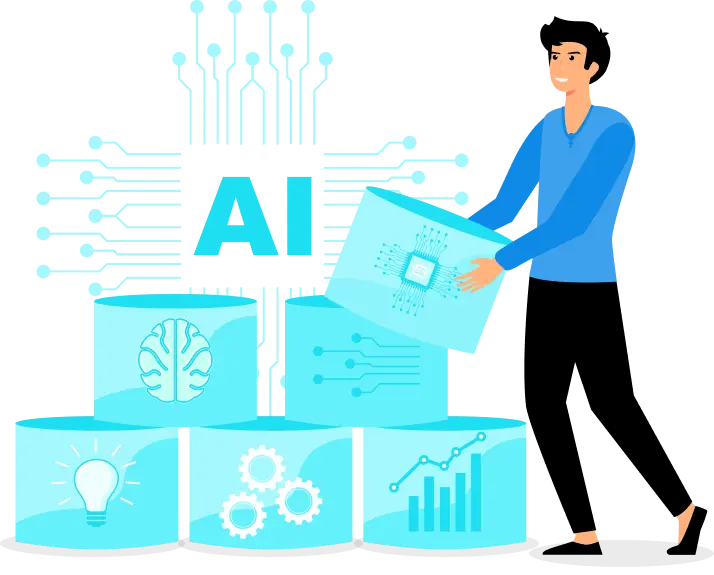
AIOps operates through an inference cycle where data moves from input to intelligence to resolution. The observing stage collects performance curves, access logs, dependency strain, saturation trends, and function behavior. The engaging stage links multisource anomalies, scores urgency, predicts propagation, and frames problem lineage. And the acting stage executes runbooks, repair commands, or workload rebalancing autonomously.
This operating model typically unfolds as:
- Observe full-stack telemetry in real-time
- Engage anomalies through correlation and scoring
- Act through guided or automatic correction
Key Use Cases for AI for IT Operations
Real-time anomaly detection in infrastructure
AIOps reads live infrastructure telemetry and highlights deviation before instability spreads across services. Sudden latency jumps, packet reorder, erratic CPU consumption, GC storms, or queue buildup surface as early signals. Instead of sifting dashboards, inference engines rank anomaly likelihood with context drawn from historical runtime.
Artificial Intelligence for IT Operations excels where systems generate volatile traffic volume. The model compares current runtime heat-maps against historical operating zones, exposing drift inside IOPS, DNS lookup time, TLS handshake latency, and microservice call depth. Faster pattern recognition keeps performance stable across rapid scaling cycles.
Predictive capacity planning and resource optimization
AIOps forecasts demand curves, seasonal traffic growth, and application expansion trends. CPU saturation windows, egress bandwidth pressure, write-heavy storage weeks, or increased multi-tenant load emerge ahead of threshold collapse. Teams shift from firefighting to forward allocation.
Artificial Intelligence for IT Operations models consumption trajectory using concurrency, transaction bursts, region-wise adoption, and feature rollout impact. Recommendations guide resource uplift or redistribution earlier in the planning cycle. Predictive allocation ensures throughput remains smooth under stress events — quarter-end, campaign surge, or microservice onboarding.
Automated incident response and root-cause analysis
AI for IT operations ties metrics, logs, and traces into a single diagnostic line instead of scattered attention points. Incident automation triggers failover logic, scales replicas, resets pods, or reconfigures routing entries. RCA becomes a flowing step rather than an isolated post-mortem task.
Artificial Intelligence for IT Operations reconstructs the failure chain: where the fault began, which component amplified, and what path carried the impact downstream. Fewer detours through tool stacks means restoration momentum stays high while escalation overhead drops.
Performance monitoring across multi-cloud hybrid environments
AIOps creates unified runtime awareness across public cloud, private cloud, edge clusters, container mesh, and inter-region data paths. Instead of viewing fragments, operators observe a continuous service line. Cross-origin latency, rate-limit backpressure, replica misplacement, or gateway overload becomes visible instantly.
Artificial Intelligence for IT Operations tracks request travel from entry point to final response. Function hops, cache hit ratios, persistence lag, and retry thrash map into one execution story. Performance tuning shifts from reactive dashboard pulling to guided tuning based on telemetry truth.
Security and threat detection in IT operations
AIOps analyzes authentication spikes, anomalous token issuance, endpoint surge patterns, and cross-network request spread. Threats appear through runtime signature deviation — silent credential reuse, unexpected access hours, or payload footprint shifts.
Artificial Intelligence for IT Operations correlates access points, network routes, traffic velocity, and event timestamps into threat lineage. Defensive posture strengthens as detection evolves through runtime similarity, instead of lists and thresholds.
Need to reliably monitor infrastructure, get smart insights,
and enable rapid troubleshooting? Watch below 👇
Common Pitfalls and How to Avoid Them
Poor data quality and alert noise
Artificial Intelligence for IT Operations loses analytical strength when trace timestamps drift or metric intervals break structure. Ingest pipes shape outcome quality, so incomplete logs or missing spans distort correlation. Clean formatting, field labeling, and stable sampling keep RCA tight under pressure.
Better results come from full-stack ingestion discipline where trace depth, metric lifetime, and event sequencing form one narrative instead of fragments. Telemetry continuity pipelines reduce investigation friction and carry signal strength forward.
Weak ownership and undefined measurement
AIOps only produces value when performance anchors exist. Response time boundaries, retry budgets, concurrency slope, and saturation ceiling give deviation meaning. When ownership is vague, RCA wanders instead of progressing.
Faster recovery emerges through service accountability design where network routes, storage throughput, query depth, and failover latency sit with defined guardians instead of floating across teams.
Maturity gaps and adoption delays
AI for IT operations replaces dashboard hunting with inference-driven sequences. Teams adjust through cycles, retrospectives, drill runs, and continuous tuning rather than one-off onboarding. Momentum builds when runbooks evolve into automation-aware iteration where signal recall increases and escalation compresses.
Tool fragmentation and weak integration
Split consoles scatter diagnosis, slowing intervention and lengthening impact windows. Logs in one pane and metrics in another force stitching instead of understanding. Clarity returns inside unified observability surfaces where signals move end-to-end with no interface hopping or context loss.

How to Choose an AIOps Solution
Evaluation criteria
Choosing Artificial Intelligence for IT Operations begins with how well a platform ingests telemetry, interprets behavior patterns, and automates recovery paths. You evaluate strength not by features alone, but by how smoothly signals transform into action. A mature system reads logs, metrics, and traces as one fabric.
Four core criteria guide the selection process clearly:
- Data source coverage handles logs, traces, metrics, events, configs
- Analytics engine depth maps deviations, lineage, causality
- Automation capability executes remediation, scaling, runbooks
- Integration and scalability connects CI/CD, ITSM, SIEM and expands reliably
On-premises vs. cloud deployment
Deployment determines control, speed, upgrade load, and expansion friction. AIOps self-hosted suits governed stacks that prefer infra proximity. Cloud placement suits scale-driven teams that expand often and need elastic overhead. Both routes work. The choice depends on retention policy, growth plans, compliance needs, and operational appetite.
| ON-PREMISES — PROS | ON-PREMISES — CONS |
| • Infra proximity • Hardware control • Retention freedom • Routing customization | • Upkeep overhead • Slow scale • Hardware limits • Upgrade burden |
| CLOUD — PROS | CLOUD — CONS |
| • Rapid rollout • Managed updates • Elastic growth • Global reach | • External reliance • Shared compute variance • Limited tuning depth • Data resides off-infra |
Open-source vs. commercial
Adoption differs by engineering appetite. AI for IT operations open-source suits hands-on teams that tune collectors, schemas, and ingestion. Commercial suits throughput-driven orgs that want faster rollout and hardened components. Neither is universally better — one rewards flexibility, the other rewards acceleration.
| OPEN-SOURCE — PROS | OPEN-SOURCE — CONS |
| • Full custom access • Schema control • Zero license rate • Community modules | • Maintenance cost • Update overhead • Feature delay risk • Strong engineering skill needed |
| COMMERCIAL — PROS | COMMERCIAL — CONS |
| • Faster adoption • Vendor support • Optimized collectors • Load-ready architecture | • Licensing cost • Vendor dependency window • Limited deep modification • Roadmap controlled externally |
Why choose Infraon for AIOps
Infraon drives signal correlation through wide telemetry intake and fast RCA compression. Noise reduction and event stitching turn alerts into narrative — not scatter. Ops teams move from chasing graphs into applying decisions because the system reveals which trigger matters right now.
In practice, recovery shortens when detection, inference, and correction live on one chain instead of sitting across tools. Infraon aligns inbound signals, correlation engines, automation pathways, and recovery execution so operations flow as one uninterrupted sequence.
Leverage:
- Unified ingestion
- Noise control
- RCA acceleration
- Distributed tolerance
- Automation-backed resolution
The Future of AI for IT Operations: Trends to Watch
Autonomous IT Operations (AIOps 2.0)
Next-phase evolution pushes decisions toward self-governing response cycles, where detection triggers remediation autonomously and runbooks adapt through pattern recall. Scaling, routing shifts, and resource redistribution move without human scheduling, guided by inference drawn from multi-cycle behavior logs. Artificial Intelligence for IT Operations heads toward engines that analyze, decide, and act through continuous learning instead of waiting for approval.
Conversational AI and ChatOps for incident resolution
Chat-driven collaboration replaces war-room chaos with instant context pull, runbook execution, and status broadcasting inside a single conversational frame. Instead of searching dashboards, teams request traces, logs, and remediation actions through natural queries.
ChatOps integrates AIOps instinct into workflows so responders jump straight to impact zones, skip tab-hunting, and settle incidents through guided dialogue with runtime agents.
AIOps in edge, IoT & hybrid cloud environments
Distributed workloads demand engines that run closer to the event source instead of central hubs. Edge telemetry feeds AIOps signals from gateways, sensors, and microservices at the perimeter, shortening detection for failures that never reach core infrastructure. Hybrid footprints benefit most from locality-aware inference, using AI for IT operations to steer remediation across cloud, edge, and on-prem tiers with minimal drift between layers.
Ethical and responsible AI in IT operations
Transparency, lineage traceability, and safe execution rules become foundational as automated decisions increase in scope. AIOps must justify action paths, highlight why flags surfaced, and expose correlation routes for review instead of operating as black box diagnosis. Responsible deployment means engines operate with oversight, verifiable decision trails, safety boundaries, and outcome fairness even under peak conditions.
Take the Next Step with Infraon and Transform Your ITOps
AIOps adoption raises uptime potential, reduces alert friction, and turns telemetry into action instead of noise. Modern infra teams move faster when decisions trigger themselves through inference. Infraon supports that shift with correlation, automation, and response motion built for real operational pressure.
How Infraon can help you deploy AIOps successfully
Infraon AIOps delivers unified ingestion, RCA compression, and automation loops that reduce diagnosis time by linking logs, metrics, traces, and event surfaces into one operational line. Its signal-driven execution removes dashboard hopping and cuts the gap between impact and correction.
Deployment support covers integration, data onboarding, correlation tuning, and workflow mapping so AIOps lands inside live environments smoothly. Teams move from react-first to pattern-first, using inference to route scaling, balance load, or trigger runbooks inside minutes instead of extended recovery cycles.
Visit Infraon AIOps to know more.
Looking for a personalized demo? Please write to us!
FAQs
What problems does AIOps solve first in enterprise IT?
Alert storms, fragmented monitoring, and slow RCA cycles. It elevates detection, classification, and resolution through inference-driven diagnosis.
How long before AIOps begins showing performance outcomes?
Adoption curve varies, but efficiency emerges once telemetry ingests cleanly and runbooks connect to automated triggers.
Does AIOps replace engineers?
Human oversight guides strategy, capacity planning, and escalation judgment. AIOps amplifies impact by reducing manual searching.
Can AIOps operate inside hybrid multi-cloud footprints?
Yes. Distributed telemetry routing supports inference across cloud, edge, and self-hosted workloads through one chain of insight.
Where should an organization start when adopting AIOps?
Begin with ingestion clarity, metric tagging, automation pathways, and service ownership assignment before layering prediction or scaling.