


What is IT Infrastructure Monitoring?
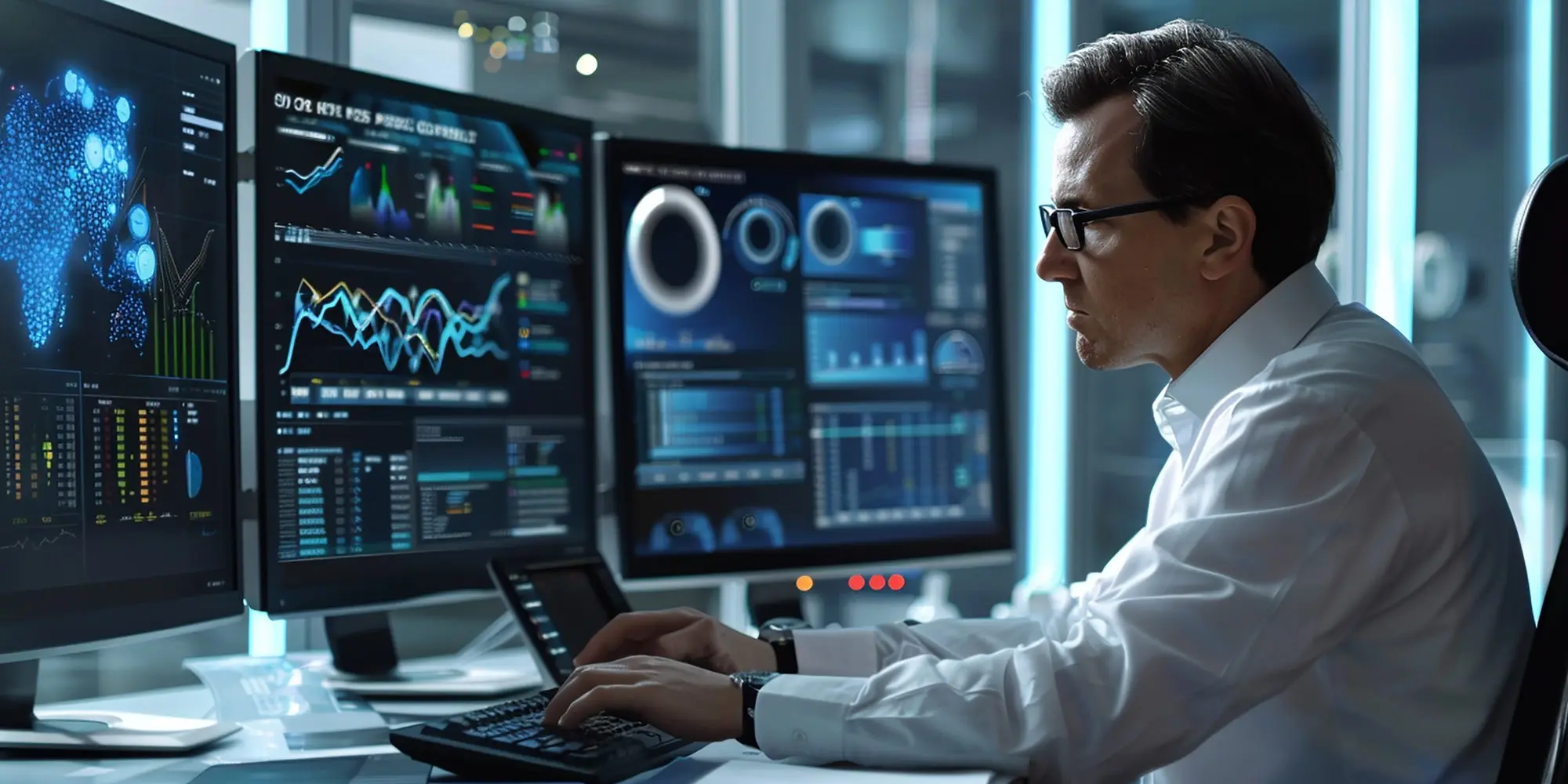
IT infrastructure monitoring is the practice of continuously tracking the health, performance, and availability of every component in your IT environment. This includes physical servers, virtual machines, network devices, cloud workloads, databases, and applications.
IT infrastructure monitoring is, basically, an operational control system for your technology stack. Every metric, log entry, and alert feeds into a central platform, providing your IT team with a real-time view of system health, potential degradation, and impending failures.
At a technical level, monitoring agents or agentless probes collect data from endpoints across your network. This data flows into a monitoring platform where it gets processed, correlated, and surfaced through dashboards and automated alerts.
Why it matters
Modern businesses run on digital infrastructure. A single degraded server or misconfigured network path can cascade into application slowdowns, failed transactions, and lost revenue. Monitoring closes the gap between something going wrong and your team knowing about it.
Why IT Infrastructure Monitoring is Critical in 2026
Rise of hybrid and multi-cloud
Organizations today rarely run on a single environment. Most enterprises operate across on-premises data centers, private clouds, and multiple public cloud providers simultaneously. This hybrid reality creates blind spots that traditional monitoring approaches were never designed to handle.
When workloads span AWS, Azure, and co-located data centers, maintaining comprehensive visibility is a significant challenge. Therefore, many teams require IT infrastructure monitoring tools capable of ingesting telemetry from every layer within this mixed environment without necessitating separate dashboards for each provider.
Downtime costs in modern businesses
The cost of downtime has grown significantly. Research from Gartner estimates that IT downtime costs enterprises an average of $5,600 per minute. For financial services, e-commerce, and telecom companies, that figure climbs considerably higher.
Beyond direct revenue loss, outages damage customer trust, trigger SLA penalties, and consume engineering hours that could go toward growth initiatives. Proactive monitoring shifts teams from reactive firefighting to structured, predictable operations.
By the numbers: The average cost of IT downtime (as per Gartner) is $5,600/min. For BFSI and telecom, the figure routinely exceeds $100,000/min depending on system criticality.
Regional challenges (India, SEA and the Middle East)
IT teams across India, Southeast Asia, and the Middle East face a distinct set of pressures. Rapid digital expansion, regulatory complexity, and infrastructure investments that often lag behind organizational growth make monitoring both more difficult and more necessary.
In India, the growth of Fintech and IT services has pushed monitoring demands significantly. In Indonesia and other Southeast Asian markets, telecom providers manage sprawling network infrastructure across geographically distributed areas. Gulf region organizations in oil and gas or government services face strict compliance requirements that monitoring tools must support.
Types of Infrastructure Monitoring
| Monitoring Type | What It Tracks | Key Metrics | Typical Tools |
| Network | Routers, switches, firewalls | Latency, packet loss, bandwidth | SNMP polling, flow data |
| Server | Physical and virtual machines | CPU, memory, disk I/O | Agent-based collection |
| Cloud | VMs, databases, serverless | Instance health, billing | Cloud-native APIs |
| Application | App performance, dependencies | Response time, error rate | APM agents, synthetic probes |
| Database | Queries, connections, storage | Query time, replication lag | DB-specific agents |
Network monitoring
Network monitoring tracks the performance and availability of routers, switches, firewalls, and connectivity paths. Key metrics include bandwidth utilization, packet loss, latency, and device uptime. Tools typically use SNMP polling, flow data, and ICMP probes to collect this data continuously.
Server monitoring
Server monitoring covers CPU usage, memory consumption, disk I/O, and process health across physical and virtual machines. Teams rely on server monitoring to identify resource bottlenecks before they cause application performance degradation or outright failures.
Cloud monitoring
Cloud monitoring aggregates telemetry from cloud-native resources such as virtual machines, managed databases, serverless functions, and Kubernetes clusters. Most platforms integrate with native cloud APIs from AWS, Azure, and GCP to pull metrics directly without requiring agents on every instance.
Application monitoring
Application monitoring tracks response times, error rates, transaction volumes, and service dependencies. This layer connects infrastructure performance to business outcomes, allowing teams to see how a degraded database server translates into slower page loads or failed API calls.
Database monitoring
Database monitoring focuses on query performance, connection pool health, replication lag, and storage utilization. Slow queries and lock contention are common sources of application-level performance issues that only become visible when database monitoring is in place.
How IT Infrastructure Monitoring Works
Data collection
Monitoring platforms collect data through agents installed on endpoints, agentless probes that scan network segments, or API integrations with cloud providers and applications. Collection intervals range from seconds for high-priority systems to minutes for less critical components.
Metrics and logs
Two primary data types feed most monitoring systems. Metrics are numerical measurements taken at regular intervals, such as CPU load at 87% or disk IOPS (input/output operations per second) at 4,200. Logs are timestamped records of system events, error messages, and application outputs.
Alerts
Alert engines compare incoming metrics against predefined thresholds or dynamic baselines. When a value crosses a threshold or deviates from its normal pattern, the system triggers notifications through email, SMS, or integrated ticketing systems. Modern platforms use AI to reduce noise by correlating related alerts into a single incident.
Dashboards
Monitoring dashboards aggregate data into visual displays that give teams a real-time operational view. Well-designed dashboards surface critical information at the right level of detail for different audiences, from NOC engineers watching individual device metrics to IT directors reviewing SLA compliance summaries.
Key Benefits of IT Infrastructure Monitoring
Reduced downtime
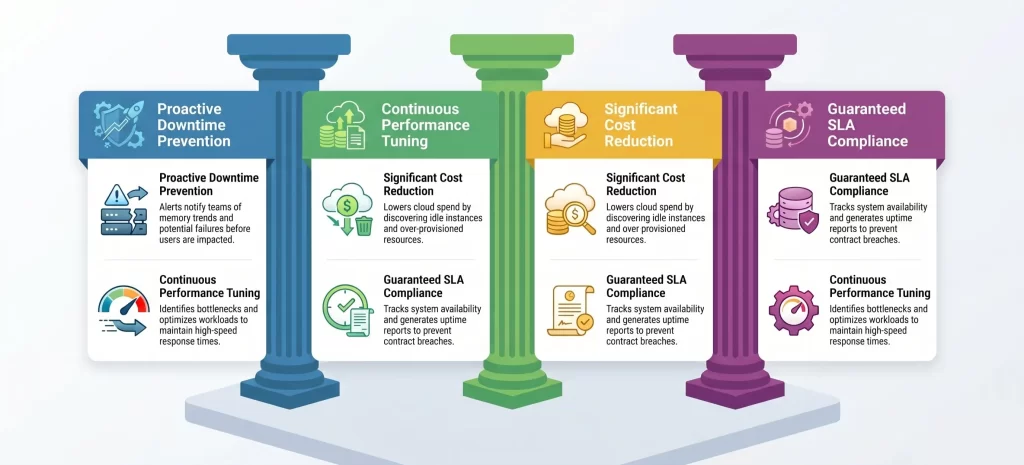
Monitoring gives teams early warning before failures occur. When a server’s memory usage trends toward its limit over 48 hours, an alert surfaces the issue before users experience slowdowns. That gap between detection and impact is where monitoring delivers its clearest value.
Improved performance
Continuous visibility into resource utilization allows teams to identify performance bottlenecks, optimize configurations, and tune workloads before they affect users. Over time, this translates into more consistent application response times and better overall user experience.
Cost optimization
IT infrastructure monitoring surfaces unused resources, over-provisioned servers, and idle cloud instances. Teams that act on this data consistently reduce cloud spend and right-size their environments without sacrificing capacity.
Better SLA compliance
SLA reporting requires accurate uptime and performance data. Monitoring platforms that track availability across systems and generate compliance reports give teams the documentation needed to demonstrate service delivery and identify gaps before they become contract issues.
Common Use Cases Across Industries
| Industry | Region | Primary Focus | Monitoring Priority |
| BFSI | India, UAE | Core banking, payment gateways | Compliance, high availability |
| Telecom | Indonesia | Network towers, data centers | Geographic coverage, SNMP volume |
| Oil & Gas | Saudi Arabia | OT and IT convergence | Security, regulatory compliance |
| IT Services | India | Multi-client infrastructure | Multi-tenant, SLA reporting |
BFSI (India and UAE)
Banks and financial institutions in India and the UAE operate under strict regulatory frameworks that require high availability and detailed audit trails. IT infrastructure monitoring tools in this sector need to cover core banking systems, payment gateways, and trading platforms simultaneously while generating compliance-ready reports for regulators.
Telecom (Indonesia)
Indonesian telecom providers manage infrastructure spanning urban data centers and remote network towers across thousands of islands. Monitoring solutions must handle high volumes of SNMP data from network devices, correlate geographic performance data, and support field teams with mobile-accessible dashboards.
Oil and gas (Saudi Arabia)
Oil and gas operations in Saudi Arabia rely on SCADA systems, operational technology networks, and enterprise IT running in parallel. Monitoring requires visibility across both OT and IT domains while meeting stringent security and compliance requirements from government and industry regulators.
IT services (India)
India’s IT services sector manages infrastructure for clients across multiple geographies and compliance jurisdictions. Service providers need IT infrastructure monitoring platforms that support multi-tenant architectures, customizable SLA dashboards, and automated reporting to meet diverse client requirements simultaneously.
Challenges in Infrastructure Monitoring
Alert fatigue
When monitoring systems generate hundreds of low-priority alerts daily, engineers stop treating them with urgency. True critical events get buried in noise. Addressing alert fatigue requires smart thresholding, AI-based event correlation, and disciplined alert hygiene to keep signal above noise.
Tool fragmentation
Many organizations end up with separate tools for network monitoring, server monitoring, cloud monitoring, and application monitoring. Each tool has its own dashboard, its own alerting logic, and its own data model. Teams spend time context-switching between consoles instead of resolving issues.
Lack of real-time visibility
Polling-based monitoring with long intervals creates gaps where degradation or failure occurs without detection. As environments grow more dynamic, particularly in cloud and container-based deployments, real-time streaming telemetry becomes essential.
Scalability issues
As infrastructure grows, monitoring configurations become harder to maintain. Adding a new server, spinning up a cloud region, or deploying a new application tier should trigger automatic monitoring coverage. Manual configuration does not scale with modern infrastructure velocity.
Best Practices for Effective Infrastructure Monitoring
Centralized monitoring
Consolidating monitoring data into a single platform eliminates the context-switching and data silos that come with fragmented tooling. A unified view enables faster root cause analysis because all relevant data lives in the same system.
AI-driven alerts
AI-based anomaly detection adapts to the natural patterns of each monitored component. Rather than firing every time a metric crosses a static threshold, AI alerts surface genuinely unusual behavior relative to historical baselines. This approach significantly reduces false positives.
Automation
Auto-remediation workflows handle routine issues without human intervention. When a server process crashes, an automation rule restarts it and logs the incident automatically. Teams focus on complex problems rather than repetitive manual tasks.
SLA-driven dashboards
Dashboards built around SLA targets keep teams focused on outcomes rather than raw metrics. When every widget ties back to a service-level commitment, prioritizing work and communicating status to stakeholders becomes far simpler.
What to look for in a monitoring tool
When evaluating monitoring platforms, four criteria consistently separate strong solutions from adequate ones.
- Scalability means the platform handles growth without requiring complete reconfiguration. Whether you are adding 50 servers or 5,000, the tool should accommodate that expansion without performance degradation.
- Integration depth determines how well the platform connects with your existing ITSM, ticketing, and cloud management tools. Strong integrations reduce manual work and keep data flowing between systems automatically.
- Automation capabilities define whether the tool can act on data, not just display it. Auto-discovery, auto-remediation, and automated reporting reduce the operational load on engineering teams.
- Cost structure matters beyond license fees. Consider deployment overhead, training time, and the engineering effort required to maintain the platform year over year.
Why Choose Infraon for IT Infrastructure Monitoring
Infraon at a glance: AI-powered monitoring engine, unified ITOM platform, built-in automation, and regional support for India, SEA, and the Middle East.
Infraon delivers IT infrastructure monitoring solutions as part of Infraon Infinity, a unified IT operations management platform, covering network, server, cloud, and application layers through a single interface.
Its AI-powered monitoring engine continuously learns from historical data to establish dynamic baselines, reducing false positives and surfacing anomalies that static threshold monitoring misses. When something unusual occurs, Infraon correlates related events into a single incident rather than flooding teams with individual alerts.
The platform’s automation capabilities extend beyond alerting. Infraon supports auto-remediation workflows, scheduled maintenance windows, and capacity planning reports that help teams stay ahead of resource constraints.
For organizations across India, Southeast Asia, and the Middle East, Infraon offers regional deployment options and compliance reporting aligned with local regulatory frameworks. Teams in these markets get enterprise-grade monitoring without the complexity and cost structure of Western vendors built for entirely different operating environments.
[Explore Infraon’s IT Monitoring Platform]
IT Infrastructure Monitoring vs. Observability
- Monitoring: This tracks the health and performance of known components. You define what to monitor, set thresholds, and receive alerts when values cross those thresholds. Monitoring answers whether something is working.
- Observability: This enables engineers to understand why something is behaving unexpectedly, even when the specific failure mode was not anticipated at design time. It relies on three data types: metrics, logs, and distributed traces, which together allow engineers to ask arbitrary questions about system behavior.
In practical terms, most organizations need both. Monitoring provides operational awareness and alerting. Observability provides the diagnostic depth to resolve novel and complex incidents faster.
Future Trends in Infrastructure Monitoring
AIOps
AIOps platforms apply machine learning to monitoring data at scale. Rather than alerting on individual metric thresholds, AIOps engines identify patterns across thousands of events to surface root causes and predict failures before they affect services. Adoption is growing rapidly as infrastructure complexity outpaces what human operators can track manually.
Predictive monitoring
Predictive monitoring uses historical performance trends to forecast future resource constraints and failure probabilities. Teams get advance warning of capacity exhaustion or hardware degradation days or weeks before the issue becomes critical, allowing planned remediation rather than emergency response.
Unified observability platforms
The convergence of monitoring, logging, and tracing into unified platforms is reshaping the tooling landscape. Rather than managing separate tools for each data type, teams increasingly want a single platform that connects infrastructure metrics to application traces to log events in a correlated timeline.
FAQs
What is IT infrastructure monitoring?
IT infrastructure monitoring is the continuous tracking of an organization’s IT components, including servers, networks, databases, cloud services, and applications, to ensure they perform reliably and within expected parameters.
What tools are used for IT infrastructure monitoring?
Common platforms include Infraon, Zabbix, Nagios, SolarWinds, Datadog, and ManageEngine OpManager. The right choice depends on the environment size, cloud complexity, budget, and integration requirements.
Why is IT infrastructure monitoring important?
Monitoring gives teams early visibility into performance degradation and potential failures before users are affected. Without it, IT teams react to outages after the fact rather than preventing them.
What is the difference between monitoring and observability?
Monitoring tracks known metrics against defined thresholds. Observability enables engineers to explore system behavior freely and diagnose unexpected failures using correlated metrics, logs, and traces.
How do you choose an infrastructure monitoring tool?
Evaluate platforms against your environment’s scale, integration requirements, automation capabilities, and total cost of ownership. Prioritize tools that support your specific deployment model, whether on-premises, cloud, or hybrid.
Conclusion
IT infrastructure monitoring is foundational to reliable digital operations. As environments grow more complex and downtime costs rise, the gap between teams with strong monitoring coverage and those without it continues to widen.
Infraon gives your team the visibility, intelligence, and automation needed to stay ahead of infrastructure issues rather than scrambling to contain them.