


What is an IT Asset Discovery Tool?
An IT asset discovery tool automatically scans and catalogs every device, application, and resource connected to an organization’s network. This includes physical hardware like servers and workstations, virtual machines, cloud instances, SaaS applications, and network infrastructure.
Within IT Asset Management (ITAM), discovery serves as the foundation. You cannot manage, secure, or optimize assets you do not know exist. Discovery tools bridge that gap by creating an accurate, continuously updated inventory of everything in your environment.
Role in ITAM
Accurate asset management starts with accurate asset discovery. Every downstream function, from license compliance to security patching to budget planning, depends on knowing what assets exist and where they live.
How IT Asset Discovery Tools Work
Agent-based vs. agentless discovery
Agent-based discovery installs lightweight software directly on endpoint devices. These agents report asset data back to a central server continuously, providing detailed hardware and software inventory, installed license information, and real-time status updates.
Agentless discovery scans the network from a central point without requiring software on each endpoint. It uses protocols like SNMP, WMI, and SSH to query devices and collect inventory data remotely. Agentless approaches deploy faster and work well for environments where installing agents on every device is impractical, though they typically provide less granular data.
Most mature discovery platforms support both methods, allowing teams to use agents for managed endpoints and agentless scanning for network devices and unmanaged assets.
Network scanning (SNMP, IP range)
Network scanning probes IP address ranges to identify active devices and query their properties. SNMP (Simple Network Management Protocol) is the standard mechanism for collecting data from routers, switches, and other network infrastructure. By scanning defined IP ranges and querying SNMP-enabled devices, discovery tools build a detailed inventory of network components without requiring agents on each device.
Cloud and API-based discovery
Cloud discovery connects to provider APIs from AWS, Azure, GCP, and SaaS platforms to automatically catalog cloud resources as they are created or modified. This approach keeps cloud inventory synchronized in real time, capturing virtual machines, databases, storage buckets, and SaaS accounts without manual updates.
Types of IT Asset Discovery Tools
Network-based tools
Network-based tools scan the network using IP ranges, SNMP, and port scanning to identify and inventory connected devices. They are effective for traditional on-premises environments with well-defined network boundaries.
Cloud-based tools
Cloud-based tools integrate with cloud provider APIs to discover and track cloud resources dynamically. As organizations increase cloud adoption, this capability has become increasingly important for maintaining complete inventory.
Endpoint-based tools
Endpoint-based tools deploy agents on individual machines to collect detailed hardware specifications, installed software, license data, and usage patterns. They provide the most granular asset data but require agent deployment across the estate.
SaaS discovery tools
SaaS asset discovery tools connect to identity providers and OAuth logs to identify sanctioned and shadow SaaS applications in use across the organization. With SaaS sprawl growing, this discovery type has become critical for both cost management and security.
Automated discovery
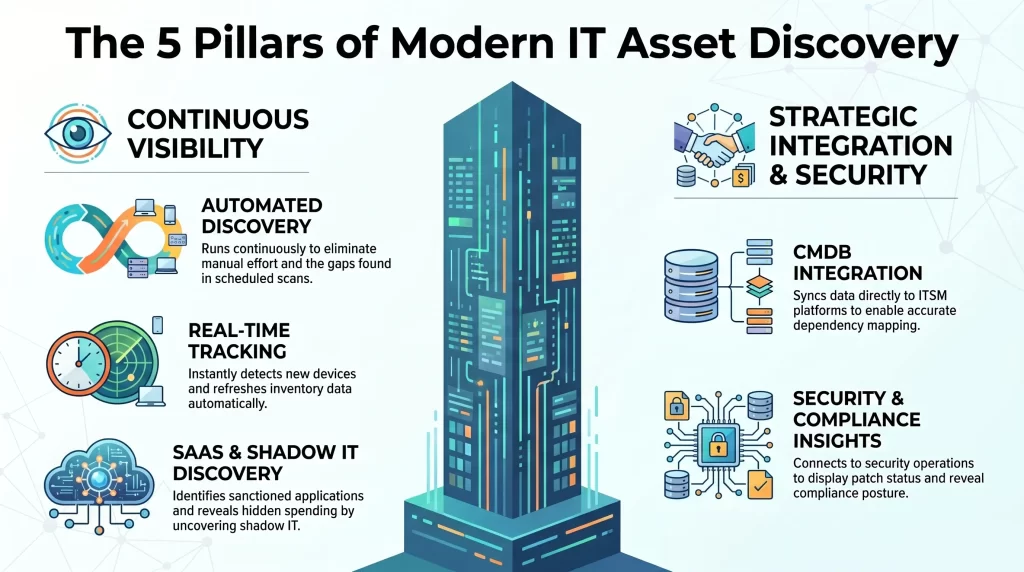
It should run continuously rather than as a scheduled scan. Environments change constantly as new devices connect, cloud resources spin up, and software gets installed. Automated, continuous discovery ensures inventory stays accurate without manual effort.
Real-time tracking
It must provide visibility into asset changes as they happen. When a new cloud instance launches or a workstation connects to the network, the inventory updates automatically.
CMDB integration
It should synchronize discovery data with your Configuration Management Database, giving your ITSM platform accurate asset information for change management, incident response, and dependency mapping.
SaaS discovery
It has to identify both sanctioned applications and shadow IT, giving IT and finance teams a complete picture of software spend and potential security exposure.
Security insights
It must enrich asset records with vulnerability data, patch status, and compliance posture, connecting discovery data directly to your security operations workflow.
Benefits of IT Asset Discovery Software
Visibility
Complete asset visibility eliminates the shadow IT problem. When every device, application, and cloud resource appears in a central inventory, IT teams can make informed decisions about management, security, and budget without guessing at what exists in the environment.
Compliance
Regulatory frameworks like ISO 27001, SOC 2, and local data protection laws require organizations to maintain accurate records of assets that process or store sensitive data. Discovery tools automate the inventory work that compliance audits require.
Cost optimization
Organizations routinely pay for software licenses, cloud instances, and SaaS subscriptions that are not actively used. Advanced asset discovery tools surface these redundancies, allowing teams to reclaim licenses, right-size cloud resources, and eliminate unnecessary subscriptions.
Security
Unmanaged assets represent attack surface that security teams cannot protect. IT asset discovery tools identify unauthorized devices and unpatched endpoints, giving security teams the information needed to reduce exposure systematically.
Best IT Asset Discovery Tools (2026)
Infraon
Best for unified IT asset management and discovery
- Automated asset discovery across on-premises, cloud, and hybrid environments
- Agent and agentless scanning with configurable collection intervals
- Real-time asset visibility with change tracking
- CMDB integration with automated relationship mapping
- SaaS and cloud resource tracking
Pros: Unified ITSM and ITAM eliminates the need for separate platforms | Strong automation | Scalable from SMB to enterprise
Cons: Newer brand compared to legacy platforms with decades of market presence
ServiceNow
Best for enterprise ITSM ecosystems
- CMDB-driven discovery with automated relationship mapping
- Cloud and on-premises visibility through a unified platform
- Strong integration ecosystem covering hundreds of third-party tools
Pros: Enterprise-grade platform with extensive workflow capabilities | Deep CMDB and ITSM integration
Cons: High licensing and implementation costs | Complex setup requiring dedicated administration resources
Lansweeper
Best for network-based discovery
- Agentless scanning with broad device coverage across Windows, Linux, and Mac
- Detailed asset inventory including hardware specifications and installed software
- Strong reporting and export functionality
Pros: Quick to deploy with minimal configuration | Good visibility across on-premises environments
Cons: Limited SaaS discovery capabilities compared to dedicated SaaS management tools
ManageEngine AssetExplorer
Best for SMBs
- Asset lifecycle tracking from procurement through retirement
- Network-based discovery with scheduled scanning
- Software license management with compliance reporting
Pros: Affordable pricing accessible to small and mid-sized organizations | Intuitive interface with low training overhead
Cons: Advanced automation capabilities are limited compared to enterprise platforms
SolarWinds
Best for network-heavy environments
- Network performance monitoring with integrated asset discovery
- Device tracking across complex network topologies
- Strong visualization and reporting for network teams
Pros: Deep network monitoring capabilities that go beyond basic discovery
Cons: Significant security scrutiny following a high-profile supply chain breach, which some procurement teams factor into evaluations
Zluri
Best for SaaS discovery
- Automated SaaS application discovery across sanctioned and shadow apps
- Shadow IT tracking with risk scoring
- License optimization recommendations
Pros: Excellent visibility into SaaS environments where traditional discovery tools fall short
Cons: Limited on-premises and network discovery capabilities
InvGate
Best for ITSM-integrated asset tracking
- Asset inventory with discovery tools integrated into the ITSM workflow
- Change and incident tracking tied to asset records
Pros: Clean, accessible interface that reduces adoption friction | Good ITSM integration
Cons: Enterprise depth and scalability lag behind dedicated ITAM platforms
Asset Panda
Best for mobile asset tracking
- Cloud-based asset tracking with custom workflow configuration
- Mobile-friendly interface with barcode and QR scanning
- Flexible data model for tracking non-IT assets alongside IT inventory
Pros: Flexible and accessible for teams managing physical assets in distributed locations
Cons: Deep automated discovery capabilities are limited compared to purpose-built network discovery tools
Comparison Table
| Tool | Best For | Key Strength | Weakness | Pricing Tier |
|---|---|---|---|---|
| Infraon | Unified ITAM | Automation + ITSM integration | Newer market presence | Mid-market |
| ServiceNow | Enterprise ecosystems | Scalability, workflow depth | High cost, complexity | Enterprise |
| Lansweeper | Network discovery | Discovery depth, reporting | SaaS discovery gap | Mid-market |
| ManageEngine | SMBs | Affordability, ease of use | Limited automation | SMB |
| SolarWinds | Network-heavy orgs | Network performance visibility | Past security concerns | Mid-Enterprise |
| Zluri | SaaS management | SaaS and shadow IT discovery | Limited on-prem coverage | Mid-market |
| InvGate | ITSM integration | UI, service management tie-in | Limited enterprise scale | SMB-Mid |
| Asset Panda | Mobile tracking | Mobile accessibility | Limited automated discovery | SMB |
How to Choose the Right Tool (Region-Based)
India and SEA
Organizations in India and Southeast Asia typically prioritize cost-effectiveness, deployment simplicity, and cloud readiness. Local teams often operate with lean IT staff, so platforms that minimize manual configuration and provide strong automation out of the box are more practical than highly customizable enterprise tools requiring dedicated administrators.
Look for platforms with transparent pricing, strong documentation, and regional support. Cloud-native or cloud-ready deployment models simplify setup and scale naturally with organizational growth.
Recommended for India and SEA: Infraon, ManageEngine AssetExplorer, and Lansweeper offer the best balance of capability, cost, and ease of deployment for organizations in these markets.
UAE and Saudi Arabia
Organizations in the UAE and Saudi Arabia operate under regulatory frameworks that require detailed asset records, data residency compliance, and auditability. Discovery tools in this region need to support compliance reporting for local and international standards, including NCA regulations in Saudi Arabia and UAE IA controls.
Enterprise scalability matters here as well. Many organizations in the Gulf region are large, complex enterprises that need platforms capable of handling thousands of assets across multiple sites without performance degradation.
Recommended for UAE and Saudi Arabia: Infraon is a strong fit for Gulf region enterprises that require compliance-grade reporting, data residency flexibility, and enterprise-scale asset management.
IT Asset Discovery vs. IT Asset Management
IT Asset Discovery
It’s the process of finding and cataloging assets across your environment. Discovery tools scan networks, query APIs, and deploy agents to identify what exists, where it lives, and what its current configuration looks like.
IT Asset Management
It covers the full lifecycle of those assets from procurement through retirement. ITAM platforms use discovery data as their foundation but extend far beyond inventory to cover financial tracking, license compliance, warranty management, and disposal workflows.
Discovery feeds ITAM. Without accurate discovery, asset management decisions are based on incomplete or stale data. Together, they form the backbone of a mature IT operations practice.
FAQs
What is IT asset discovery software?
IT asset discovery software automatically scans and catalogs every device, application, and cloud resource connected to an organization’s environment. It builds and maintains an accurate inventory without requiring manual input from IT teams.
How does asset discovery work?
Discovery tools use a combination of network scanning, installed agents, and cloud API integrations to identify assets. They query device configurations using protocols like SNMP and WMI, pull data from cloud provider APIs, and aggregate everything into a centralized inventory.
What is the difference between agent and agentless discovery?
Agent-based discovery installs software directly on endpoint devices for continuous, detailed reporting. Agentless discovery scans the network remotely using standard protocols without requiring software installation on each device. Each approach has tradeoffs around data granularity, deployment effort, and coverage of unmanaged devices.
Which is the best IT asset discovery tool?
The right tool depends on your environment and requirements. Infraon is a strong choice for organizations seeking unified ITSM and ITAM with strong automation. ServiceNow suits large enterprises already invested in that ecosystem. Lansweeper works well for network-focused discovery, while Zluri addresses SaaS-heavy environments.
Why Infraon is a Smart Choice
Infraon Assets brings together IT asset discovery, CMDB management, and ITSM in a single platform, eliminating the integration overhead that comes with running separate tools for each function.
Its discovery engine covers on-premises, cloud, and hybrid environments through both agent and agentless methods, keeping inventory synchronized as environments change. The CMDB integration automatically maps relationships between assets and services, giving teams accurate configuration data when they need it most.
Infraon scales from SMB deployments to large enterprise environments, and its regional support model makes it a practical choice for organizations across India, Southeast Asia, and the Middle East.
What sets Infraon apart?
- Unified platform combining ITSM, ITAM, and discovery in one place
- No integration overhead
- No fragmented data
- Real-time visibility from day one