



Network asset management gives IT teams a clear record of the devices, systems, software, services, and dependencies connected across the business. That record matters because network environments now stretch across offices, data centers, cloud platforms, remote users, and third-party services. When teams lack visibility, they spend longer locating assets, tracing incidents, validating ownership, and proving compliance.
A strong network asset management program turns scattered inventory data into a working source of truth. It helps teams discover assets, track their health, understand relationships, reduce risk, and make better choices across the asset lifecycle.
What Is Network Asset Management?
Network asset management is the practice of discovering, recording, monitoring, and managing assets connected to an organization’s network. These assets can include routers, switches, firewalls, servers, endpoints, virtual machines, applications, licenses, cloud resources, and IoT devices. The goal is for IT teams to know what exists, where it sits, who owns it, how it connects, and how it performs.
How network asset management works
A network asset management program starts with discovery. IT asset discovery tools scan networks, IP ranges, endpoints, cloud accounts, and connected systems to identify active assets. The data then flows into an asset repository or CMDB, where each record can be enriched with ownership, location, lifecycle stage, warranty data, software details, and dependency data. From there, teams can monitor asset health, track configuration changes, link incidents to affected assets, and plan upgrades with far better context.
Network assets every organization should track
Every organization has a different mix of network assets, but the core tracking need is similar. IT teams should maintain visibility across devices, systems, services, and resources that support daily operations. Missing one class of assets can create blind spots during incident response, audit preparation, and capacity planning.
- Network devices such as routers, switches, access points, firewalls, and load balancers
- Servers, endpoints, laptops, workstations, mobile devices, and virtual machines
- Cloud resources, SaaS applications, storage instances, and connected workloads
- Software licenses, firmware versions, operating systems, and patch status
- IoT devices, printers, cameras, scanners, and other connected equipment
Difference between network asset management and IT asset management
Network asset management focuses on assets that connect, communicate, or depend on the network. IT asset management has a wider scope and covers hardware, software, contracts, financial data, procurement, lifecycle status, and usage. The two functions work best together because asset value, risk, performance, and ownership rarely sit in one system alone.
| Network Asset Management | IT Asset Management |
| Focuses on network-connected assets and their operational context | Covers the full IT asset lifecycle across hardware, software, licenses, contracts, and cost data |
| Tracks connectivity, dependencies, health, configuration, and network availability | Tracks procurement, ownership, usage, lifecycle stage, compliance, and financial records |
| Used heavily by network, operations, security, and service desk teams | Used across IT operations, finance, procurement, compliance, and security teams |
| Supports faster troubleshooting, capacity planning, and risk control | Supports lifecycle planning, cost control, license governance, and audit readiness |
Why Network Asset Management Matters in 2026
Network environments are larger, faster, and harder to map manually. A device may sit in an office, a workload may run in a cloud account, and a user may connect from home through a secure tunnel. Each asset can affect security, service quality, and cost. Network asset management gives teams the control layer they need to manage this spread with confidence.
Hybrid infrastructure
Hybrid infrastructure creates asset records across data centers, branch offices, cloud platforms, and edge locations. When these records live in separate tools, teams lose context. Network asset management brings those records together so IT can understand how physical, virtual, and cloud resources support service delivery.
Cloud adoption
Cloud adoption expands the asset base through virtual machines, containers, storage, databases, load balancers, and SaaS services. Many of these resources can be created quickly and removed just as fast. A cloud-aware asset process helps IT see active resources, assign ownership, control cost, and reduce unmanaged exposure.
Remote workforce
Remote work adds endpoints, home networks, VPN sessions, and mobile devices to the support model. IT teams need accurate endpoint records and connection context to troubleshoot issues quickly. Asset visibility also helps security teams confirm patch status, device ownership, and access rights across distributed users.
Cybersecurity risks
Unknown assets become security gaps. An unmanaged device can miss patches, run old firmware, or connect through weak controls. Network asset management supports stronger cybersecurity by revealing what is connected, which assets need attention, and how a change may affect connected services.
Compliance requirements
Auditors expect organizations to prove control over infrastructure, access, software, and data handling. Accurate network asset records make audit preparation smoother because teams can show ownership, configuration status, patch activity, lifecycle records, and policy alignment through a governed system.
Top 12 Benefits of Network Asset Management
What Are the Benefits of Network Asset Management?
- Complete Network Visibility: Gain a live view of connected assets across locations, users, and platforms.
- Automated Asset Discovery: Identify new, removed, or changed devices while keeping inventory records current.
- Reduced Downtime: Link assets with alerts, incidents, dependencies, and ownership data to speed up response.
- Better Capacity Planning: Use asset utilization trends to plan upgrades, right-size resources, and prevent rushed purchases.
- Improved Security: Detect unknown devices, weak configurations, patch gaps, and exposed infrastructure.
- Faster Incident Resolution: Give technicians instant access to asset ownership, location, warranty, etc.
- Stronger Compliance Readiness: Maintain audit-ready records through automated discovery, monitoring, and change tracking.
- Lower IT Costs: Find unused devices, idle cloud resources, duplicate tools, and underused software licenses.
- Lifecycle Optimization: Manage procurement, maintenance, upgrades, replacement, and secure disposal from one system.
- License Optimization: Connect software inventory with devices, users, and application activity to control license usage.
- Better Vendor Management: Track contracts, warranties, support plans, renewals, and vendor-linked assets in one place.
- Smarter IT Decisions: Use performance, usage, risk, and cost data to guide investments and operational plans.
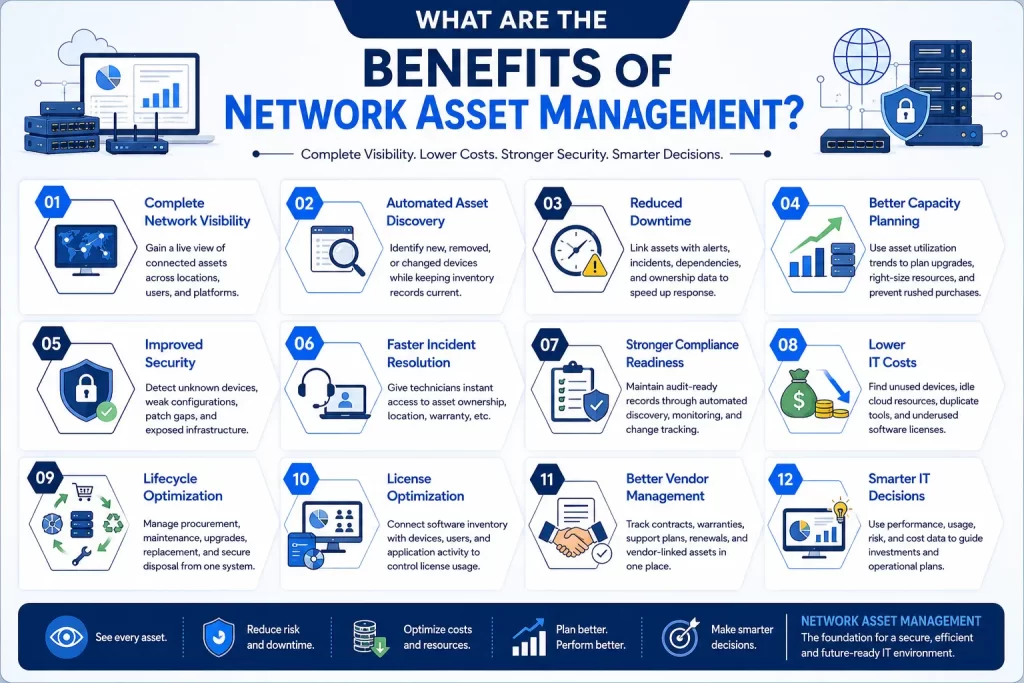
The main value of network asset management comes from turning disconnected records into action-ready information. Once assets are visible and linked to service operations, teams can respond faster, plan with better data, and reduce avoidable risk.
- Complete network visibility: Complete network visibility gives teams a live view of connected assets across locations, users, and platforms. That view reduces guesswork during incidents because teams can see what exists, where it runs, and which services rely on it.
- Automated asset discovery: Automated asset discovery reduces manual effort and improves inventory accuracy. Discovery scans can identify new devices, detect removed assets, and refresh records so teams work from current data rather than stale spreadsheets.
- Reduced downtime: Downtime lasts longer when teams lack asset context. Network asset management helps teams connect alerts, incidents, dependencies, and ownership data so they can find the affected asset and act faster.
- Better capacity planning: Capacity planning improves when IT teams can see how assets are used over time. Utilization data helps teams plan network upgrades, right-size resources, and avoid rushed purchases caused by poor visibility.
- Improved security: Security starts with knowing what is connected. Network asset management helps teams detect unknown devices, spot weak configurations, track patch gaps, and reduce exposure across distributed infrastructure.
- Fast incident resolution: Incident resolution becomes faster when support teams can open a ticket and see linked asset data at once. Ownership, location, dependency, warranty, and configuration details give technicians stronger context before they start troubleshooting.
- Compliance readiness: Compliance improves when records stay updated through discovery, monitoring, and change tracking. Teams can respond to audit requests with stronger evidence and fewer last-minute data collection cycles.
- Lower IT costs: Asset visibility helps reduce waste. Teams can identify unused devices, idle cloud resources, unused licenses, duplicate tools, and assets nearing end of life before they create extra cost or risk.
- Lifecycle optimization: This helps teams manage each asset from planning through retirement. This gives IT a better way to plan procurement, maintenance, upgrades, replacements, and secure disposal.
- License optimization: This depends on knowing where software runs and how it is used. Network asset management can support license control by linking software inventory with devices, users, and application activity.
- Better vendor management: Vendor management improves when IT teams can see which assets are tied to contracts, warranties, support plans, and renewal cycles. This helps teams plan renewals and negotiate with cleaner data.
- Smarter IT decisions: IT decisions come from accurate operational data. Network asset management helps leaders see asset performance, risk, usage, and cost patterns before they approve investments or change plans.
Common Network Asset Management Challenges
Shadow IT
Shadow IT appears when teams create or connect assets outside approved processes. These assets may still affect security, cost, and service quality, but IT may lack ownership, usage, and risk data until a problem appears.
Manual inventory
Manual inventory processes create delays and human error. Spreadsheets can miss asset changes, duplicate records, and lose ownership data. As the network grows, manual tracking becomes too slow for daily operations.
Incomplete discovery
Incomplete discovery leaves teams with partial visibility. A tool may find endpoints but miss cloud assets, virtual machines, or devices behind segmented networks. The result is an inventory that looks organized but still hides risk.
Configuration drift
Configuration changes happen when asset settings move away from approved standards. Small untracked changes can affect performance, availability, and security. Teams need change visibility to detect drift before it creates service impact.
Siloed IT teams
Siloed IT teams often maintain separate asset records for network, security, service desk, cloud, and operations. When records stay split, no single team sees the full service context during incidents or planning cycles.
Cloud visibility issues
Cloud visibility issues arise when resources are created quickly, tagged poorly, or managed through separate accounts. Without strong cloud discovery and governance, teams can lose track of ownership, spend, and exposure.
15 Network Asset Management Best Practices
Automate asset discovery
Use automated discovery to refresh asset records across endpoints, network devices, virtual machines, and cloud resources. Automation reduces manual effort and helps teams catch changes early.
Maintain a single source of truth
Create one trusted asset repository for ownership, location, status, lifecycle, and dependency data. A shared record helps different teams work from the same context.
Standardize asset naming
Use consistent naming rules for devices, services, locations, environments, and owners. Clean names make search, reporting, and incident handling faster.
Monitor asset health
Track CPU, memory, storage, device status, firmware, availability, and usage patterns. Health data helps teams identify weakening assets before users feel the impact.
Track asset lifecycle
Record each asset from planning and procurement through deployment, maintenance, refresh, and retirement. Lifecycle tracking helps leaders plan budgets and reduce risk from aging assets.
Integrate with ITSM
Connect asset data with incidents, changes, problems, and service requests. ITSM integration gives agents asset context inside the workflow they already use.
Use network mapping
Map assets and dependencies so teams can see how services connect. Network mapping helps with root cause analysis, change planning, and impact assessment.
Schedule regular audits
Run regular audits to compare discovered assets with approved inventory records. Audits help remove duplicates, catch missing records, and support compliance work.
Monitor software dependencies
Track software, services, versions, and dependencies across connected assets. This helps teams manage patching, license use, and risk from outdated components.
Implement role-based access
Use role-based access so the right teams can view or update the right asset data. This protects sensitive records and keeps ownership clear.
Track configuration changes
Record configuration changes and link them to approved change requests where possible. This makes it easier to trace service impact back to recent changes.
Use AI for anomaly detection
Apply AI to detect unusual asset behavior, usage spikes, configuration changes, and risk patterns. This helps teams respond before a small issue spreads.
Measure asset utilization
Measure how assets are used across locations, teams, and services. Utilization data helps teams reduce idle resources and plan purchases with better evidence.
Create compliance reports
Build compliance reports that show ownership, patch status, configuration status, lifecycle records, and audit activity. Reports should be easy for IT and governance teams to use.
Review asset performance quarterly
Run quarterly reviews to evaluate performance, cost, utilization, and risk. These reviews help teams refresh plans before assets cause downtime or unnecessary spend.
Features Every Network Asset Management Tool Should Have
The right network asset management tool should help teams discover assets, maintain accurate records, monitor health, understand dependencies, and connect asset data with IT operations. The feature set should match the scale and complexity of the environment.
Automated discovery
Automated discovery identifies assets across networks, cloud accounts, virtual environments, and remote endpoints. It keeps inventory data current as assets are added, changed, or removed.
Network scanning
Network scanning helps teams detect devices across IP ranges, subnets, and segmented environments. Strong scanning capability reduces hidden assets and supports better security coverage.
Real-time monitoring
Real-time monitoring gives teams status and performance data across key assets. This helps IT identify outages, degradation, and risk before user complaints increase.
Dependency mapping
Dependency mapping shows how assets, services, applications, and network paths connect. This context helps during incidents, change approvals, and migration planning.
Asset relationship mapping
Asset relationship mapping connects devices with users, services, contracts, tickets, and configuration records. These links help teams understand operational impact quickly.
CMDB integration
CMDB integration connects discovered asset data with configuration records. It helps teams maintain stronger service context across incidents, problems, changes, and audits.
ITSM integration
ITSM integration brings asset context into ticketing workflows. Agents can see the affected device, ownership, history, and dependencies while handling an incident or service request.
Patch visibility
Patch visibility helps teams see which assets need updates, which patches are pending, and which systems carry exposure. This supports stronger security and audit readiness.
Software inventory
Software inventory tracks installed applications, versions, licenses, and usage. It helps teams manage compliance, remove unused software, and reduce risk from outdated versions.
Compliance dashboard
A compliance dashboard gives leaders a clear view of audit status, configuration gaps, policy exceptions, and overdue actions. This reduces manual reporting work during audits.
Cloud asset visibility
Cloud asset visibility helps teams track workloads, services, storage, and cloud resources across providers. This supports governance, cost control, and security monitoring.
Custom Reporting
Custom reporting helps teams answer business and operational questions using asset data. Reports can cover lifecycle status, ownership, utilization, incidents, compliance, and cost patterns.
How IT Asset Discovery Tools Improve Network Asset Management
IT asset discovery tools support network asset management by finding assets automatically and updating inventory records with technical details. They reduce the gap between what IT thinks exists and what is actually connected.
Agent-based discovery
Agent-based discovery uses installed agents on endpoints or servers to collect detailed asset data. It works well for managed devices that need deeper inventory, usage, and health information.
Agentless discovery
Agentless discovery scans the network without installing software on each device. It is useful for discovering infrastructure, devices, and systems where agent installation is difficult.
SNMP discovery
SNMP discovery collects data from network devices such as routers, switches, printers, and firewalls. It helps teams understand device status, configuration, interface data, and performance.
IP range discovery
IP range discovery scans defined address ranges to detect active assets. It helps teams find devices across subnets, offices, and segmented environments.
Cloud discovery
Cloud discovery connects to cloud platforms to identify resources, services, tags, owners, and usage. This helps IT manage cloud assets with the same discipline used for on-prem systems.
Virtual Machine Discovery
Virtual machine discovery identifies VMs across hosts, clusters, and cloud platforms. It helps teams track dynamic environments where workloads change frequently.
Discovery Best Practices
Discovery works best when teams define scan schedules, approved IP ranges, ownership fields, naming rules, and validation checks. Clean discovery planning leads to cleaner inventory data.
How AI Is Transforming Network Asset Management
AI adds stronger analysis to network asset management by detecting patterns that manual review can miss. It can help teams classify assets, forecast capacity needs, detect unusual behavior, and recommend actions based on past activity.
- Predictive maintenance uses asset health and performance patterns to identify devices that may fail soon. This helps teams plan repairs or replacements before a weak asset affects service quality.
- Automated asset classification helps categorize devices, workloads, and services based on discovered attributes. This reduces manual tagging effort and improves reporting accuracy.
- Intelligent alerting groups related alerts, reduces noise, and highlights issues that need attention. This helps teams focus on service impact rather than scattered event lists.
- Capacity forecasting uses historical data to project future resource needs. IT leaders can plan upgrades, bandwidth changes, and cloud resources with stronger evidence.
- Self-healing networks use automation to respond to known issues, reset services, adjust configurations, or route traffic based on approved rules. AI helps identify when these actions should trigger.
Network Asset Management Use Cases Across Industries
Every industry depends on connected assets, but the operating pressures vary. Network asset management helps each sector improve visibility, reduce downtime, and maintain stronger control over assets that support users, services, and business operations.
Healthcare
Healthcare organizations track medical systems, connected devices, endpoints, and network infrastructure that support patient care. Asset visibility helps reduce downtime, support audits, and manage connected equipment across hospitals and clinics.
Banking
Banks need strict control over devices, applications, servers, network paths, and security systems. Network asset management supports audit readiness, incident response, and operational control across branches and data centers.
Manufacturing
Manufacturers rely on plants, sensors, industrial systems, endpoints, and network devices that support production. Asset tracking helps teams reduce downtime, plan maintenance, and protect operational technology environments.
Telecommunications
Telecommunications providers manage large networks with distributed assets, customer-facing systems, and field infrastructure. Network asset management helps with capacity planning, service assurance, and lifecycle planning.
Government
Government agencies need visibility across offices, citizen services, secure systems, and field assets. A governed asset record supports audits, security reviews, and service continuity.
Retail
Retail teams manage stores, POS systems, wireless networks, cameras, inventory devices, and cloud services. Asset visibility helps maintain store uptime, support seasonal demand, and reduce device loss.
How to Choose the Right Network Asset Management Tool
Scalability
The tool should handle growth across users, devices, locations, cloud resources, and business units. Scalability matters when asset counts rise quickly or new sites come online.
Automation
Automation should cover discovery, updates, alerts, workflows, reports, and lifecycle events. This reduces manual work and keeps asset records fresher.
Security
Security features should include access controls, audit trails, patch visibility, configuration tracking, and policy reporting. These controls help teams reduce exposure and prove governance.
Ease of deployment
Deployment should fit the organization’s environment and team capacity. A tool that takes too long to configure can delay adoption and weaken early results.
Reporting
Reporting should help leaders, auditors, and operations teams answer practical questions. Useful reports cover ownership, lifecycle status, health, incidents, utilization, and compliance.
Pricing
Pricing should reflect asset volume, feature needs, deployment model, integrations, and support. Teams should evaluate cost against visibility gains, reduced downtime, and lower manual effort.
Vendor support
Vendor support matters during setup, integration, workflow design, and scaling. Strong support helps teams move from tool installation to steady operational use faster.
Why Modern IT Teams Choose Infraon IT Asset Management
Infraon IT Asset Management helps teams bring asset discovery, visibility, lifecycle control, and ITSM context into one connected workflow. For organizations managing hybrid networks, remote endpoints, and growing cloud usage, this connected approach helps reduce blind spots and gives IT teams cleaner operational data.
Unified asset discovery
Infraon ITAM supports unified asset discovery across IT environments so teams can identify assets and maintain cleaner records from a central platform.
Real-time network visibility
Infraon ITAM’S real-time visibility helps teams see asset status, availability, and operational context. This supports faster investigation during incidents and better planning during changes.
Lifecycle management
Infraon ITAM’s lifecycle management helps teams track assets from discovery and deployment through maintenance, refresh, and retirement. This gives leaders stronger control over cost, risk, and planning.
ITSM integration
Infraon ITAM’s easy ITSM integration connects asset records with incidents, service requests, changes, and workflows. Agents gain asset context while handling service activity.
Compliance reporting
Infraon ITAM’s smart compliance reporting helps teams collect evidence around ownership, configuration, patch status, and asset history. This reduces manual work during audit cycles.
Automation workflows
Infraon ITAM comes with automation workflows that help teams reduce repetitive asset tasks, route updates, trigger alerts, and keep operational records current.
Cloud and hybrid support
Infraon ITAM’s cloud and hybrid support helps teams manage resources across distributed environments. This is useful when assets span data centers, cloud platforms, branch networks, and remote users.
Network Asset Management Trends for 2026
Network asset management is moving toward stronger automation, deeper security context, and better service intelligence. In 2026, teams will expect asset platforms to support record-keeping, risk sensing, action guidance, and business service impact analysis.
AI-driven discovery
AI-driven discovery will help teams identify assets, classify them, detect duplicates, and highlight unusual behavior. This will make asset data easier to maintain as environments grow.
Zero Trust integration
Zero Trust integration will connect asset identity, access, security posture, and policy checks. IT and security teams will need asset data to validate trust before granting access.
Digital twin networks
Digital twin networks will give teams a model of infrastructure, dependencies, and service paths. This will support planning, testing, incident analysis, and change impact reviews.
Autonomous IT operations
Autonomous IT operations will use asset data, monitoring, AI, and automation to handle routine tasks with less manual effort. This can include remediation, routing, scaling, and policy checks.
Sustainability and green IT
Sustainability and Green IT will push teams to track energy use, device utilization, refresh cycles, and disposal activity. Asset management data will help support greener IT decisions.
Frequently Asked Questions
What is network asset management?
Network asset management is the process of discovering, tracking, monitoring, and managing assets connected to an organization’s network. It covers devices, infrastructure, cloud resources, software, and dependencies that support IT services.
Why is network asset management important?
It gives IT teams visibility into connected assets, ownership, health, security status, and dependencies. This helps with incident response, compliance, capacity planning, lifecycle control, and cost management.
What is a Network Asset Management Tool?
A network asset management tool helps teams discover assets, maintain inventory records, monitor health, map dependencies, track configurations, and connect asset data with ITSM workflows.
How does Network Asset Management differ from IT Asset Management?
Network asset management focuses on network-connected assets and operational context. IT Asset Management covers the wider asset lifecycle, including procurement, ownership, contracts, software, licenses, compliance, and cost data.
How do IT Asset Discovery Tools support Network Asset Management?
IT asset discovery tools scan networks, endpoints, cloud platforms, and virtual environments to identify assets and update inventory records. They help teams reduce manual tracking and improve data accuracy.
What assets should organizations monitor?
Organizations should monitor network devices, endpoints, servers, virtual machines, cloud resources, software, licenses, IoT devices, security tools, and any asset that connects to or supports business services.
Can Network Asset Management improve cybersecurity?
Yes. It improves cybersecurity by revealing unknown assets, patch gaps, outdated software, configuration drift, and risky connections. Security teams can only protect assets they can see and assess.
How often should network assets be audited?
Network assets should be reviewed on a regular schedule, with automated discovery running daily or continuously where possible. Many teams use continuous discovery with quarterly asset reviews for governance, compliance, and planning.