
Products
Free Tools
More
Improve IT Efficiency

Incident Response Efficiency Calculator
Get data-backed insights on the hidden costs of downtime and make smarter IT decisions.

Ticket Backlog Impact Calculator
Estimate productivity loss, cost impact, backlog growth, and SLA risk. Get AI-driven insights to reduce your IT support backlog.

MTTR Impact Analyzer
Calculate SLA breaches, MTTR impact, customer churn risk, and revenue loss from delayed fault resolution.
Optimize IT Asset Costs
Company

About Us
Learn more about our mission, vision, and the values that drive us. Discover who we are and what makes us stand out.

Our Partners
Discover the trusted partners who enhance our services through strong collaborations.

Partner Program
Our Partner Program is all about new opportunities and building lasting relationships. Join us on this journey!
Resources
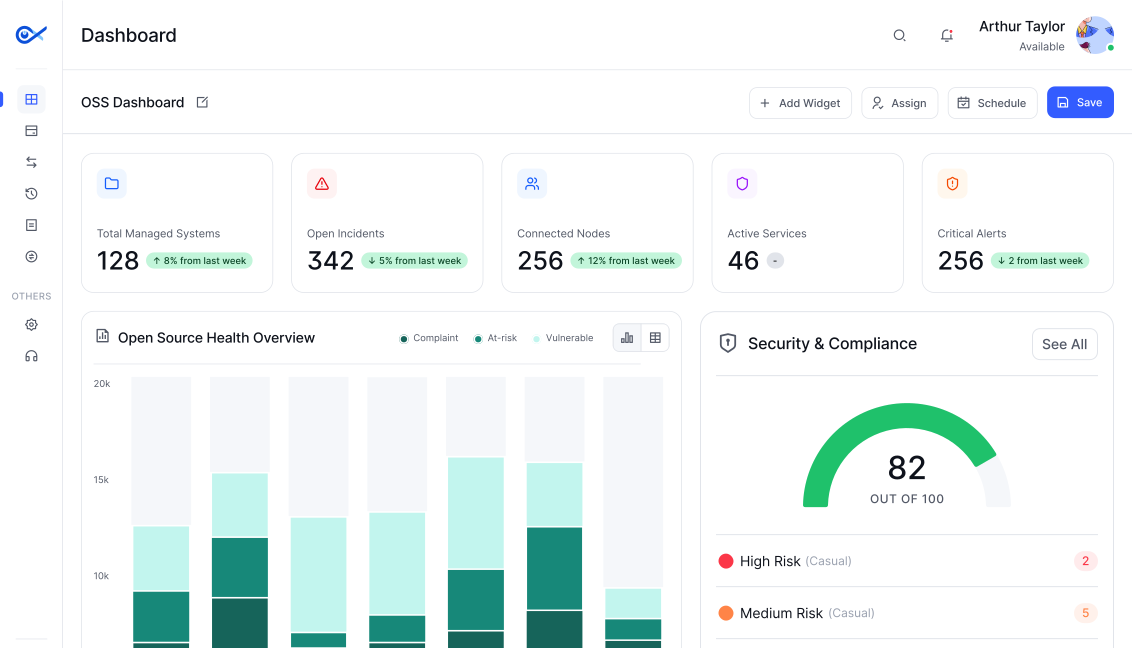
Most IT operations management platforms claim to help manage, grow, and secure your infrastructure. But most end up doing half the job, leading to very harsh truths.
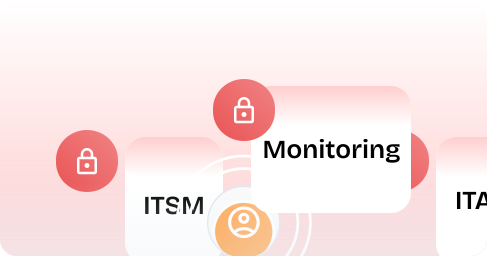
Most IT teams operate 6-12 disconnected tools across service desk, monitoring, assets, and infrastructure. However, none of them are fully aligned, leading to ROI headaches.

Events flood in, but teams still struggle to correlate issues and predict failures. Ultimately, they fail to act before users are impacted.

CIOs and IT leaders rarely get a single, reliable view of operational health, risk, and performance - making it harder to make confident decisions about hiring, budgeting, and technology investment.
Infraon OSS covers resource lifecycle, provisioning and activation, SLA management, performance management, service orchestration, and more.
A comprehensive open-source observability platform for monitoring and managing IT infrastructure, applications, and services.
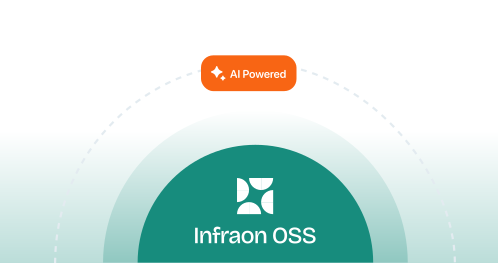
Make sure active and passive inventory blueprints capture network, topology, and service relationships.
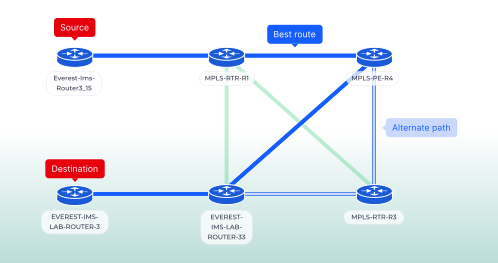
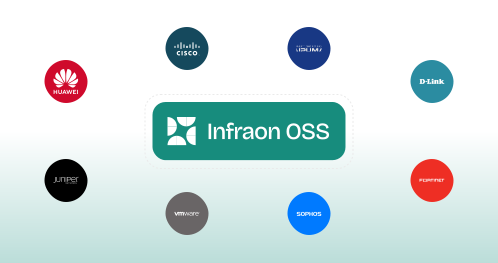
Ensure connector coverage, spanning Cisco, Juniper, Nokia, Huawei, ZTE, Tejas, Ciena, Calix, Eltex, and other OEMs.
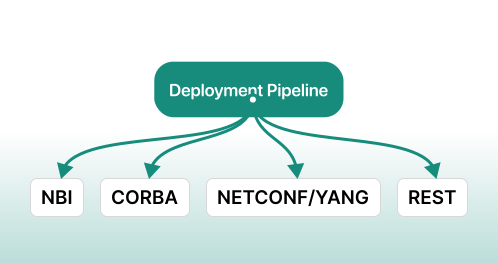
Use NBI, CORBA, NETCONF/YANG, and REST to push configurations with a full audit trail.
Align TMF OpenAPI v4/v5, REST southbound paths, and BPMN flows.

Get an architecture that covers SNMP, gNMI/gRPC, XML, SSH/CLI, TL1, eTOM, SID, ODA, and ITIL4.
Correlate alarms, traps, KPIs, RCA, SIA, and remediation steps before customer impact spreads.
Move orders through feasibility, reservation, allocation, activation, verification, and monitoring.
Connect portals, CRM, order management, GIS, AAA, ACS, WFM, EMS, NMS, and ITSM.
Track spectrum, OTN/ODU/CTP, OLT/ONT, route usage, SLA health, and breach risk.
4.7
Over 10K+ Entrepreneurs, and
business choose us

Infraon OSS is built to help telecom teams manage multi-domain networks with one platform, so they can deliver better services, faster.
Faster service activation
Lower NOC effort
Better SLA control
Certifications & Appraisals





Frameworks & Standards We Align With




Infraon OSS checks available resources, reserves capacity, activates the service, and tracks performance against the committed SLA. So, when faults occur, you can see the affected service, customer, and SLA.

Maintain network elements, links, active inventory, passive inventory, topology, and service relationships.
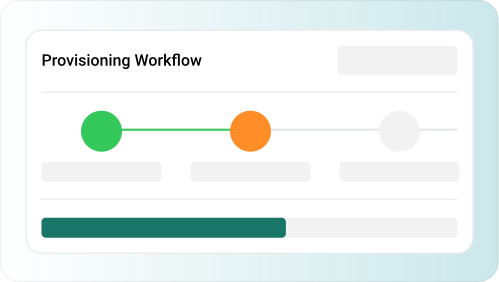
Optimize resources, create work orders, push logical configs, activate through ZTP, verify, and roll back when required.
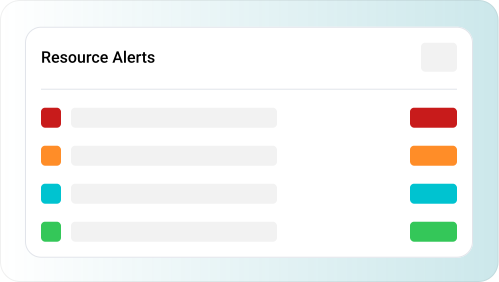
Ingest faults, enrich alarms, correlate service impact, open tickets, and trigger remediation.
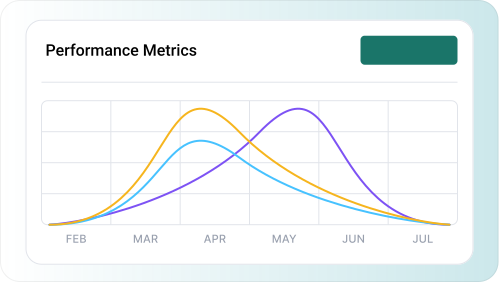
Collect details on PM, KPIs, health, errors, QoS, traffic, and optical power at defined intervals.
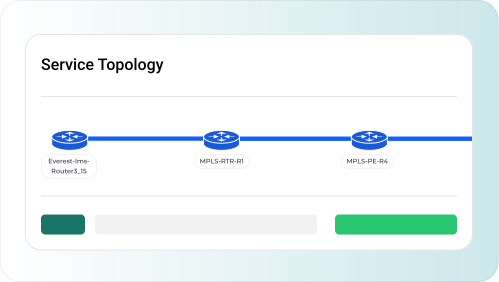
Translate catalog intent into RFS/CFS mapping, topology trails, route logic, and path choices.
Create vendor commands via templates, execute activation, verify results, and retain audit history.
Track availability, latency, packet loss, breach prediction, penalty exposure, and customer reports.
Use RCA, SIA, knowledge guidance, escalation logic, and customer impact views during incidents.
For resource reservation
For service activation
From alarm to ticket
MTTR reduction
NOC team reduction
Operational cost reduction
Service availability
RCA automation for faults
Fewer escalations
Infraon replaces disconnected tools across ITSM, network monitoring, asset management, and more - all managed from a single platform.
An Operations Support System (OSS) is a specialized platform used to manage the operational side of telecom and IT networks.
It enables teams to detect and resolve faults, monitor network performance, handle configuration changes, and assure service quality.
OSS platforms are critical for maintaining smooth day-to-day operations, especially in environments that involve multiple vendors, technologies, and large-scale deployments.
OSS and BSS serve different but complementary functions.
OSS focuses on the technical and operational infrastructure, such as monitoring network health, managing faults, and ensuring service continuity.
BSS (Business Support Systems), on the other hand, handles business processes like billing, customer relationship management, and order handling.
Together, OSS and BSS form a complete operational and business ecosystem for service providers.
Without an OSS, organizations often deal with fragmented visibility, meaning data is scattered across multiple tools with no central source of truth.
Fault detection becomes slower, service outages last longer, and the risk of configuration errors rises.
The lack of centralized control also makes it harder to meet SLAs, respond quickly to performance degradation, and keep operational costs under control.
The five main functions typically include: Fault Management – Detecting, isolating, and resolving network faults.
Performance Management – Tracking KPIs like latency, uptime, and throughput.
Configuration Management – Managing network configurations and changes.
Inventory Management – Maintaining a centralized record of all network assets.
Service Assurance – Ensuring that services meet contractual performance standards.
Infraon OSS offers a range of capabilities, including rapid fault isolation, KPI-based performance monitoring, real-time configuration control, and centralized inventory tracking.
It also integrates automation tools, service assurance modules, and compatibility with BSS/OSS and third-party systems.
These features work together to enhance visibility, reduce operational strain, and maintain consistent service delivery.
The platform is suited for telecom carriers, ISPs, data center operators, and large enterprises with complex, distributed network environments.
Any organization that manages high-volume, multi-technology infrastructure can benefit from its centralized control, proactive monitoring, and automation capabilities.
OSS platforms enhance service level assurance by delivering real-time fault correlation with automated ticket creation and guided resolution steps.
SLA-based alerts prioritize incidents by impact severity, enabling teams to focus on critical issues first.
Features like protection-aware provisioning maintain high availability, driving stronger SLA compliance and reducing mean time to repair (MTTR).
Unifying network visibility across domains such as IP/MPLS, DWDM, SDH, and GPON, OSS platforms help streamline oversight and control.
They incorporate algorithm-driven decision-making to speed up operations while reducing errors, and enforce security plus configuration policies consistently.
Such an approach accelerates service rollout by up to 90% and ensures greater operational consistency.


