


Artificial Intelligence in ITSM What if your IT service desk could learn from every ticket, predict problems before they happen, and automate the routine work that bogs your team down?
That’s the promise of bringing artificial intelligence in ITSM. It’s about infusing your existing processes with smart technology that learns from data, makes decisions, and improves service delivery on its own.
AI in ITSM leverages tools like machine learning, natural language processing, and predictive analytics. Together, they transform how services are managed. These systems digest mountains of historical data, spotting patterns in how users behave and how systems perform, to automate repetitive tasks and forecast issues before they disrupt your business.
The impact touches every part of the service journey. From the moment a request is submitted to the resolution of an incident and beyond, AI works continuously to make service faster, smarter, and more proactive.
Why AI Is Becoming Essential for Modern ITSM
The digital transformation initiatives across industries have created unprecedented complexity in IT environments. Organizations now manage hybrid cloud infrastructures, numerous SaaS applications, and distributed workforces that demand instant support regardless of location or time zone. Traditional ITSM approaches struggle to keep pace with these demands, leading to:
- Overwhelmed service desks
- Delayed resolutions
- Frustrated users
AI-based ITSM addresses these challenges by processing information at speeds and scales that human teams cannot match. The technology handles thousands of concurrent requests, analyzes complex interdependencies across IT systems, and identifies solutions based on comprehensive historical knowledge.
The shift toward remote and hybrid work models has further accelerated AI adoption in ITSM. Organizations need to:
- Provide consistent, high-quality support across distributed teams without increasing service desk staff
- Maintaining or improving service quality through intelligent automation and predictive capabilities
AI in ITSM vs. Traditional ITSM
| Feature | Traditional ITSM | AI in ITSM |
|---|---|---|
| Request Handling | Manual ticket categorization and assignment based on predefined rules | Automated intelligent categorization using NLP, dynamic routing based on agent expertise and workload |
| Response Time | Hours to days depending on queue depth and agent availability | Minutes to instant for common issues through automated resolution and chatbot assistance |
| Cost Efficiency | Linear scaling – higher volumes require proportional staff increases | Exponential efficiency – handles growing volumes with minimal additional resources |
| Issue Detection | Reactive – problems addressed after users report them | Proactive – AI predicts and prevents issues before user impact |
| Knowledge Management | Static documentation requiring manual updates and searches | Dynamic, self-updating knowledge base with intelligent recommendations |
| Decision Making | Based on individual experience and manual analysis | Data-driven insights analyzing thousands of historical cases and patterns |
How AI Is Transforming IT Service Management
From reactive support to predictive IT operations
AI-powered predictive analytics continuously monitor system health metrics, application performance data, and usage patterns to identify warning signs before failures occur. These systems recognize subtle anomalies that human operators might miss, such as gradual memory leaks, slowly degrading disk performance, or unusual API response times.
The predictive capabilities extend beyond infrastructure monitoring to encompass user behavior analysis. AI systems learn typical usage patterns for individual users and departments, flagging anomalous activities that might indicate security threats, approaching capacity limits, or training needs.
AI’s role in ITSM digital transformation
AI-driven service transformation extends to how organizations measure and demonstrate value from IT services. Advanced analytics provide real-time visibility into service performance, user satisfaction trends, and operational efficiency metrics.
The transformation also encompasses cultural shifts within IT organizations. Teams spend less time on repetitive troubleshooting and ticket management, freeing capacity for innovation, user experience design, and strategic planning. This evolution elevates IT’s role within the organization while improving job satisfaction for technical staff.
Improving user experience with AI-driven ITSM
AI personalization extends throughout the service experience. The systems learn which solutions work best for specific users, which communication channels each person prefers, and how to adjust technical explanations to match individual expertise levels.
Proactive communication represents another user experience enhancement enabled by AI. Rather than waiting for users to report problems, AI-powered systems detect issues affecting specific individuals or groups and reach out with solutions before users notice the problem.
The Role of AI Automation in ITSM
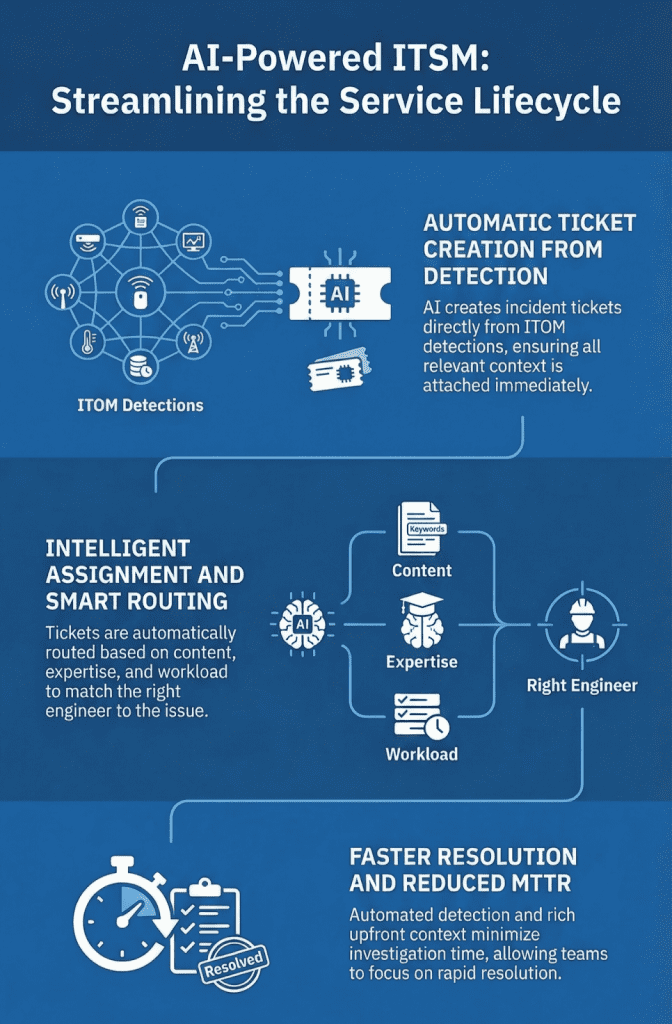
Automated ticket categorization and routing
The automation goes beyond simple keyword matching to understand context and intent. When a user submits a ticket stating “I can’t access the finance dashboard,” AI comprehends this refers to an access issue with a specific business application rather than a network connectivity problem or browser issue.
Intelligent routing takes this further by matching tickets with the most appropriate resolver based on multiple factors. AI analyzes agent expertise from past resolution histories, current workload levels, shift schedules, and even success rates with similar issues.
The system might route a complex database performance issue to a specialist who has successfully handled similar problems, while directing a password reset to any available tier-one agent. This optimization reduces resolution times while ensuring agents work on tasks that match their capabilities.
AI-powered virtual agents and chatbots
Modern AI assistants handle inquiries 24/7 across multiple languages, providing instant assistance regardless of time zones or service desk staffing levels. AI virtual agents also guide users through complex troubleshooting procedures with dynamic branching based on responses to diagnostic questions. When users encounter authentication issues, the virtual agent can easily walk them through specific steps.
Integration with backend systems enables virtual agents to restart services, reset passwords, create user accounts, modify permissions, and execute other operational tasks while maintaining appropriate security controls. The agents learn from each interaction, improving their ability to understand user intent and provide accurate assistance.
Intelligent incident resolution
When incidents are submitted, AI-powered service management immediately correlates them with known issues, recent changes, and ongoing problems to identify root causes and appropriate solutions. The system accesses comprehensive knowledge bases to recommend specific remediation steps. Pattern recognition also enables AI to identify relationships between seemingly unrelated incidents.
If multiple users report slow application performance, the system recognizes these as symptoms of a single underlying issue rather than treating each as isolated problems. Undoubtedly, automated remediation represents the pinnacle of intelligent incident resolution, where AI systems detect issues and implement fixes without creating tickets or involving human agents.
Predictive issue detection and prevention
AI algorithms continuously analyze metrics from infrastructure components, applications, and services to establish baseline performance patterns and identify deviations indicating developing problems. Machine learning models trained on historical incident data recognize the warning signs that precede common failures, enabling preventive action before user impact occurs.
Benefits of Artificial Intelligence in ITSM
Faster resolution and reduced downtime
AI speeds up ITSM by automating categorization, routing, and first-line support, so tickets reach the right team sooner. From there, diagnostics shorten troubleshooting, and virtual agents finish common requests right away. As resolution time drops, downtime falls for both users and business workflows. On top of that, early warnings for hardware and capacity issues shift work into planned maintenance instead of surprise outages.
Lower operational costs
AI cuts costs by handling routine demand at scale, which keeps service levels steady as ticket volumes grow. At the same time, guided recommendations help junior agents resolve tougher issues, which reduces reliance on senior staff. Beyond labor, predictive maintenance prevents incidents that trigger overtime and emergency response work. Over time, fewer outages also reduce business disruption costs that are outside the IT budget.
Better decision-making with AI insights
AI analytics move reporting past monthly dashboards by surfacing trends and drivers hidden in day-to-day tickets. With forecasting, teams can adjust staffing, automation, and training before backlogs build. Then, pattern analysis highlights repeat escalations and multi-contact issues, pointing to where knowledge and workflows need updates. Since these insights can be explored through natural language queries, more stakeholders can act on data faster.
Scalable and consistent service delivery
Traditional ITSM hits limits as volumes rise because humans face constraints around time and attention. AI-powered ITSM changes that by serving many users at once through virtual agents and automated routing, while models improve as more data comes in. As a result, service quality stays steady during spikes, mergers, or seasonal surges. That consistency also reduces variation between agents and makes service level management easier.
Common AI in ITSM Use Cases
Service desk automation
AI-led service desk automation shifts first contact and fulfillment into automated flows, reducing handoffs while keeping context intact as issues move forward. Virtual agents handle routine needs, while backend workflows carry requests through checks, approvals, and execution. When human agents step in, AI adds context and guidance to keep resolution moving.
- Virtual agents address common requests through conversational input
- Automated workflows manage approvals, licensing checks, and fulfillment steps
- Agent assist surfaces history, similar cases, and suggested responses
Incident and problem management
AI accelerates incident handling by spotting issues early and linking related reports into a single thread. Diagnostic analysis then narrows root causes faster by comparing live conditions with past patterns. Over time, recurring signals point problem teams toward permanent fixes.
- Early anomaly detection creates incidents before user impact spreads
- Correlation groups related tickets around shared root causes
- Pattern analysis highlights repeat issues needing long-term correction
Change risk prediction
AI brings structure to change evaluation by scoring risk based on data rather than individual judgment. It reviews dependencies, past outcomes, and timing factors to flag changes needing extra care. If conflicts appear, the system suggests safer sequencing.
- Risk scoring draws from configuration relationships and change history
- Impact analysis highlights systems and services tied to each change
- Collision detection flags overlapping changes with shared dependencies
Asset and capacity optimization
AI keeps asset records current through continuous discovery while surfacing waste tied to idle resources. Usage trends then feed forecasts that guide capacity planning ahead of demand spikes. In cloud environments, the same analysis highlights spend reduction paths.
- Continuous discovery maintains accurate hardware and software inventories
- Forecasting models project future resource demand from usage trends
- Cloud analysis identifies rightsizing and commitment opportunities
AI in ITSM Process Flow
Data collection and analysis
AI in ITSM starts by pulling data from monitoring tools, service desk records, CMDBs, and change systems so analysis reflects both operations and service context. That data then gets normalized and enriched by fixing duplicates, gaps, and mismatched fields, while linking incidents to assets and recent changes. With real-time streams layered in, AI can spot anomalies as they occur, correlate related signals quickly, and trigger fast remediation when suitable.
Pattern recognition and learning
AI learns by scanning historical tickets, system signals, and outcomes to find repeatable relationships between events and impact. As it processes new cases, successful fixes increase confidence for similar scenarios, while failed attempts adjust future recommendations. Unsupervised learning also groups similar incidents and flags unusual sequences, which helps teams find hidden trends or risks earlier.
Automated actions and recommendations
AI turns detection into action by running predefined remediation steps if known conditions appear, such as restarting services or clearing capacity pressure, while keeping an audit trail for review. In case a scenario needs human judgment, it supports agents with relevant knowledge, similar past cases, and guided diagnostics, and it supports approvers with risk and impact signals. Feedback loops then tune what gets suggested, so high-value guidance rises and low-value guidance fades.
Continuous improvement through AI models
AI models stay useful by retraining as environments, applications, and user behavior change, so predictions and recommendations remain aligned with current operations. Performance tracking spots drift through metrics like forecast accuracy, user satisfaction, and time saved, which drives targeted fixes in data, logic, or retraining cycles. As confidence grows, teams expand from early wins like ticket categorization into advanced areas such as predictive maintenance, change risk scoring, and capacity optimization.
Types of AI Used in ITSM
Machine Learning (ML)
ML powers many ITSM functions by learning from past tickets and operational data to classify issues, estimate resolution time, and recommend fixes. Supervised models learn from labeled history, while unsupervised methods cluster similar incidents and flag anomalies teams might miss. Reinforcement learning can also improve automated remediation by learning which actions lead to better outcomes in changing conditions.
Natural Language Processing (NLP)
NLP helps ITSM tools understand ticket text, chats, and emails so intent, apps, and error details get extracted from everyday language. That reduces reliance on rigid category forms and improves routing and prioritization. Sentiment detection adds another layer by spotting urgency or frustration, and language generation produces usable replies and summaries for users and agents.
Generative AI in ITSM
Generative AI creates new content on demand, which supports documentation and troubleshooting work that used to depend on manual effort. It can draft knowledge articles from resolved tickets, update and translate content, and adapt explanations for different audiences. For unusual issues, it can suggest diagnostic paths and potential causes by reasoning across system details and prior signals.
AIOps for IT Operations Management
AIOps applies AI to operational telemetry by pulling logs, metrics, and alerts into a unified view and correlating related events to cut noise. Predictive models then flag risks like failures or capacity strain early, giving teams time to act. When issues match known runbooks, automated remediation can trigger responses like restarts, scaling, or scripted fixes to reduce resolution time.
Best Practices for Implementing AI in ITSM
Start with high-impact use cases
- Pick early use cases tied to visible pain points like password resets, ticket categorization, and FAQ chat support
- Choose areas with enough historical data so outputs hit usable accuracy from day one
- Define success measures upfront, such as ticket deflection, faster routing, or shorter resolution time
- Use early wins to build adoption and expand into harder workflows in phases
Ensure data quality and governance
- Audit and clean core sources first, including tickets, CMDB records, and change data
- Standardize fields and naming rules, then enforce them at entry to reduce inconsistency
- Assign data ownership and track quality metrics so drift gets caught early
- Apply access controls, encryption, and privacy handling for sensitive and regulated data
Align AI with ITSM goals
- Align each initiative to a service outcome like cost per ticket, SLA performance, or user satisfaction
- Integrate AI into existing workflows and ITIL-aligned processes so adoption stays manageable
- Define business KPIs alongside model metrics so value is judged by service results
- Prioritize use cases based on impact and operational readiness, then sequence rollout accordingly
Monitor, train, and optimize AI models
- Track performance signals such as prediction accuracy, automation success, and recommendation uptake
- Retrain on a cadence that matches change velocity in apps, users, and infrastructure
- Feed errors and user feedback into iteration cycles to keep recommendations useful over time
How Infraon Enables AI-Powered ITSM
Intelligent ticket handling and automation
Infraon uses NLP to read requests from any channel, extract intent and key details, then auto-categorize, prioritize, and route tickets based on skill, workload, and past outcomes. Routine requests can trigger workflows for resets, provisioning, and access changes, with status updates sent back through the user’s chosen channel.
For tickets that need an agent, Infraon surfaces relevant knowledge, similar resolved cases, and suggested diagnostic steps to speed resolution and keep handling consistent across the team.
AI-driven insights for IT teams
Infraon analytics unearth trends in incident volume, emerging issue clusters, and capacity pressure early, so that teams can act before impact spreads. Real-time dashboards highlight anomalies and cost drivers across services and apps, guiding resource and improvement choices.
For recurring issues, correlation and root-cause support connects symptoms to shared factors such as recent changes or common system conditions.
Scalable AI capabilities built into ITSM
Infraon supports a phased rollout, starting with categorization and workflow automation, then expanding into predictive analytics and deeper automation as teams gain comfort. Virtual agents and automated ticket processing handle high concurrency and volume spikes while keeping response quality consistent.
Integrations with monitoring, CMDB, and asset systems bring richer context into decisions by unifying operational signals and service records.
Supporting ITSM Transformation with Artificial Intelligence in ITSM
Infraon helps teams move from reactive handling to predictive operations by pairing automated detection with analytics-driven prioritization. As repetitive work shifts into automation, service desk time moves toward complex troubleshooting and service improvement work.
Ongoing model training and interaction learning keep recommendations, virtual agents, and insights improving as more operational data and outcomes flow through the platform.
Final Thoughts
Effective Artificial Intelligence in ITSM requires thoughtful implementation grounded in clear objectives, high-quality data, and continuous optimization. As Artificial Intelligence in ITSM continues to mature and organizations gain experience, its transformative potential will expand to support increasingly advanced and sophisticated applications.
The future of IT service management will also be defined by intelligent systems that predict and prevent problems, automate routine work, and provide insights that drive continuous improvement. Those embracing AI-powered ITSM position themselves to meet rising service expectations while maintaining operational excellence and cost discipline. The question facing organizations today is how quickly they can implement these transformative capabilities to remain competitive in an increasingly digital world.