



For enterprises operating across Malaysia’s key economic corridors, the Klang Valley, Penang Technology Park, and Iskandar Malaysia in Johor, managing distributed IT assets without a centralized system creates compounding risk.
The hidden cost of unmanaged IT assets in Malaysian enterprises
Here is what happens when assets go untracked:
- Hardware assets are misplaced during office relocations or workforce changes. For example, a laptop valued at RM5,000 is unaccounted for, with no record indicating its last custodian. Replacement expenditures directly impact IT budgets.
- Software licenses are acquired in excess. One business unit procures 100 Microsoft 365 licenses, while another acquires an additional 50. Both operate independently. The organization pays for 120 licenses, though only 100 are actively utilized.
- Outdated assets remain operational beyond their intended lifecycle. A server continues functioning for eight years post-warranty. Performance gradually deteriorates, unnoticed, until total system failure occurs. Emergency replacement expenses significantly surpass planned budgets.
- Maintenance contracts renew automatically. No one checks if the equipment still exists. The enterprise pays RM10,000 annually for support on decommissioned storage arrays.
These expenses are concealed within operational budgets, lacking explicit waste classification. They are distributed across hardware allocations, software investments, and maintenance portfolios. Only a comprehensive asset management platform exposes these inefficiencies.
Pain Points Faced By IT Managers Every Day in Malaysia
Before evaluating any asset tracking system, consider the specific operational frustrations that drive Malaysian IT leaders to seek a better solution. In conversations with enterprise clients across the BFSI, telecommunications, and manufacturing sectors in Malaysia, four pain points surface consistently.
No single source of truth across multiple locations
The Penang office maintains asset records in spreadsheets; the Johor office employs a separate approach. The Kuala Lumpur headquarters operates an outdated tracking solution. When determining the total laptop inventory across sites, the process requires three days and remains inaccurate.
Software license compliance is a ticking clock
Your organization undergoes biannual audits, necessitating the collection of license documentation from multiple disparate systems. Some licenses are underutilized, reflecting excess investment. Others are overdeployed, representing compliance risks. The uncertainty of over-deployment persists, and an unexpected vendor audit could incur substantial financial penalties.
Reactive IT instead of preventive management
A network switch malfunctions, prompting the IT team to locate a replacement urgently. No proactive tracking of lifecycle or warranty expiration was performed. Replacement delivery occurs in three days, resulting in two days of operational downtime. Preventive asset management would have eliminated such disruptions.
Audit readiness consumes disproportionate resources
Senior engineers devote two weeks before each audit to consolidate asset data across five systems, reconciling discrepancies manually and preparing reports for auditors. This equates to RM10,000 per audit, with four audits annually costing RM40,000. These resources could be strategically reallocated.
The Competitive Landscape: Asset Management Software in Malaysia
Malaysian enterprises assessing asset management solutions encounter several product categories. Clear differentiation supports CIOs in making more informed, strategic decisions when selecting a shortlist.
| Solution Type | Typical Fit & Limitations |
| Infraon Assets | Built for Malaysian enterprises needing unified asset and ITSM. Delivers discovery, lifecycle management, and compliance reporting in one platform. |
| SAP or Oracle ERP Modules | Strong for financial asset tracking but weak for IT specific needs like software license management and automated discovery. Requires significant customization. |
| HashMicro (Malaysia local) | Good for basic asset tracking in smaller organizations. Limited scalability for enterprises with 1,000 plus employees across multiple locations. |
| ServiceNow ITAM | Enterprise grade but expensive. Implementation timelines often exceed six months. Better suited for global deployments with large budgets. |
| EZOfficeInventory or AssetCloud | Affordable for small teams. Lacks enterprise features like agentless discovery, BI dashboards, and ITSM integration. Not designed for Malaysian regulatory requirements. |
What Malaysian CIOs Should Look for in an Asset Management System
When evaluating an asset tracking system for an enterprise environment in Malaysia, the evaluation criteria should extend beyond feature checklists. Here is what matters at scale.
Real-time asset discovery across your entire environment
Manual asset tracking fails at enterprise scale. Employees add devices. Contractors bring equipment. Virtual machines spin up and down. A spreadsheet cannot keep pace. Your asset management system must discover assets automatically, using both agent-based for deep visibility and agentless for network-wide scanning.
Hardware and software lifecycle management in one platform
Separate tools for hardware and software create blind spots. A server nearing the end of its life needs a replacement budget. The software running on that server needs license verification. Both decisions belong together. One platform gives you the complete picture.
ITSM integration for connected IT operations
An asset management system that does not talk to your ITSM tool creates duplicate work. Incident tickets should pull asset configurations automatically. Change requests should update asset records automatically. Problem investigations should reference asset history automatically. Infraon Assets delivers this integration natively.
Audit-ready reporting out of the box
Auditors require clear reports. The system must generate compliance reports automatically, including software license summaries, hardware warranty statuses, and asset location registers, making audit preparation easier and faster.
Scalability across locations and asset types
Your asset management system should be able to support growth by scaling to handle more locations, asset types, users, and compliance requirements, ensuring that your enterprise’s expanding needs are met seamlessly.
How Infraon Assets Solves These Challenges for Malaysian Enterprises
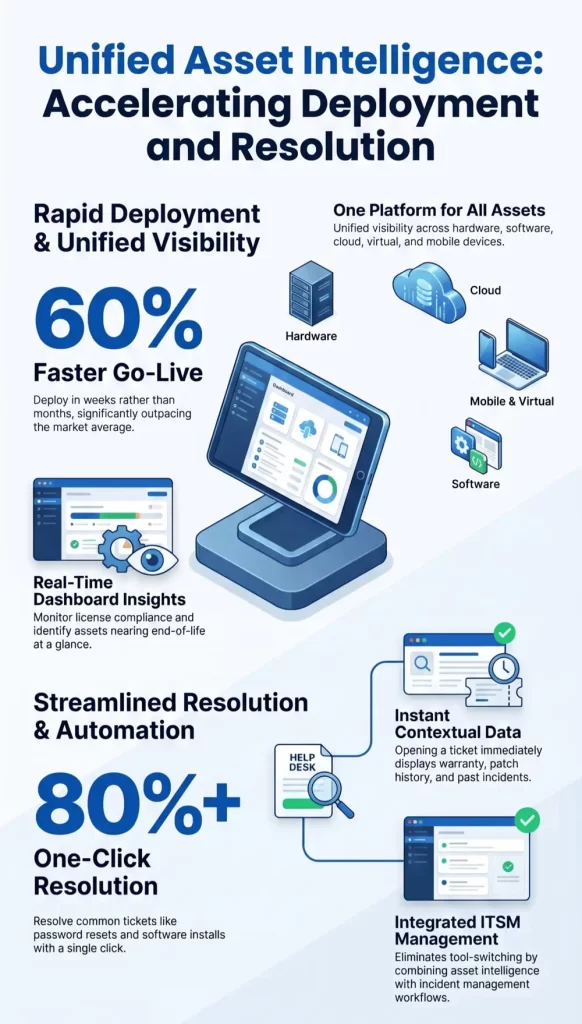
Deploy in weeks, not months
Infraon’s implementation approach delivers go live 60% faster than the market average. Malaysian IT teams become operational and gain value within weeks, not quarters. This is a material commercial advantage when business transformation timelines are tight.
One platform for all asset types
Infraon Assets provides a unified platform where hardware assets, such as servers, laptops, and network switches, are tracked alongside software assets like licenses, applications, and subscriptions, as well as cloud resources, virtual machines, and mobile devices. This comprehensive view eliminates the need to switch between different tools, streamlining asset management and decision-making.
Agent-based and agentless discovery
Infraon supports both agent-based and agentless discovery, allowing organizations to choose the approach that fits their environment. Agent-based discovery provides detailed configuration data for Windows servers, while agentless scanning covers network devices. The flexibility ensures complete asset visibility regardless of technical constraints.
Built-in BI and dashboard-driven insights
Infraon Assets features business intelligence tools and real-time dashboards, which enable IT teams to quickly assess license compliance, identify assets nearing end-of-life, and visualize hardware distribution across locations. These insights help IT teams to focus on decisions rather than building manual reports.
Integrated ITSM and incident management
When an incident ticket is opened for a laptop, Infraon Assets automatically displays relevant information such as warranty status, installed software, patch history, and previous incidents. This immediate access to context helps engineers resolve incidents more quickly.
80% plus ticket resolution in one click
Infraon’s integration between asset data and incident workflows enables quick resolution for common problems. Tickets for password resets, software installations, or hardware replacements automatically check relevant asset and user details, speeding up resolution times and reducing manual steps.
The Business Case: What Malaysian Enterprises Can Expect
CIOs building the internal business case for an asset management system investment will need to quantify return.
Documented ROI outcomes of Infraon Assets

Enterprises using Infraon Assets typically achieve these results:
- 75% increase in asset efficiency: The same number of assets deliver more value because they are tracked, maintained, and replaced on schedule.
- 40% reduction in software license spends: Duplicate purchases stop. Over-deployment penalties disappear. True-ups happen only when actually needed.
- 60% faster audit preparation: Reports are generated in minutes instead of weeks. Engineer time redirects from audit survival to strategic projects.
- 50% lower hardware procurement costs: End-of-life planning replaces emergency purchasing. Volume buying replaces last-minute markups.
Industry Specific Considerations for Malaysian Enterprises
Banking and Financial Services (BFSI)
Bank Negara Malaysia requires strict IT asset controls. Every device accessing customer data must be tracked. Every software license must be compliant. Every hardware disposal must follow security protocols. Infraon Assets delivers audit trails for all asset movements and changes.
Telecommunications
Telcos manage thousands of assets across tower sites, data centers, and customer premises equipment. Location tracking becomes essential. Infraon Assets maps assets to physical locations automatically. Field teams find equipment faster. Inventory accuracy improves dramatically.
Manufacturing and industrial
Factory floor assets include specialized equipment with unique maintenance schedules. Infraon tracks maintenance history, warranty dates, and spare parts inventory. Planned maintenance replaces reactive breakdowns. Production uptime improves.
Government Linked Companies (GLCs)
GLCs face procurement audits and asset disposal regulations. Every asset purchase must be justified. Every disposal must be documented. Infraon Assets creates complete provenance records from acquisition to retirement.
Quick Comparison: Key Evaluation Criteria
| Evaluation Criteria | What Infraon Assets Delivers |
| Deployment Speed | Go live in weeks, 60% faster than traditional enterprise solutions |
| Asset Type Coverage | Hardware, software, cloud, virtual, and mobile assets in one platform |
| Discovery Approach | Agent based and agentless options available simultaneously |
| ITSM Integration | Native integration with Infraon ITSM and open APIs for other platforms |
| Compliance Reporting | Audit ready reports for software licenses, hardware warranties, and asset locations |
| Scalability | Supports thousands of assets across hundreds of locations |
| Total Cost of Ownership | Transparent subscription pricing with no hidden implementation fees |
| Support Model | Local support for Malaysian enterprises during business hours plus 24×7 global coverage |
| Certifications | SOC 2 certified and GDPR compliant platform |
Ready to Transform How Your Organization Manages IT Assets?
If your organization is in the consideration or decision stage of selecting an asset management system for your Malaysian operations, the next step is a structured evaluation, not another spreadsheet exercise.
Start Your Free Trial or Book a Personalized Demo
Visit: Infraon Assets
- No credit card required
- Ready-to-use automation
- Dedicated onboarding support
Frequently Asked Questions (FAQs)
What is asset management software, and why do Malaysian enterprises need it?
Asset management software tracks all IT assets throughout their lifecycle from purchase to disposal. Malaysian enterprises need it because manual tracking fails at scale. Lost hardware, non-compliant software, and unexpected replacement costs all disappear when assets are properly managed.
How is an asset tracking system different from a CMDB?
An asset tracking system focuses on financial and lifecycle information. Who bought the asset? How much does it cost? When the warranty expires. A CMDB focuses on configuration relationships. Which server runs which application? How network devices connect. Many enterprises need both. Infraon delivers asset tracking and can feed data to any CMDB.
How long does it take to implement asset management software for a large enterprise in Malaysia?
Implementation for a large enterprise typically takes four to eight weeks. Infraon customers often go live faster because of pre-built discovery templates and automated onboarding workflows.
Can the software manage both IT and non-IT assets?
Yes. Infraon Assets manages any asset type: IT assets like servers and laptops, office assets like furniture and projectors, as well as facility assets like HVAC systems and security cameras. All this happens on the same platform.
How does asset management software help with software license compliance in Malaysia?
The software discovers all installed software across your network. It compares installations against purchased license quantities. It flags over-deployment and under-deployment automatically. Audit reports are generated on demand.
Is Infraon Assets suitable for industries regulated by Bank Negara Malaysia or other Malaysian authorities?
Yes. Infraon Assets maintains complete audit trails for all asset changes. The platform supports regulatory reporting requirements for BFSI, telecommunications, and GLC sectors.
What happens after we go live? Is there ongoing support?
Ongoing support includes system monitoring, security updates, and technical assistance. Infraon provides dedicated customer success managers for enterprise clients. Regular health checks ensure the system continues to deliver value.