


What Is IT Change Management?
IT change management refers to the disciplined handling of modifications made to production IT systems, services, and infrastructure. These modifications may involve software releases, configuration updates, infrastructure upgrades, or policy adjustments. The goal centers on reducing service disruption while keeping accountability, traceability, and governance intact throughout the change journey.
Within IT service management, change management functions as a control mechanism for operational risk. Every request passes through defined evaluation, approval, execution, and review steps. This ensures system updates happen in a controlled manner, with visibility into ownership, timing, impact, and outcomes.
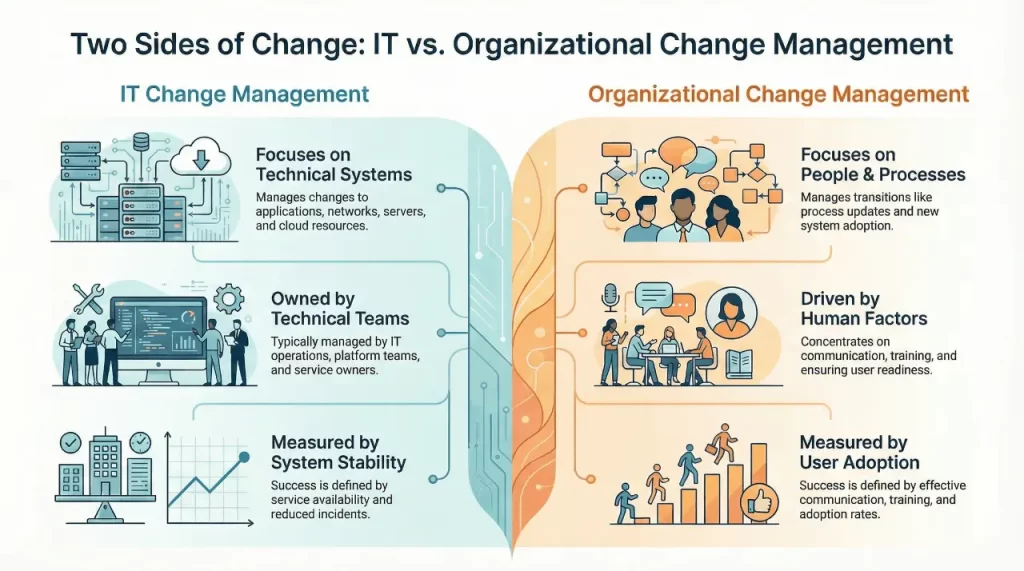
IT change management vs. organizational change management
IT change management focuses on technical changes within IT environments such as applications, networks, servers, and cloud resources. Ownership typically rests with IT operations, platform teams, and service owners. Success gets measured through service availability, incident reduction, and operational reliability.
Organizational change management addresses people-focused transitions such as process updates, role changes, or adoption of new business systems. It concentrates on communication, training, and adoption readiness. While both disciplines manage change, their objectives, execution models, and success measures differ.
Why IT change management matters in ITSM
In ITSM, change management acts as a safeguard between operational stability and ongoing improvement. Uncontrolled system updates often lead to outages, security gaps, and prolonged recovery efforts. A formal change practice reduces such outcomes by enforcing review, approvals, and post-change evaluation.
Change records also connect closely with incidents, problems, and assets. This linkage helps teams trace service disruptions back to recent changes, improving root cause analysis and future decision-making.
Why IT Change Management Is Critical for Modern IT Teams
Impact on uptime, security, and compliance
Production systems face constant pressure from frequent updates, integrations, and infrastructure changes. Each modification carries operational risk when execution happens without formal monitoring. Change management reduces unplanned downtime by ensuring reviews happen before deployment, ownership stays defined, and rollback plans remain available when outcomes diverge from expectations.
Security posture also depends heavily on disciplined change handling. Unauthorized configuration updates, rushed patches, or undocumented fixes often introduce vulnerabilities. A controlled change process ensures security reviews, approval checkpoints, and audit trails remain intact for every modification. Compliance teams benefit from documented approvals, execution records, and post-change reviews that support regulatory audits and internal governance.
Relevance for enterprises in India, GCC, and SEA
Enterprises operating in India, GCC, and Southeast Asia often manage hybrid environments that include on-premises infrastructure, cloud services, third-party platforms, and outsourced operations. These environments increase coordination overhead during system updates. Change management brings order by aligning teams around shared approval flows, timelines, and accountability.
Regional enterprises also face sector-specific compliance expectations in banking, telecom, healthcare, and government services. A formal change discipline supports audit readiness by maintaining traceable records for system updates that affect customer data, service availability, or regulatory obligations.
IT Change Management Process: A Step-by-Step Approach
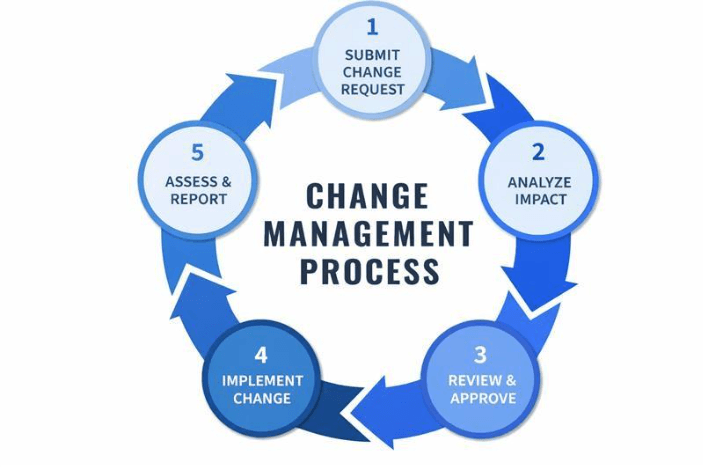
Change request initiation
The process begins when a request gets raised for a production system update. This request documents the purpose of the change, affected services, expected timelines, and responsible owners. Requests may originate from planned releases, infrastructure upgrades, security patches, or remediation work tied to prior incidents. Capturing this information early builds accountability from the start.
Risk and impact assessment
Once submitted, the change undergoes evaluation to assess potential service disruption, dependency impact, and operational exposure. Teams review affected applications, infrastructure components, and business services. Historical change outcomes and incident patterns often inform this assessment, helping teams decide whether the change warrants deeper scrutiny or fast-track handling.
Change Approval (CAB)
After assessment, the request moves through an approval workflow. Standard approvals may follow predefined rules, while higher-risk changes require CAB review. Approvers examine risk level, rollback readiness, timing, and resource availability before granting authorization. Approval decisions remain recorded against the change request for audit reference.
Change implementation
Approved changes proceed to execution based on the scheduled window. Tasks get assigned, progress updates recorded, and execution status tracked through completion. During this phase, teams monitor service health closely and trigger rollback plans if outcomes diverge from expectations.
Post-implementation review
After execution, teams conduct a review to assess results. This review captures success criteria, incidents triggered, deviations from plan, and lessons learned. Findings feed future assessments, helping reduce repeated issues and improve decision quality over time.
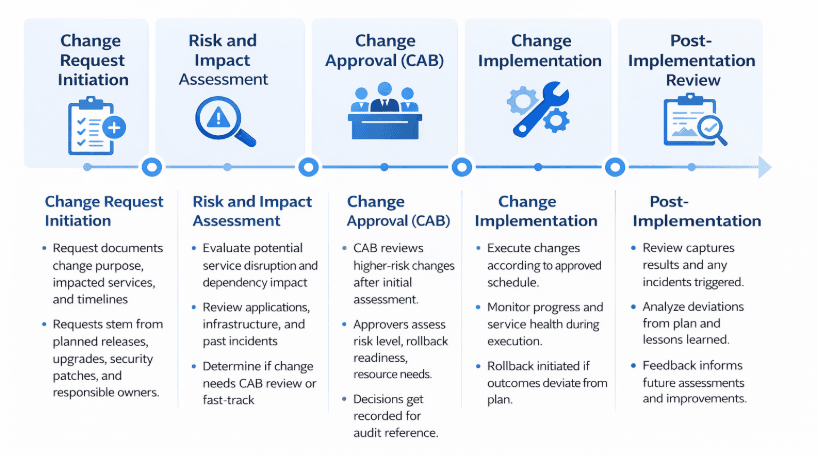
IT Change Management Lifecycle Explained
Standard changes
Standard changes cover low-risk, repeatable activities such as routine maintenance tasks or pre-approved configuration updates. These changes follow predefined workflows and approval paths, which reduces processing time while maintaining governance. Teams rely on documented procedures and historical success records to handle these changes with minimal overhead.
Normal changes
Normal changes apply to modifications that require assessment and authorization before execution. Examples include application upgrades, infrastructure expansion, or major configuration updates. These changes move through evaluation, approval, execution, and review stages, with insights from service owners and change advisory members based on risk level.
Emergency changes
Emergency changes address urgent issues that demand immediate action, such as security incidents or critical service outages. These changes bypass standard scheduling to restore service quickly. Even with accelerated handling, documentation, approvals, and post-execution reviews remain mandatory to preserve accountability and audit readiness.
IT Change Management Frameworks You Should Know
ITIL change enablement framework
The ITIL change enablement framework defines how organizations manage risk while introducing updates to live services. It classifies changes by risk and urgency, then assigns review paths, approval depth, and documentation expectations accordingly. This framework emphasizes accountability, traceability, and post-change learning rather than speed alone.
Within ITSM programs, ITIL supports alignment between change activities and service outcomes. It encourages teams to evaluate business impact, coordinate stakeholders, and record decisions so future changes benefit from prior outcomes.
How frameworks adapt to agile and DevOps
Modern delivery models demand faster release cycles and frequent updates. Change frameworks adapt by streamlining approvals for low-risk updates while retaining governance for higher-risk modifications. Automation plays a major role by routing approvals, tracking execution, and recording outcomes within delivery pipelines.
Rather than slowing delivery, these adaptations help teams balance velocity with operational control. The result involves faster releases backed by accountability, audit history, and service protection.
Real-World Examples of IT Change Management
Application deployment change
An enterprise plans a new version rollout for a customer-facing application. The change request captures release scope, impacted services, deployment timing, and ownership. Risk review highlights potential downtime during peak usage hours, leading teams to schedule deployment during a low-traffic window. After approval, the release proceeds with monitored execution and a post-release review to record performance and user impact.
Infrastructure upgrade change
A data center upgrade involves replacing legacy servers supporting internal systems. The change undergoes evaluation to identify dependent applications, backup readiness, and rollback requirements. CAB approval confirms sequencing and resource availability. Execution follows a phased approach to limit service disruption, with review records documenting performance outcomes and any corrective actions taken.
Cloud migration change
A business moves a workload from on-premises infrastructure to a cloud environment. The change process tracks asset dependencies, data transfer plans, and security checks. Approvals focus on risk exposure and compliance needs. After migration, teams review service performance, access controls, and incident trends to confirm expected outcomes.
IT Change Management Best Practices
Automate approvals and workflows
- Route change requests based on risk level, service impact, and urgency
- Reduce manual handoffs by using rule-driven approval paths
- Record approval decisions automatically for audit readiness
Maintain a centralized change calendar
- Track planned, ongoing, and completed changes in one shared view
- Prevent scheduling conflicts between dependent systems
- Improve coordination between operations, security, and application teams
Track change success metrics
- Measure success rates, rollback frequency, and incident correlation
- Identify recurring failure patterns over time
- Use outcome data to improve future change decisions
Align change with incident and problem management
- Link changes to related incidents and known issues
- Improve root cause identification after service disruptions
- Reduce repeat incidents tied to recurring system updates
Risks in IT Change Management
Poor impact analysis
When impact evaluation remains incomplete, changes affect dependent services in unexpected ways. Applications and infrastructure that rely on shared components experience outages after deployment, even though the change itself appeared isolated. Recovery takes longer because teams first need to identify what actually broke before remediation begins.
Manual approvals and delays
Approval processes that rely on emails or informal communication slow down planned releases. Urgent fixes often move forward under time pressure, which increases operational exposure. Ownership gaps also emerge when decision records stay scattered, making accountability difficult during post-change reviews.
Lack of visibility and audit trails
If execution history is fragmented, teams struggle to trace which change triggered a service disruption. Investigations take longer, audit reviews become painful, and confidence in change outcomes erodes over time.
How Infraon ITSM Helps Simplify IT Change Management
Infraon ITSM brings change handling into the same operational system used for incidents, problems, assets, and service requests. This removes dependency on email threads and external tools during evaluation, approval, and execution. Change records remain connected to the services and assets they affect, which supports informed decisions and faster follow-through.
Infraon ITSM focuses on consistency and traceability throughout the change lifecycle. From request creation to post-implementation review, every action stays logged within the system. Teams gain shared visibility into schedules, ownership, approvals, and outcomes, which reduces friction during reviews and audits.
Automated change workflows and approvals
Infraon routes change requests through predefined workflows based on risk level, urgency, and service impact. Approval paths adjust automatically, reducing delays caused by manual routing. Decision history remains captured within each change record for governance and review.
Risk scoring and impact analysis
The system evaluates risk using linked services, affected assets, historical outcomes, and related incidents. This helps teams understand potential exposure before execution begins. Risk indicators remain visible during approval and execution stages to support informed decisions.
Integrated incident, problem, and change views
Changes stay linked to incidents and problems that triggered or followed them. Teams reviewing outages or service degradation can trace recent changes quickly. This connection improves root cause analysis and reduces repeated failures caused by similar updates.
Audit-ready reporting and dashboards
Infraon generates reports covering approval timelines, change success rates, failed executions, and rollback activity. These reports support internal reviews and regulatory checks without manual data collection. Dashboards provide real-time insight into upcoming and completed changes for operational teams.
Frequently Asked Questions on IT Change Management
What is the IT change management process?
The IT change management process covers how production system updates move from request to review. It includes request submission, evaluation, approval, execution, and post-implementation review. This process helps teams manage risk while maintaining accountability for system updates.
What are the types of IT changes?
IT changes typically fall into three categories. Standard changes cover low-risk, repeatable updates with predefined approval paths. Normal changes require assessment and authorization before execution. Emergency changes address urgent issues that demand immediate action, followed by documented review.
How is IT change management different from change control?
IT change management governs the full lifecycle of a system update, from request through review. Change control focuses on approval and authorization activities within that lifecycle. Change management provides broader insights, while change control operates as one step within it.
Which tools are used for IT change management?
IT change management tools form part of ITSM platforms. These tools support request tracking, approval workflows, execution tracking, reporting, and audit history. Integrated platforms link changes with incidents, problems, and assets for better operational monitoring.