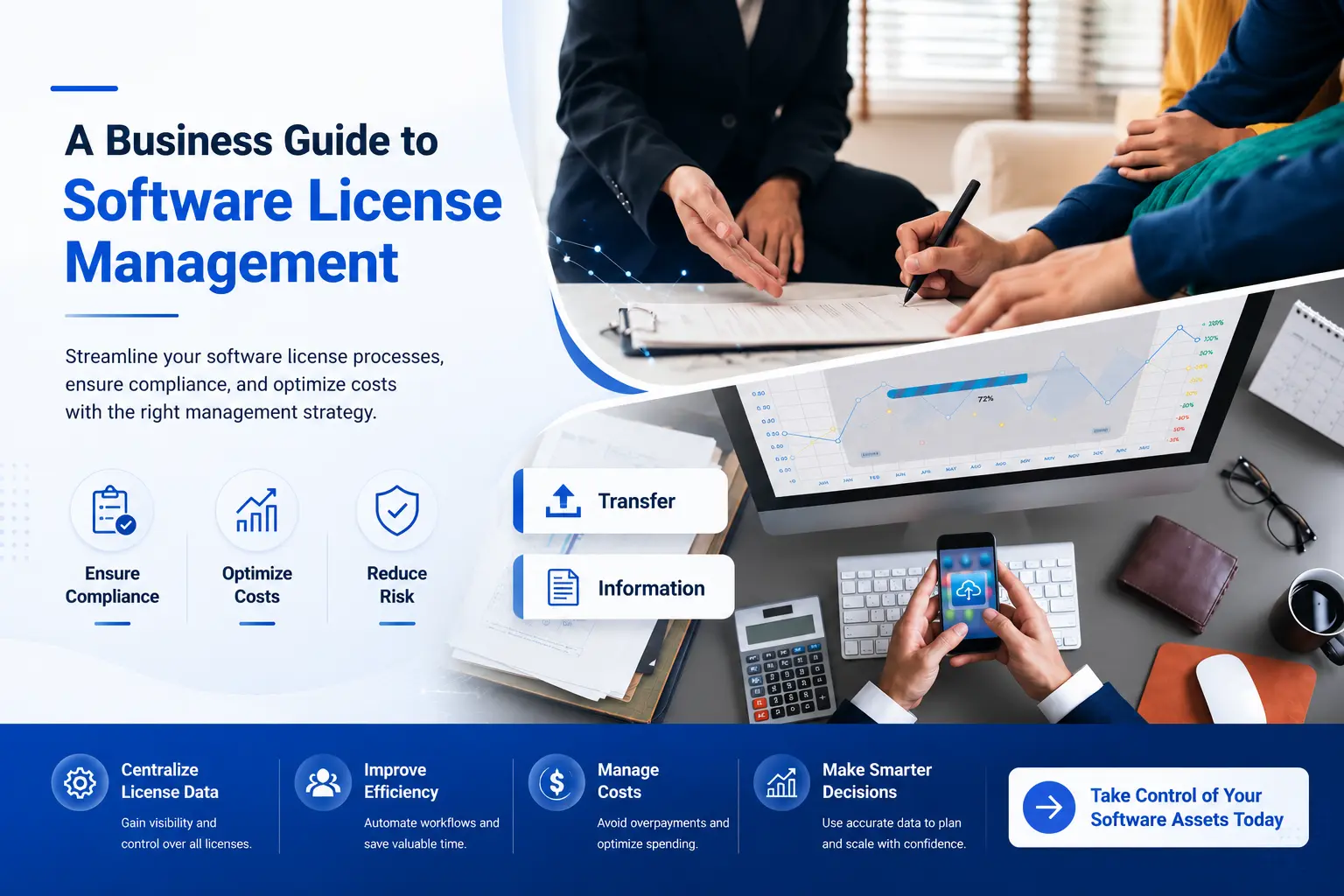



Software license management (SLM) is the relentless process of tracking, documenting, and optimizing your organization’s software licenses throughout their lifecycle from purchase to renewal to retirement. SLM is like a financial ledger for every piece of software your team uses. Without it, you guarantee unnecessary spend, audit failures, and exposure to unlicensed copies.
Types of software licenses you need to track in 2026
Modern IT environments include various license types, each with specific rules. A proper SLM tool tracks them all.
- Perpetual licenses never expire but require maintenance tracking
- Subscription licenses renew regularly
- Volume licenses offer bulk discounts but require careful allocation
- Concurrent licenses limit users. Trial licenses may expire or become paid
Why software license management matters for IT teams in India, UAE and Southeast Asia
Regulatory compliance is tightening across these regions. India’s IT Act and data localization rules, the UAE’s Cybercrime Law, and Malaysia’s Personal Data Protection Act all demand accurate software inventories. Additionally, foreign software vendors conduct audits more aggressively in high-growth markets. One unlicensed installation can trigger fines and reputational damage. SLM turns this risk into a managed process.
What to Look for in a Software License Management Tool
Not all software license management tools are built the same. Before shortlisting options, make sure your chosen tool checks these boxes.
- Real-time license visibility – Can you see all licenses, their usage status, and expiry dates from a single dashboard? Spreadsheets go stale within days.
- Usage monitoring and metering – Does it track actual usage (not just license allocation) to help you identify idle or underused seats? Allocation without usage data leads to waste.
- Compliance and audit readiness – Will it flag non-compliant software and generate audit-ready reports at the click of a button? Manual audit prep takes weeks.
- Automated renewal alerts – Does it send proactive notifications before contracts expire? Missing a renewal deadline can mean price hikes or service interruptions.
- Integration ecosystem – Does it connect with your existing ITSM, HRMS, or procurement systems? Siloed data defeats the purpose of license management.
Quick Comparison of the 8 Best Software License Management Tools
| Tool | Best For | Standout Feature | Free Trial |
|---|---|---|---|
| Infraon | All-in-one ITAM + License Management for mid-market and enterprise | Centralized ITAM with real-time license visibility + ITSM integration | Yes |
| Zluri | SaaS-heavy enterprises | Automated SaaS discovery and license optimization | Yes |
| ManageEngine AssetExplorer | Budget-conscious IT teams | Full-featured ITAM at low cost | Yes (30 days) |
| ServiceNow SAM | Large enterprises already on ServiceNow | Native SAM Pro module with CMDB integration | Contact sales |
| Ivanti License Optimizer | Complex licensing environments (Microsoft, Adobe) | Advanced license reconciliation and reharvesting | Yes |
| Snow License Manager | Mid-to-large orgs needing deep analytics | SnowGrid technology for cross-platform usage data | Yes |
| Flexera FlexNet Manager | Enterprise-grade SAM with compliance depth | Entitlement management and audit defense | Demo only |
| AssetSonar | SMBs managing hardware + software together | Cloud-based asset lifecycle with license tracking | Yes (14 days) |
8 Best Software License Management Tools in 2026 – Reviewed and Ranked
1. Infraon – Best all-in-one ITAM with built-in license management
Infraon Assets is a fully integrated ITAM solution with a dedicated software license management module built right in. It gives IT teams across India, Southeast Asia, and the Middle East real-time visibility into their software estates without the complexity that comes with enterprise-only platforms.
Key features:
- Centralized license tracking dashboard: manage all licenses (perpetual, SaaS, volume, trial) from one place
- Real-time visibility into license allocations, expiry dates, purchase counts, and availability
- Compliance tracking with automated alerts to flag non-compliant or expiring licenses
- ITSM integration for streamlined license request and ticketing workflows
Best for:
Mid-market to enterprise IT teams (200–5000 employees) looking for an integrated ITAM platform with strong license management capabilities. It is especially suited for organizations in India, the UAE, and Southeast Asia that need compliance tracking alongside cost control.
Rating – G2 4.6/5, Gartner Peer Insights 4.4/5
2. Zluri – Best for SaaS-heavy enterprises
Zluri specializes in SaaS discovery and management, connecting to your SSO provider, finance systems, and APIs to map every SaaS application. Shadow IT is made visible instantly.
Key features:
- Automated SaaS discovery across 200,000+ apps
- License usage analytics to identify inactive users
- Renewal calendars with contract optimization suggestions
- App recommendation engine for right-sizing subscriptions
Best for:
Zluri works for fast-growing tech companies and digital-native businesses with more than 50 SaaS subscriptions and limited visibility into employee-driven purchases.
3. ManageEngine AssetExplorer – Best budget-friendly option
ManageEngine AssetExplorer offers ITAM at an affordable price for small and mid-sized teams. It features software license management, hardware tracking, purchase order management, and contract administration.
Key features:
- License reconciliation between purchase records and discovered installations
- Compliance dashboard with automated alerts
- Integration with ServiceDesk Plus for ticketing
- On-premise or cloud deployment options
Best for
It is ideal for organizations already using other ManageEngine products, and for teams with limited budgets but serious compliance needs.
4. ServiceNow SAM – Best for large enterprises already on ServiceNow
ServiceNow Software Asset Management (SAM) is a native module within ServiceNow, using the platform’s configuration management database (CMDB) to provide a unified truth for hardware, software, and services.
Key features:
- Native CMDB integration for automatic license alignment
- Software normalization to handle different versions and editions
- Entitlement management with direct procurement feeds
- Automated software removal for non-compliant installations
Best for:
Enterprises with an existing ServiceNow investment, typically 5,000+ employees, that want to avoid point solutions and keep everything inside one workflow engine.
5. Ivanti License Optimizer – Best for complex licensing environments
Ivanti License Optimizer handles complex licensing scenarios, especially for Microsoft, Adobe, and VMware. It deeply discovers and reconciles usage against entitlements for optimization opportunities.
Key features:
- License re-harvesting from idle or underused installations
- True-up calculations for enterprise agreements
- Contract repository with expiry tracking
- Role-based dashboards for procurement and finance teams
Best for:
It is a good fit for organizations with multiple geographic locations and complex volume agreements.
6. Snow License Manager – Best for mid-to-large orgs with deep analytics needs
Snow License Manager uses a distributed SnowGrid architecture to collect usage data throughout your network. Its analytics engine turns that data into actionable insights about waste, risk, and opportunities.
Key features:
- SnowGrid technology for agent-based and agentless discovery
- Publisher-specific compliance rules for 8,000+ software vendors
- Cloud, on-premise, and hybrid deployment support
- What-if analysis for license pool changes
Best for:
Snow is strong for mid-to-large organizations (1,000–50,000 users) that need granular usage metrics for vendor negotiations.
7. Flexera FlexNet Manager – Best for enterprise-grade SAM with compliance depth
Flexera FlexNet Manager leads in enterprise software asset management, addressing rigorous compliance for IBM, Oracle, and SAP licensing where risks are high.
Key features:
- End-to-end entitlement management from contract to installation
- Advanced license reconciliation with app-to-app dependency mapping
- Automated true-up reporting for major publishers
- Integration with Flexera’s IT visibility and cloud cost tools
Best for:
FlexNet Manager is the tool of choice for global enterprises with thousands of applications and high-stakes vendor audits.
8. AssetSonar – Best for SMBs managing hardware + software together
AssetSonar is a cloud asset management platform that includes software license tracking. Its simple interface suits smaller teams without dedicated SAM analysts.
Key features:
- Barcode and QR code scanning for hardware-software associations
- License pool management with check-in/check-out functionality
- Pre-built reports for compliance and budget planning
- Integration with Jira, Slack, and Zapier
Best for:
AssetSonar is popular with IT teams that manage remote or field equipment.
Head-to-Head Comparison: 8 Software License Management Tools (2026)
| Feature | Infraon | Zluri | ManageEngine | ServiceNow | Ivanti | Snow | Flexera | AssetSonar |
|---|---|---|---|---|---|---|---|---|
| License Tracking | Yes | Yes | Yes | Yes | Yes | Yes | Yes | Yes |
| SaaS Discovery | Limited | Yes | Limited | Yes | Limited | Yes | Yes | No |
| On-Premise Support | Yes | No | Yes | Yes | Yes | Yes | Yes | No |
| ITSM Integration | Yes | Limited | Yes | Yes | Yes | Limited | Yes | Limited |
| Compliance / Audit Ready | Yes | Limited | Yes | Yes | Yes | Yes | Yes | Limited |
| Free Trial | Yes | Yes | Yes | No | Yes | Yes | No | Yes |
| Implementation Effort | Medium | Low | Medium | High | High | Medium | High | Low |
| G2 Rating | 4.6 | 4.5 | 4.3 | 4.4 | 4.2 | 4.5 | 4.5 | 4.3 |
5 Costly Mistakes IT Teams Make with Software License Management
Mistake 1: Relying on spreadsheets for license tracking
Spreadsheets lack alerts, real-time sync, and audit trails. One accidental deletion or missed update can break compliance, leading to wasted time reconciling versions instead of optimizing costs.
Mistake 2: Ignoring license expiry and renewal dates
Vendors often increase renewal prices by 5–10 percent each year. Missing a notification window locks you into unfavorable terms. Worse, an expired license for a critical tool can halt operations.
Mistake 3: Confusing license allocation with actual usage
Just because you assigned a license to an employee does not mean they use it. Many teams pay for hundreds of “active” seats that have not been launched in months. Usage metering exposes this waste.
Mistake 4: Failing to track SaaS and subscription licenses
Perpetual licenses live on-premise. SaaS lives in a browser. If your SLM tool ignores either category, you only see half the picture. Shadow SaaS purchases bypass IT entirely and create unknown risk.
Mistake 5: Waiting for an audit to test your compliance
Audits come with tight deadlines and penalties for errors. Proactive compliance checks throughout the year turn a panic into a routine sign-off. The cost of fixing non-compliance after an audit notice is ten times higher.

10 Questions to Ask Before Buying a Software License Management Tools
- Does the tool discover software on every device, including remote laptops and virtual machines?
- How does it handle license reconciliation when a single computer has multiple installations?
- Can it differentiate between free, trial, and paid licenses automatically?
- What reports can it generate for a software vendor audit?
- Does it support the license models you actually use, such as concurrent, named user, or floating?
- How are renewal alerts delivered? Email, dashboard, or both?
- Can you set custom thresholds for compliance warnings, for example, 90 percent utilization?
- What integrations exist with your HRMS to offboard licenses when employees leave?
- Is the tool cloud-native, on-premise, or hybrid? Which fits your data policy?
- What is the cost after the first year, including support and updates?
Software License Management Best Practices for 2026
Start with a complete inventory of every software installation, not just what procurement knows about. Use discovery agents or API connectors to find shadow IT. Then, normalize product names across different publishers (for instance, “MS Word” and “Microsoft Word 365” are the same license). Next, map each installation to a valid license entitlement.
Flag any installation without a match. Finally, set up monthly reviews of underused licenses and reclaim them before the renewal window opens.
Making the move from spreadsheets to a proper SLM tool
Transitioning from spreadsheets does not require a big bang migration. First, run your new SLM tool in parallel with your spreadsheet for one month. Use the tool to audit your spreadsheet’s accuracy. You will likely find mismatches. Then stop updating the spreadsheet and train the team on the tool’s dashboard. Finally, archive all old spreadsheets as read-only references.
Within 90 days, your team will wonder how you ever managed without automated alerts and real-time visibility.
Why Infraon Is the Right Choice for IT Teams in India, UAE and Southeast Asia
Infraon builds its software license management capabilities specifically for the operational realities of IT teams in these regions. Local time zone support, phone-based customer service, and pricing in INR and AED remove barriers that global vendors ignore.
The platform integrates with popular ITSM tools used across Asia, including those from ManageEngine and Freshservice.
More importantly, Infraon’s compliance dashboards reflect local regulatory requirements such as India’s IT Act reporting and the UAE’s Data Security Law. For mid-market teams that want enterprise features without the complexity or the cost, Infraon delivers a complete solution.
Frequently Asked Questions About Software License Management Tools
What is the difference between software license management and software asset management?
Software license management (SLM) is a subset of software asset management (SAM). SLM focuses specifically on license entitlements, usage, and compliance. SAM covers the full lifecycle, including procurement, deployment, maintenance, and retirement. Most tools combine both, but some SLM-only products ignore hardware or contract management.
Which is the best software license management tool for small businesses?
For small businesses (under 200 employees), AssetSonar or ManageEngine AssetExplorer offer the best balance of features and affordability. Infraon also scales down well for smaller teams, especially those planning for growth. Avoid enterprise-focused tools like Flexera or ServiceNow unless you have dedicated SAM staff.
How does software license tracking software help with compliance?
License tracking software automates the comparison between licenses you own and software actually installed. When it finds an installation without a matching license, it sends an alert. During an audit, you export a report that shows every license, its purchase date, and its current assignment. This proves compliance and prevents fines.
What is the average cost of a software license management solution?
Costs range from $1 to $10 per user per month for basic tracking. Mid-range tools like ManageEngine or AssetSonar average $3–$6 per user. Enterprise solutions like Flexera or ServiceNow start at $20,000 annually for minimum deployments. Most vendors offer volume discounts for multi-year contracts or larger user counts.
Can software license management tools integrate with IT service management platforms?
Yes. Most modern SLM tools include APIs or native integrations with popular ITSM platforms such as ServiceNow, Jira Service Management, and Zendesk. Integration allows employees to request licenses through the same portal they use for incident tickets, and it automatically removes licenses when an off-boarding ticket closes.
How do I choose between on-premise and cloud-based license management?
Choose cloud-based (SaaS) if your organization has no regulatory requirement to keep license data on internal servers. Cloud tools offer automatic updates and less IT overhead. Choose on-premise if your compliance policy forbids third-party data storage, or if you operate in a highly restricted industry such as defense or banking. Most mid-market teams choose the cloud.
What compliance laws affect software licensing in India, the UAE, and Malaysia?
India’s Information Technology Act 2000 requires software records for cybercrime investigations. UAE’s Cybercrime Law (Federal Decree-Law No. 5 of 2012) penalizes unlicensed software use. Malaysia’s Personal Data Protection Act 2010 does not directly mandate license management, but auditors frequently cite it during software compliance reviews. Additionally, all three countries enforce standard BSA (Business Software Alliance) audit protocols.
How long does it take to implement a software license management tool?
A cloud-based tool for a mid-sized organization (500 devices) takes 2–4 weeks. This includes deploying discovery agents, importing existing license records, and training staff. On-premise tools can take 6–12 weeks due to server setup and database configuration. Enterprise platforms with custom workflows may require 3–6 months and external consultants.
Conclusion
Software license management is no longer a nice-to-have back-office task. Audit risks, cloud subscription costs, and remote work have made it a core IT discipline. The eight tools reviewed here cover every segment from small business to global enterprise.
Start by auditing your current license visibility. If you are still using spreadsheets, any of these platforms will deliver an immediate return on investment. For IT teams in India, the UAE, and Southeast Asia, Infraon offers the most balanced combination of features, local support, and fair pricing. Test a free trial. Ditch the spreadsheets. And take control of your software estate before your next audit arrives.