



IT operations teams deal with growing system volume, faster release cycles, and tighter service expectations. Traditional monitoring tools generate large alert volumes, yet teams still spend hours sorting signal from noise under pressure. Manual triage slows response time, while disconnected tools stretch incident handling and service recovery.
AIOps tools apply machine learning and statistical models to operational data so teams spot patterns early, reduce alert overload, and connect incidents to business services. These platforms ingest metrics, logs, and events from multiple sources, then present prioritized insights linked to operational risk and service impact.
In this blog, you’ll find a practical list of AIOps tools for 2026, a side-by-side comparison, free and trial options, and guidance for selecting a platform that fits modern IT operations.
Comparison of Top AIOps Tools
| Tool | Trial | Best For | Core Capabilities | Notes |
|---|---|---|---|---|
| Infraon AIOps | 14-day trial + demo | Enterprise IT and growing ops teams | Event correlation, noise reduction, anomaly detection, alarm prediction, service impact mapping, automated response | Focus on incident intelligence and service-level visibility |
| ManageEngine | Free tier + paid plans | Teams invested in ManageEngine products | Alert correlation, performance analytics, operational dashboards | Strong alignment with ManageEngine ecosystem |
| Freshservice | Free trial | Mid-size IT teams | Ticket intelligence, automation rules, ML-driven insights | ITSM-first product with AIOps features |
| Splunk | Free trial | Data-heavy environments | Log analytics, ML-based alerts, predictive trends | Broad analytics depth with higher setup effort |
| New Relic | Free tier + paid plans | DevOps and engineering teams | Full-stack telemetry, anomaly detection, forecasting | Strong focus on application performance |
| Dynatrace | Free trial | Large cloud deployments | Automated discovery, AI-driven root cause, dependency mapping | Tuned for complex cloud estates |
| PagerDuty | Free trial | On-call and incident response teams | Event aggregation, alert routing, incident analytics | Priority on response workflows |
| ServiceNow | Demo | Large enterprises | ITOM intelligence, CMDB linkage, predictive signals | Broad platform scope with longer rollout cycles |
List of Top AIOps Tools for 2026
1) Infraon AIOps — Intelligent AIOps Ecosystem
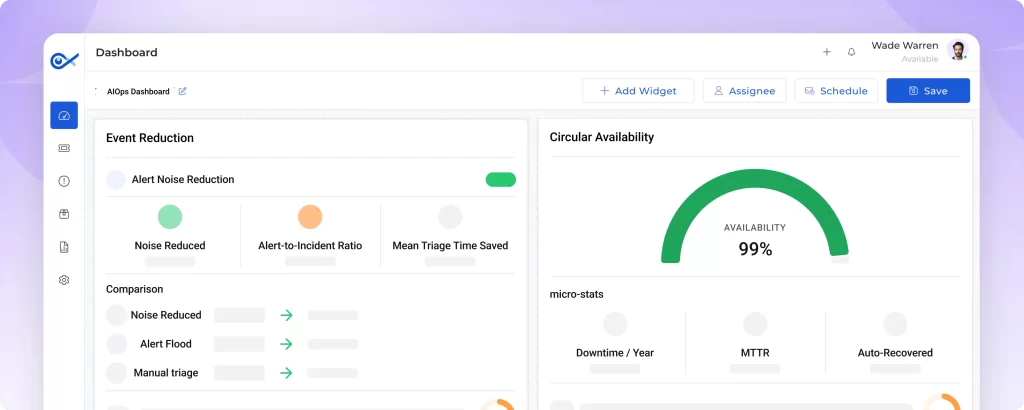
Infraon AIOps helps maximize existing monitoring, ITSM, and infrastructure tools and focuses on turning raw operational signals into fewer, higher-value incidents. The product targets everyday operational friction such as alert overload, slow response, and limited visibility into service impact.
What Infraon AIOps does well
- Groups related alerts, metrics, and logs into incident views that reflect real operational failures
- Reduces alert overload by suppressing duplicates and low-priority signals
- Assigns priority based on service impact rather than raw event volume
Infraon AIOps’ Anomaly detection and alarm prediction extend incident intelligence beyond reactive handling. Historical data establishes operating ranges for systems and services, which helps flag unusual behavior before performance degrades. Alarm prediction highlights potential failures tied to usage growth, resource pressure, or trend deviation.
Predictive and planning capabilities
- Detects abnormal patterns using historical and live operational data
- Predicts alarms linked to capacity pressure and service degradation
- Supports forward-looking capacity forecasts for infrastructure and cloud usage
Business service impact analysis links technical events to applications and services. This connection helps teams understand which services face risk and where response effort should focus when multiple issues appear at once.
Service-level visibility and response
- Maps incidents to services using topology and dependency views
- Highlights downstream impact on applications and users
- Guides escalation and response based on business relevance
Automation completes the operational loop. Infraon AIOps supports automated routing, response actions, and workflow triggers so teams can reduce manual effort during incident handling while keeping human oversight in place.
2) ManageEngine — AIOps for Existing ManageEngine Users
ManageEngine adds AIOps capabilities on top of its monitoring and IT management products, helping teams handle alert volume and performance data generated within the same product family. The approach works best for organizations already committed to the ManageEngine ecosystem.
Analytics applied to alerts and performance metrics help teams focus attention on operational issues that affect service delivery, rather than reacting to raw alert volume during busy periods.
Highlights
- Alert grouping and suppression inside ManageEngine tools
- Performance trend analytics for infrastructure and applications
- Central dashboards for operational visibility
3) Freshservice — ITSM-Driven AIOps
Freshservice brings AIOps into service desk operations by tying intelligence directly to ticket handling and workflow automation. The focus stays on reducing manual effort during incident intake and escalation.
Operational signals feed into tickets so service teams can prioritize incidents faster and handle repeat issues with more consistency during high-volume periods.
Highlights
- Automated ticket prioritization using incident signals
- Workflow automation within service desk processes
- Pattern identification for recurring incidents
4) Splunk — Analytics-Led AIOps
Splunk approaches AIOps through large-scale data analytics, applying machine learning to logs, metrics, and events generated by complex systems. Teams rely on it to identify patterns and anticipate operational issues from high-volume telemetry.
The platform suits environments where operational data volume is high and teams need flexibility in how analytics models get applied.
Highlights
- Machine learning on log and telemetry data
- Predictive alerts based on trend analysis
- Custom operational dashboards
5) New Relic — Application-Centric AIOps
New Relic focuses its AIOps capabilities on application and service performance, using full-stack telemetry to highlight abnormal activity and performance drops. The platform integrates closely with engineering and operations workflows.
Teams gain insight into how application issues surface in production, which helps speed up troubleshooting and improve performance planning.
Highlights
- Full-stack telemetry for applications and infrastructure
- Anomaly detection tied to application metrics
- Forecasting based on historical usage data
6) Dynatrace — Automated Root Cause Identification
Dynatrace applies AI-driven analysis to dependency data and performance signals to identify root causes during incidents. The platform links issues to service dependencies, which helps teams understand failure chains in complex environments.
This approach works well in large cloud deployments where manual dependency tracking becomes impractical.
Highlights
- Automatic dependency discovery
- AI-driven root cause identification
- Service-level visibility for cloud workloads
7) PagerDuty — Incident Response Intelligence
PagerDuty centers its AIOps features on incident response and on-call coordination. Analytics help reduce alert overload and improve routing so teams can respond faster during outages.
The platform focuses on response execution rather than deep signal analytics, making it a strong fit for teams managing frequent incidents.
Highlights
- Event aggregation and alert deduplication
- Intelligent alert routing and escalation
- Incident trend analytics
8) ServiceNow — Enterprise AIOps at Scale
ServiceNow embeds AIOps within its broader service management platform, linking operational data with ITOM and CMDB records. This supports enterprise teams that want operational intelligence tied directly to service workflows.
The platform emphasizes platform breadth and workflow automation across large IT organizations.
Highlights
- Predictive insights linked to ITOM data
- CMDB-based service visibility
- Workflow automation for large operations
How to Choose the Right AIOps Tool for IT Operations
Choosing an AIOps tools comes down to how well it aligns with daily operational pressure. Teams handle different signal volumes, service expectations, and escalation paths, so the right platform should reduce effort during incidents rather than add another layer of tooling.
An AIOps product should work with existing monitoring, ITSM, and infrastructure systems and help teams move faster during outages, capacity stress, and performance drops. Trial access matters here, since teams need hands-on exposure to see how alerts, predictions, and workflows behave under real load.
Selection criteria to focus on
- Data sources supported, including metrics, logs, events, and service data
- Alert reduction depth, including correlation and suppression
- Prediction features tied to capacity, performance, and service risk
- Automation options for routing, response, and workflows
- Trial or free access for hands-on validation before commitment
Why Infraon AIOps Stands Out
Infraon AIOps differentiates itself by focusing on how incidents unfold in real IT environments rather than treating alerts as isolated signals. The platform prioritizes incident intelligence, tying events to services and operational risk so teams can decide faster during high-pressure situations.
Instead of forcing teams to replace existing tools, Infraon AIOps works with current monitoring, ITSM, and infrastructure systems. This reduces onboarding friction and keeps attention on reducing alert overload, improving response timing, and maintaining service reliability.
What sets Infraon AIOps apart?
- Incident views driven by event correlation and service impact
- Predictive signals for capacity pressure and performance degradation
- Automation for routing, response actions, and workflow triggers
- Support for hybrid and multi-tool IT environments
- Trial access that enables real operational testing before rollout
Get Started With Infraon AIOps
- Start a 14-day trial to test alert correlation and prediction on live data
- Request a guided demo focused on incident handling and service impact
FAQs
What is an AIOps tool?
An AIOps tools applies machine learning and statistical methods to operational data such as metrics, logs, and events. The goal is to reduce alert overload, highlight abnormal patterns, and support faster incident handling during outages and performance drops.
Are there free AIOps tools available?
Some AIOps platforms offer free tiers, limited plans, or time-bound trials. These options help teams validate alert reduction, prediction, and workflow support using real operational data before a paid rollout.
How does AIOps help IT teams during incidents?
AIOps reduces manual effort by grouping related signals into incident views and prioritizing them based on service impact. Teams spend less time sorting alerts and more time resolving issues that affect users and business services.
Which AIOps tool works well for small IT teams?
Small teams often benefit from tools that offer fast setup, guided workflows, and limited reliance on custom modeling. Platforms such as Infraon AIOps and Freshservice are often considered when teams want incident intelligence without heavy operational overhead.
How much do AIOps tools cost?
Pricing varies based on data volume, feature access, and deployment size. Many vendors price by node count, usage, or service scope, with trials helping teams estimate long-term cost before commitment.