


ITSM refers to the way an organization plans, delivers and improves IT services; ITIL provides guidance for organizing that work. The difference between ITIL and ITSM is therefore the difference between service management as an operating discipline and a recognized framework that teams can use within it.
A company can manage incidents and service requests without formally adopting ITIL. Equally, earning ITIL certificates alone creates little value until teams put sound service practices into daily use.
Let’s explore their relationship, the practices inside ITIL 4, the arrival of ITIL (Version 5), and how to decide how much formal guidance your organization needs.
ITIL vs. ITSM: The Short Answer
ITSM covers the people, responsibilities and activities involved in delivering IT services. ITIL offers a set of management practices, principles and operating concepts for improving that delivery. ITSM is the organizational discipline; ITIL is a framework teams may adopt fully or selectively. Their relationship depends on operational needs rather than a requirement to use both formally.
| Comparison point | ITIL | ITSM |
|---|---|---|
| Meaning | Framework and guidance for digital product and service management | Organizational discipline for managing IT services |
| Primary question | Which principles and practices can improve service delivery? | How will our organization deliver and manage services? |
| Ownership | Published and developed under PeopleCert | Implemented by individual organizations |
| Prescriptiveness | Adaptable guidance rather than a universal workflow blueprint | Practices and workflows defined by organizational needs |
| Main audience | Service managers, practitioners, leaders and improvement teams | Service desk teams, IT operations, business owners and users |
| Scope | Value systems, guiding principles, management practices and governance | Actual delivery, resolution, requests, change, service levels and improvement |
| Certifications | Individual ITIL qualifications are available | ITSM itself has no single mandatory certificate |
| Tools | Vendor-neutral framework; no required product | Can use multiple software products and manual methods |
| Success measures | Adoption of useful practices and improved outcomes | Service quality, restoration times, user experience, cost and risk |
| Dependency | Can inform ITSM and related disciplines | Can operate with ITIL, alternative frameworks or locally designed practices |
What Is ITIL?
ITIL began as the Information Technology Infrastructure Library and became an established body of service management guidance. ITIL 4, introduced in 2019, expanded attention to value creation, collaboration, continual improvement and ways of working such as Agile and DevOps. It groups operational recommendations into practices rather than treating service management as a fixed sequence of departmental stages.
ITIL (Version 5), introduced in 2026, carries that guidance into a broader digital product and service context. PeopleCert’s ITIL certifications describe the current qualification routes.
What Is ITSM?
IT service management describes the work required to deliver services employees and customers rely on. A service desk records incidents and requests; infrastructure teams restore failed components; change owners assess release risk; service owners review commitments and performance.
These responsibilities exist wherever an organization manages IT services, regardless of the terminology used internally. A mature program connects them through agreed priorities, accountability and shared service information.
Is ITIL the Same as ITSM?
ITIL is a source of guidance; ITSM is the work being managed. A documented incident practice may recommend categorization and escalation, while a service desk decides which fields to capture, who receives a priority-one incident, and how restoration is verified. The framework informs choices. The enterprise remains responsible for staffing, technology, governance, implementation and results.
Can You Do ITSM Without ITIL?
Yes. A small IT function may use a ticket queue, an inventory, an escalation roster and a service-level agreement with no formal ITIL initiative. Teams can also follow ISO/IEC 20000, COBIT or their own tested operational methods. ITIL becomes useful when common language and repeatable practices help resolve coordination problems. The decision is about value gained from adopting guidance, rather than eligibility to manage IT services.
How ITIL and ITSM Work Together in Practice
Consider a payroll application that becomes inaccessible two hours before a monthly salary run. Monitoring reports connection failures, while employees contact the service desk. The technical event and the business disruption describe the same incident from different viewpoints. ITIL guidance can inform how the incident is prioritized, escalated, communicated and later reviewed. ITSM is the coordinated response carried out by real teams.
- Record and classify the disruption. The service desk confirms which users are affected, the time the issue began, the service involved and current business impact. A critical payroll deadline justifies urgency even if the server failure affects a limited set of hosts. A single parent incident prevents dozens of employee reports from becoming independent investigations.
- Establish restoration ownership. An incident manager calls in the application and database teams. The service owner is responsible for employee communications; engineers work on restoration. A shared record holds the incident timeline, decisions and current workaround. Teams avoid a situation in which every specialist assumes a colleague is driving the incident.
- Restore the service and verify it. Suppose the database connection pool is exhausted. Engineers adjust the pool configuration under an approved emergency change, rerun failed transactions and confirm that payroll batches resume. Service desk agents then check the employee-facing outcome before closure. Restoration time and affected payroll transactions are captured for later analysis.
- Prevent recurrence. A problem review examines the connection-pool threshold, recent deployments and monitoring thresholds. An improvement action may introduce a capacity alert or a controlled configuration update. The review separates immediate restoration from longer-term root-cause work so a temporary workaround never masquerades as a permanent fix.
The relationship is visible in each step: ITIL gives a common way to think about incident ownership and continual improvement; the organization’s ITSM procedures determine real escalation groups, change authority, communications and evidence. The service desk platform records the work, while engineering teams perform the technical recovery. Neither a certification nor a workflow template can substitute for clear operational ownership.
An enterprise can test the approach through a tabletop exercise. Give participants the same payroll scenario, then ask who declares major-incident status, how the service owner receives updates, and what evidence permits closure. Missing answers reveal operational gaps before an actual outage. Follow-up exercises can cover a failed identity service or a high-impact network change, each involving different specialist groups.
Inside the ITIL Framework
What Replaced ITIL v3? The Transition to ITIL 4
ITIL v3 taught a service lifecycle through strategy, design, transition, operation and continual improvement. ITIL 4 reorganized the discussion around value, connected activities and 34 management practices. Its service value chain describes work that may flow through several activities in different sequences. Incident restoration and service design can therefore use related resources without being treated as separate organizational silos.
The four dimensions of service management are organizations and people, information and technology, partners and suppliers, and value streams and processes. Reviewing all four helps managers detect incomplete initiatives. Installing a portal addresses technology; it does little for request fulfillment if approvers lack ownership or suppliers have unclear escalation commitments. Similarly, a documented incident playbook is weakened when monitoring data remains outside the service desk.
Furthermore, PeopleCert launched ITIL (Version 5) in 2026. It introduces a broader digital product and service perspective and a revised certification route. PeopleCert says the 34 practices continue with adjustments and are regrouped in Version 5. The three-category classification applies to ITIL 4. Version 5 organizes its retained practices differently. Teams maintaining ITIL 4 practices can continue operational improvements while reviewing the revised qualifications. See the official ITIL FAQ.
The Seven Guiding Principles of ITIL 4
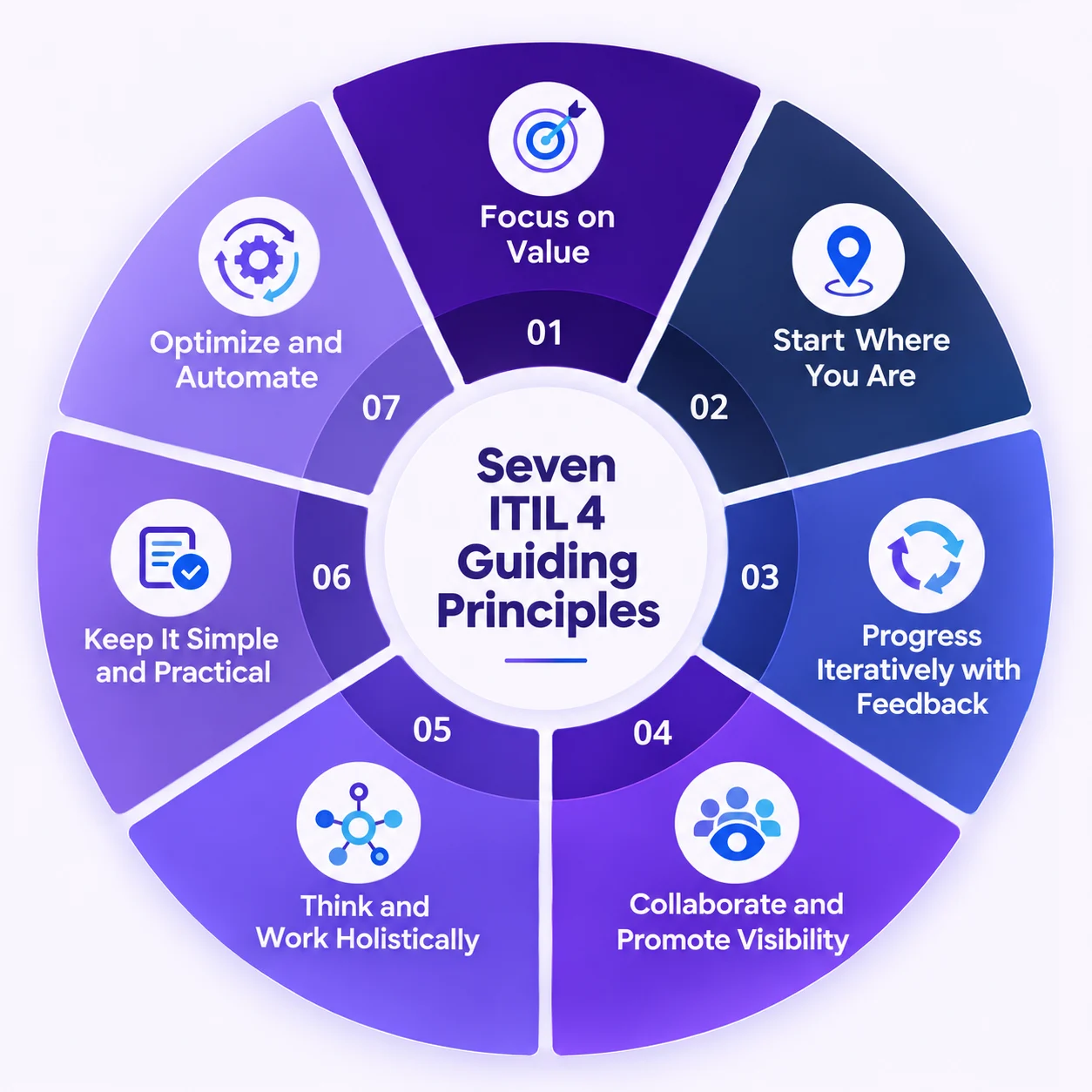
ITIL 4 presents seven principles that help teams make choices without creating a separate rulebook for every situation.
- Focus on value: define who receives the service and what outcome the work should produce; faster ticket closure has limited worth if users remain unable to finish their tasks
- Start where you are: audit functioning practices and current data before replacing workflows; preserve useful knowledge and relationships
- Progress iteratively with feedback: pilot changes with a representative service group, measure results and improve the next release
- Collaborate and promote visibility: give affected teams shared information about service status, decisions and dependencies
- Think and work holistically: assess changes to technology alongside their impact on people, external partners and the service being delivered
- Keep it simple and practical: remove approvals and fields with no demonstrated operational purpose while preserving controls that address real risk
- Optimize and automate: first identify a sound workflow, then automate suitable parts; automation that repeats a confused workflow scales the confusion
These principles can change a very ordinary activity. When an employee requests access to a reporting system, the team can start by observing the current route, find the approvals that genuinely protect sensitive data, publish a clear request form and automate repeatable identity checks. The improvement is measured through elapsed approval time and the number of avoidable follow-ups, rather than the count of automation rules deployed.
The ITIL 4 Service Value System
The Service Value System (SVS) describes how organizational components work together to create value through services. It includes guiding principles, governance, a service value chain, practices and continual improvement. These parts connect strategy with day-to-day work rather than representing five departments that must act in a fixed order.
The service value chain identifies six activities: plan, improve, engage, design and transition, obtain/build, and deliver and support. A new employee onboarding service might start with engagement to gather requirements, move into design to standardize approval and provisioning, obtain access or equipment, then deliver the finished service. Feedback from users may trigger improvement during any stage.
Governance decides authority and risk appetite. Practices provide people and resources for repeated activities. Continual improvement monitors outcomes and drives changes. A manager who focuses only on the service value chain can overlook these surrounding components. Service reliability also depends on business priorities, policy decisions and a shared willingness to change established habits.
A useful SVS review follows one real service from user request to completion. Record where information is entered twice, which decisions lack an accountable owner and which performance indicators reveal genuine customer impact. Such reviews often surface failures between teams rather than within individual departments.
The 34 ITIL 4 Practices in Three Categories
The ITIL 4 practice model groups 14 general management practices, 17 service management practices and three technical management practices. Each practice represents organizational resources used to perform a recurring purpose.
| ITIL 4 practice | Category | What it covers |
|---|---|---|
| Architecture management | General | Structure and relationships among business, information and technology elements |
| Continual improvement | General | Identifying and acting on opportunities for better service outcomes |
| Information security management | General | Protecting information and managing security requirements |
| Knowledge management | General | Creating and sharing usable organizational knowledge |
| Measurement and reporting | General | Establishing measures and presenting performance evidence |
| Organizational change management | General | Helping people adopt organizational changes |
| Portfolio management | General | Selecting and managing investments in products and services |
| Project management | General | Coordinating work with defined objectives and timeframes |
| Relationship management | General | Building relationships with stakeholders |
| Risk management | General | Identifying, assessing and addressing uncertainty |
| Service financial management | General | Budgeting and accounting for service-related expenditure |
| Strategy management | General | Defining direction for products and services |
| Supplier management | General | Managing third parties and contractual relationships |
| Workforce and talent management | General | Planning and developing workforce capabilities |
| Availability management | Service | Meeting agreed availability needs |
| Business analysis | Service | Understanding business needs and recommending changes |
| Capacity and performance management | Service | Matching service resources to demand |
| Change enablement | Service | Assessing and authorizing changes with managed risk |
| Incident management | Service | Restoring normal service following disruptions |
| IT asset management | Service | Managing assets throughout their useful life |
| Monitoring and event management | Service | Detecting and responding to meaningful changes in service state |
| Problem management | Service | Reducing the likelihood and impact of recurring incidents |
| Release management | Service | Making new and changed services available |
| Service catalog management | Service | Maintaining dependable information about available services |
| Service configuration management | Service | Maintaining information about configuration items and their relationships |
| Service continuity management | Service | Preparing services for major disruptions |
| Service design | Service | Designing services for purpose and organizational constraints |
| Service desk | Service | Providing a point of communication between users and provider |
| Service level management | Service | Agreeing and reviewing service targets |
| Service request management | Service | Handling predefined user requests |
| Service validation and testing | Service | Checking that services meet their intended requirements |
| Deployment management | Technical | Moving components into live and other environments |
| Infrastructure and platform management | Technical | Managing infrastructure and platforms for services |
| Software development and management | Technical | Building and managing software components |
Read our detailed guides:
Trying to activate all 34 practices at once usually creates a large governance program with weak ownership. An organization facing repeated outages might kick off with incident, problem and monitoring practices. A team facing uncontrolled production changes may invest in change enablement and service configuration management first. HR-driven onboarding delays suggest improving the request catalog and approval routing.
The practice categories also help managers assign the right participants. Supplier management may involve procurement and legal teams. Security management depends on risk owners. Capacity management needs infrastructure engineering data. Service desks can coordinate many activities, but assigning every practice to the service desk manager creates responsibility without the corresponding authority.
What ITIL Does Outside Its Core and Where Other Frameworks Help
ITIL supplies service-management guidance, but organizations also need corporate governance, product engineering methods, security controls and operational improvement techniques. Other frameworks can serve these needs alongside ITIL. Selecting one should begin with the decision or problem an enterprise faces rather than a desire to collect methods under a single transformation program.
COBIT
COBIT, developed by ISACA, addresses governance and management of enterprise information and technology. Boards and executives use it to clarify decision rights, oversight, risk and alignment with organizational goals. ITIL can inform operational service practices under that governance. For example, COBIT may help assign accountability for risk decisions, while ITIL-derived change procedures describe how engineers request and evaluate a change. ISACA’s COBIT resources describe its governance focus.
Lean IT
Lean thinking seeks to remove waste from work and improve flow. In a service desk, waste may appear as duplicate classification, repeated requests for identical details, unnecessary transfers and reports nobody acts upon. Value-stream analysis can show where a ticket waits without advancing the user’s request. ITIL principles provide a compatible service context, while Lean methods offer tools for discovering delays through direct observation.
Agile and DevOps
Agile helps teams deliver increments based on feedback; DevOps emphasizes collaboration and automation in software delivery and operations. Neither requires abandoning accountable incident response or change risk management. A product team can deploy changes frequently through an automated pipeline while documenting appropriate approvals and incident recovery measures. Risk-based change enablement can become lighter for tested, repeatable deployments and stronger for unfamiliar changes affecting critical services.
FitSM
FitSM provides a comparatively lightweight collection of service-management requirements and guidance. Its smaller entry point may appeal to organizations that need defined responsibilities, repeatable services and gradual process maturity without a wide initial program. Teams can borrow FitSM’s service definitions and roles while keeping operational practices that already function well. Compare the depth of governance required before selecting a framework solely on perceived simplicity. FitSM publishes its scheme and resources.
MOF
Microsoft Operations Framework (MOF) is a historical body of guidance associated with the operation and management of Microsoft-centric IT environments. It can inform older internal methods, but organizations evaluating a present-day framework should check publication currency and fit with their current technology. In practice, cloud operations, identity management and cross-platform services often demand approaches that extend past older MOF material.
When to Combine Frameworks
Combining methods makes sense when each solves a distinct problem. Consider a financial-services company: COBIT informs board-level technology governance, ITIL service practices help manage incidents and changes, and DevOps helps release software frequently. Lean analysis examines waiting time within approval workflows. A security standard supplies control requirements independent of any one framework.
The danger is duplicated ceremonies. Two change boards, conflicting incident severity labels and multiple service inventories can increase effort without improving services. Assign one decision owner for each recurring activity, define the evidence required and document which framework contributes to that decision. The result should look like one operational method to staff, rather than a collection of competing manuals.
Do You Actually Need ITIL? A Decision Framework
Formal adoption has costs. Teams spend time defining roles, documenting practices, maintaining service data and learning common terms. That investment can be worthwhile where inconsistent work creates serious disruption. Where the service environment is modest and existing procedures produce strong results, selective adoption may be the better choice.
Signals That Formal ITIL Adoption Will Help
- Repeated incidents reach several teams before an accountable incident owner emerges
- Business units use conflicting priority definitions, leaving major disruptions difficult to coordinate
- Change failures repeatedly affect production services, with limited evidence of risk assessment
- Service targets are agreed informally and measured differently by each department
- Executives request reliable comparisons of service performance between regions or suppliers
- Asset, configuration and service records contain gaps that undermine incident investigation
These symptoms suggest a shared practice model could reduce disagreements over responsibilities and evidence. Formal adoption can also help large organizations manage supplier transitions and regulated service operations. Start with the consequences of inconsistency and quantify them where feasible: repeated transfer counts, restoration delays, failed changes or hours of manual reconciliation.
Signals That a Full Program May Add Little Value
A three-person technology team may already resolve most incidents rapidly because staff know the environment and communicate directly. Introducing multiple boards, detailed workflow approvals and documentation for every small request could slow service delivery. Another warning appears when executives request certification chiefly for branding, without identifying operational problems to solve.
Ask the organization to explain the expected gain in concrete service terms. A good objective is reducing incorrect routing of urgent incidents or recovering audit evidence within a defined period. A weak objective is implementing ITIL simply because peer companies have done so. Even large enterprises should decline practices that create maintenance work without changing service outcomes.
Adopting ITIL Partially: Where to Start
A partial adoption can get started with three connected practices: incident management, service request management and continual improvement. Define severity levels, ownership and incident communications. Standardize two or three frequent request types. Review a small set of measures every month and make one documented change based on those findings.
A second wave can introduce problem management when recurring incidents consume capacity. Change enablement becomes the priority if releases are disrupting operations. Service configuration management deserves attention when teams struggle to identify the service consequences of infrastructure changes. These decisions can follow real demand rather than a predetermined rollout calendar.
A practical 90-day pilot
- Days 1–30: review ticket samples; document service owners and the current escalation route; record baseline recovery and request completion times
- Days 31–60: trial consistent classification and major-incident communications in one service group; publish two common request forms and train assigned staff
- Days 61–90: examine failure points, adjust approvals and routing, verify service measures, then decide which practices justify expansion
The pilot should produce a revised operating procedure and evidence from actual tickets. It may also show that a present workflow performs adequately. Treat that result as useful information rather than as a project failure.
After the pilot, give each practice an accountable owner and a review interval. Assign an incident manager to severity definitions, a service owner to business communication and a request manager to catalog items. Publish the working rules where agents already look for operational information. If procedures are hard to find during an incident, their quality on paper makes little difference. Review exception cases before expanding the pilot to another team.
Do Small Businesses Need ITIL?
Small organizations benefit from service ownership, a basic escalation route and a record of recurring failures. They rarely need the governance depth of a multinational enterprise. A small team might adopt a single service catalog, a straightforward incident priority matrix and monthly service review without certifying staff immediately.
As the business grows, handoffs become harder to coordinate informally. At that point, selective ITIL practices can standardize expectations between new staff, contractors and departments. Team size alone never determines the answer. Service criticality, supplier dependence, compliance demands and incident frequency should influence the decision.
What ITIL Certification Actually Involves
The ITIL 4 Certification Path
ITIL 4 Foundation introduces service-management concepts, four dimensions, guiding principles, the service value system and practices. Higher ITIL 4 qualifications have included Managing Professional, Strategic Leader and Practice Manager routes, with different modules covering hands-on service work and leadership. An individual’s certificate demonstrates learning assessed through an exam; enterprise procedures require their own operational review.
PeopleCert now lists ITIL Foundation (Version 5), its Foundation Bridge for ITIL 4 certificate holders, and revised higher-level modules. The current route contains Practice Manager, Managing Professional and Strategic Leader designations; relevant combinations can lead to ITIL Master. Learners should check the current PeopleCert qualification scheme before purchasing a course. ITIL 4 credentials continue to have defined renewal routes, and the release of Version 5 leaves existing operational knowledge useful.
Certification planning should follow work roles. Incident and service desk leaders may benefit from guidance on monitoring, restoration and requests; people responsible for organizational technology strategy may focus on governance, value and transformation. A successful plan gives learners opportunities to apply concepts through a real service improvement project rather than treating course completion as the end result.
Certifying a Platform: What PinkVERIFY Assesses
PinkVERIFY is a third-party assessment run by Pink Elephant for IT service management products. Its published approach examines how software handles designated service practices against assessment criteria. Pink Elephant explains that the approach has been revised to reflect contemporary working methods and multiple ITSM frameworks. A vendor’s assessment therefore concerns assessed software capabilities under the program’s rules, rather than certifying every customer workflow or guaranteeing every service outcome. Pink Elephant’s PinkVERIFY directory provides the published listings.
Deepak Gupta on Assessing Certification Claims
When I review ITSM certification claims, I begin by identifying what has actually been assessed. A professional qualification tells me about an individual’s learning. A product assessment tells me which capabilities were evaluated. Neither replaces a live demonstration using the organization’s own incident types, approval routes and service data.
A buyer comparing products should ask which practices were assessed, the assessment version and the product release listed. Follow this with a controlled demonstration that shows the team’s actual workflow. This avoids treating a badge as a substitute for acceptance testing.
Common Misconceptions About ITIL
“Every organization has to implement all 34 practices.”
ITIL is guidance. Organizations can introduce the practices that address their operating problems, then add others as requirements change. Attempting an all-at-once rollout can dilute responsibility and create unnecessary approval work.
“ITIL is software.”
ITIL describes management concepts and practices. A service-management product may automate parts of those practices, but a configuration screen cannot determine business impact, accountable ownership or risk appetite on behalf of management.
“ITIL certification proves an organization delivers strong service.”
An individual exam measures an individual’s knowledge. Operational outcomes require reliable data, sound handoffs, relevant governance and a culture of acting on lessons from incidents and requests.
“ITIL and Agile are incompatible.”
Teams can release incremental software changes while maintaining reliable service records and risk-based approvals. The value comes from aligning operational control with release risk, rather than demanding identical treatment for every deployment.
“ITIL creates paperwork.”
Poor implementations can create that result. ITIL 4 also encourages simplicity, iterative improvement and automation. Managers should remove redundant records and manual approvals while retaining evidence necessary for accountability, customer communication and control.
A related misunderstanding is that adopting a framework guarantees identical practices in every department. Common priority definitions may be useful, yet different services face different recovery targets and risk constraints. Standardize the language and decision criteria first; let the detail reflect service needs.
ITSM: Getting Started With Benefits, Implementation and Measurement
A service-management initiative needs a defined business outcome before the team selects templates or training. Choose a problem visible in service data: recurring password-reset queues, unresolved incidents with repeated ownership changes, or release-related outages. Measure the current state and agree who will own a pilot. Document the intended improvement in plain terms so the people doing the work can judge progress.
Identify the baseline. Review a representative sample of incidents and requests, including records that took much longer than expected. Look at reopening frequency, transfers, priority changes, repeated questions and service interruptions. Combine system data with agent interviews: timestamps show delay, while interviews may explain why a handoff occurs. The distinction matters when deciding what to automate.
Define the minimum operating method. For incident management, specify intake, severity assessment, assignment, escalation, communications and closure evidence. For requests, identify the request owner and approval authority. For change enablement, define who can approve routine, standard and emergency changes. Each procedure should fit on a page before it expands into detailed team instructions.
Test on a live service. Select an application with manageable request volume and willing stakeholders. Train service desk agents and resolver groups together so each understands the other’s responsibilities. Maintain one issue log for confusion observed during the pilot. Make adjustments from actual tickets rather than inserting every hypothetical exception into the first version.
Measure outcomes and review tradeoffs. Use a balanced scorecard rather than celebrating ticket closure volume alone. A team that closes requests quickly but triggers repeated reopenings has shifted work to users. A team with strict change controls may reduce failures while increasing deployment queues. Discussion must weigh speed against risk and user experience.
| Measure | What to examine | Common interpretation trap |
|---|---|---|
| Mean time to restore service | Time from disruption to verified restoration | Treating ticket closure as restoration |
| First-contact resolution | Cases resolved during initial contact | Comparing teams with different issue mixes |
| Reopened incidents | Closed cases that require further work | Mistaking fast closures for durable fixes |
| Change failure rate | Changes that cause incidents or require recovery | Ignoring different change risk profiles |
| Request fulfillment time | Elapsed time by request category | Mixing simple access requests with complex procurement |
| Service-level attainment | Results against agreed service targets | Selecting targets without business relevance |
| User satisfaction | Feedback linked to service interactions | Overweighting a small group of respondents |
As practices mature, review links between service-management data and infrastructure signals. A monitored device can explain why incidents arrive together; a CMDB can identify other services depending on that device. Yet these records create value only when their quality is high enough for decision-making.
See Infraon’s ITSM implementation guidance for staged rollout considerations.
Managers should also revisit the initial business case after three to six months. If incident communications improved but recovery time remained unchanged, investigate engineering bottlenecks instead of introducing extra service desk forms. If request fulfillment accelerated while approval exceptions increased, review policy coverage. Continual improvement means using evidence to change the method, including deciding to stop activities that consume time without a clear service result.
Frequently Asked Questions
What Is the Difference Between ITIL and ITSM?
ITSM is the organizational work of managing IT services. ITIL provides a collection of practices, principles and management concepts that can improve that work. Organizations decide how much ITIL guidance to use. Success depends on implemented procedures, accountable people and measurable service outcomes.
Is ITIL the Same as ITSM?
No. ITIL is a recognized framework associated with service management; ITSM is the wider operating discipline. An organization may perform ITSM with ITIL-inspired procedures, another framework or its own methods. Neither installing ticketing software nor completing an ITIL course independently establishes operational maturity.
Can You Do ITSM Without ITIL?
Yes. Incident response, requests, change controls and service reviews can work through locally designed methods or guidance from other standards. ITIL offers common language and reusable practices when teams need them. Smaller operations often begin with basic ownership and escalation procedures before seeking formal adoption.
What Are the Seven Guiding Principles of ITIL 4?
These principles focus on value; start where you are; progress iteratively with feedback; collaborate and promote visibility; think and work holistically; keep it simple and practical; and optimize and automate. The principles help teams make decisions while adapting service practices to their own circumstances.
What Replaced ITIL v3?
ITIL 4 succeeded the v3 lifecycle model in 2019, emphasizing service value, guiding principles and management practices. PeopleCert introduced ITIL (Version 5) in 2026. Teams referencing older training materials should distinguish the ITIL 4 structure from the newer qualification scheme and practice grouping.
How Many Practices Are in ITIL 4?
ITIL 4 defines 34 management practices. They are grouped as 14 general management practices, 17 service management practices and three technical management practices. Organizations can select practices according to current needs rather than launch all 34 at once. Version 5 retains 34, with grouping adjustments.
Is ITIL Still Relevant in 2026?
Yes. The need for consistent incident handling, service ownership and change decisions remains. PeopleCert’s 2026 Version 5 release extends the framework into digital product and service management. Existing ITIL 4 knowledge can still inform daily work, with qualification decisions based on current PeopleCert guidance.
What Are the Alternatives to ITIL?
COBIT emphasizes technology governance; FitSM offers lean service-management guidance; Lean methods analyze waste; Agile and DevOps address product delivery and collaboration. Microsoft Operations Framework appears in some historical environments. Teams may combine methods when each serves a clear purpose and decision ownership stays unambiguous.
Do Small Businesses Need ITIL?
A small business needs reliable service routines, regardless of framework adoption. Formal ITIL training may help as complexity increases, but a basic incident log, service ownership and straightforward escalation rules may be enough initially. Review service criticality and team capacity before funding a wider program.
Which Came First, ITIL or ITSM?
Organizations managed technology services before ITIL appeared. ITSM describes that wider activity, while ITIL was developed later as a formal collection of good-practice guidance. ITIL has changed through several editions. The distinction remains useful because service management predates the publication of any single framework.
Explore Infraon ITSM
Review how our ITSM tool can bring incident handling, requests and service accountability into a unified ITOps environment.