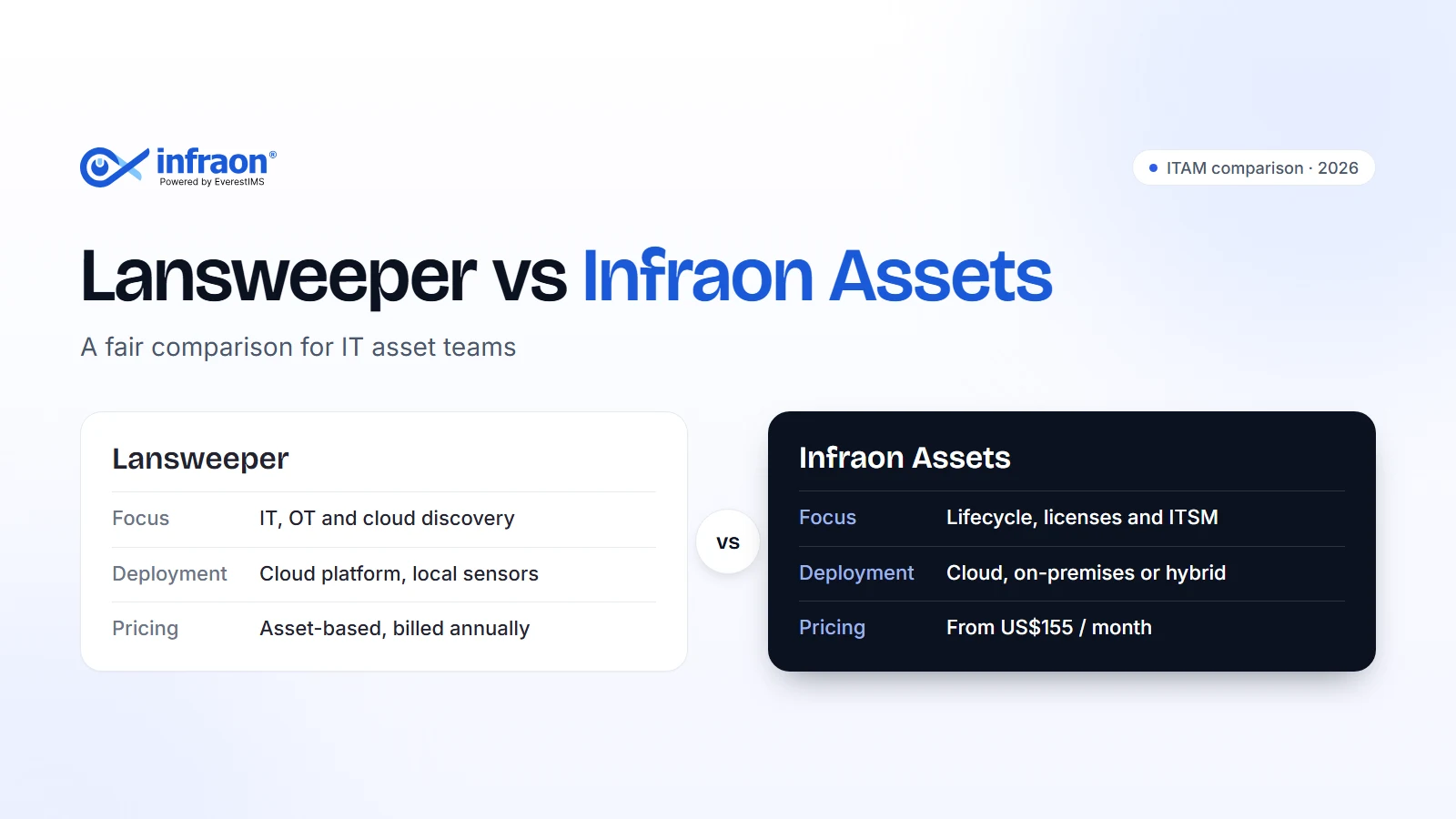

Lansweeper vs. Infraon Assets is a choice between discovery-led asset intelligence and broader asset lifecycle management connected to IT service operations. Lansweeper has strong network, cloud, and Operational Technology (OT) discovery capabilities, with inventory data that feeds other business systems. Infraon Assets brings discovery, procurement, contracts, software license governance, and asset lifecycle processes together, with a direct connection to Infraon ITSM through Infraon Infinity.
IT teams seeking to connect equipment records with service requests, incidents, and renewals have a strong reason to consider Infraon. Teams prioritizing detailed discovery of complex networks may prefer Lansweeper. The decision also affects who maintains asset relationships, which integrations require extra subscriptions, and how much time administrators spend reconciling inventory with procurement and service records.
While Infraon Assets is our product, both are assessed against the same purchasing criteria.
Lansweeper vs. Infraon Assets at a Glance
Quick comparison table
| Decision area | Lansweeper | Infraon Assets |
|---|---|---|
| Best for | Discovery-led inventory spanning IT, OT, and cloud | Asset lifecycle, license governance, contracts, and connected ITSM |
| Discovery methods | Network and cloud discovery, endpoint agents, active and passive methods | Agent-based endpoints and agentless discovery for servers, network devices, and cloud resources |
| Software license tracking | Software inventory; dedicated SAM add-on for entitlement analysis | Software license governance in eligible asset-management plans |
| Built-in service desk | Cloud product enriches external ITSM tickets; Classic has a helpdesk | Asset records connect with Infraon ITSM and ticketing workflows |
| Deployment | Cloud-managed Platform with local sensors; Classic installed locally | Cloud, on-premises, and hybrid options subject to scope |
| Pricing model | Asset-based, annual subscriptions; separate SAM charges where selected | Asset-count and plan-based subscriptions; advanced functions vary by tier |
| Setup time | Depends on scanning credentials, network segments, and connections | Initial discovery can be established rapidly; phased asset rollout depends on data readiness |
Choose Lansweeper if…
- Your immediate priority is finding unmanaged devices throughout complicated IT and OT networks
- Security teams need rich device fingerprinting, lifecycle indicators, and vulnerability-related inventory context
- An established service desk already handles requests and changes, and needs updated asset intelligence
- Network discovery, traffic sensors, and cloud-account coverage outweigh procurement workflows
Choose Infraon Assets if…
- Procurement, assignment, warranty, maintenance, and retirement records belong in one asset workflow
- IT teams need software license usage, contracts, and renewal information alongside hardware records
- Incidents and requests should carry asset context through a connection with Infraon ITSM
- Cloud, on-premises, or hybrid deployment choices influence buying decisions
What Each Product Is Built For: Lansweeper vs. Infraon Assets
Summary of Lansweeper
Lansweeper focuses on discovering and understanding connected technology. Its current Platform brings network, endpoint-agent, and cloud discovery into a centrally managed inventory. OT sensors and passive traffic visibility help teams identify devices where routine scanning is restricted. Asset details, lifecycle signals, and risk insights can flow to CMDB, security, and service desk systems.
Summary of Infraon Assets
Infraon Assets manages hardware, software, vendors, contracts, and asset history from purchase through disposal. Teams can track device allocation, stock, maintenance, depreciation, and license entitlements while discovering infrastructure through agents and agentless methods. After integration with Infraon ITSM, it becomes easy to connect asset ownership and lifecycle information to service activities.
Feature-by-Feature Comparison: Lansweeper vs. Infraon Assets
Asset discovery
Agent-based and agentless scanning
Both products use agents and network-based methods, but their operating emphasis differs. Lansweeper draws on network discovery hubs, endpoint agents, cloud connectors, and passive observation. Infraon uses agents for laptops and desktops and agentless scanning for servers, network equipment, and cloud resources. Buyers should test agent-based vs. agentless discovery against firewalls, endpoint policies, and remote access controls.
Lansweeper offers dedicated traffic and IT/OT sensors for active and passive discovery.
Network, cloud and OT device coverage
Lansweeper has a strong case where network equipment, industrial controllers, remote machines, and cloud resources share the same inventory requirement. Its IT and OT sensor can identify connected devices through fingerprinting and collect deeper details where credentials are available.
Infraon Assets discovers network devices, servers, endpoints, and cloud resources, with advanced discovery capabilities assigned to the relevant plan.
Hardware inventory and lifecycle tracking
Lansweeper provides inventory history, device age, warranty information, and end-of-life or end-of-sale indicators. Infraon Assets connects those records to purchase, allocation, maintenance, depreciation, transfers, and retirement activities.
Warranty, contract and vendor management
Infraon Assets tracks procurement, vendor agreements, warranty expiry, maintenance obligations, and contract renewals as part of asset administration. Lansweeper also retrieves warranty information for major manufacturers and helps identify hardware approaching lifecycle milestones.
Stock and consumables tracking
Infraon includes spares, consumables, barcode and QR identification, and asset allocation workflows in its product tiers. Lansweeper’s central strength is discovered technology inventory; a buyer requiring storeroom balances and consumable issue records should assess any additional application or integration needed.
Software asset and license management
Infraon Assets can compare discovered software installations, usage, and purchased entitlements, helping IT teams identify underused licenses and prepare audit evidence.
Lansweeper inventories installed software and offers a separate Lansweeper SAM product for entitlement matching, compliance reporting, and optimization. The purchasing scope also depends on software asset management requirements. That add-on is available to qualifying Pro and Enterprise customers.
CMDB and relationship mapping
Teams comparing asset management vs. configuration management should trace a configuration item to its owner, recent changes, and affected service. Infraon links asset and service information through its connected ITSM environment. Lansweeper enriches external CMDB systems with discovered configuration data and offers topology views and relationship information.
Both vendors should demonstrate how an affected server is traced through an incident and what happens when its owner or status changes.
ITSM and ticketing integration
Built-in service desk vs. connected help desk tools
Infraon Assets connects with Infraon ITSM, so that technicians can work with service tickets and asset records within the Infraon environment. Service desk coverage and subscription entitlements should be confirmed before purchase; an asset subscription alone should never be treated as a full ITSM contract.
Lansweeper’s current cloud product enriches tickets in external systems such as ServiceNow and Jira Service Management. Lansweeper Classic also includes a helpdesk, which is a distinct offering. Infraon has a stronger proposition where asset and service processes are being consolidated under one vendor.
Reporting, dashboards and audits
Lansweeper provides inventory views, discovery results, scheduled reports, dashboards, and exports. Infraon Assets connects asset reports to license usage, warranties, maintenance, costs, and lifecycle status. Both can contribute to IT asset audits, though evidence requirements differ between security discovery and financial asset control.
Security and vulnerability insights
Lansweeper’s Risk Insights draws on discovered hardware and software data to identify exposure, aging technology, and known vulnerability context. It is a strong option when security teams need broad asset visibility before prioritizing remediation. Infraon Assets contributes asset ownership, installed-software information, lifecycle status, and compliance reports; its wider monitoring and service capabilities can help assign remediation tasks.
Integrations and APIs
Lansweeper offers ITSM, CMDB, and security connectors, with plan-dependent API access. Infraon provides REST API connectivity and third-party integration options linked to identity, monitoring, and service workflows.
Integration selection should cover authentication, permitted data direction, duplicate handling, error alerts, connector fees, and responsibility after a product upgrade.
Deployment, Data Residency and Security
Cloud, on-premises and hybrid options
Lansweeper Platform uses cloud-managed inventory with local discovery components, while Lansweeper Classic runs through a locally installed application.
Infraon provides cloud, on-premises, and hybrid deployment paths through its product environment. Backup, network access, and upgrade responsibilities should be confirmed in the contract.
Where your asset data is stored
Local scanning and local data storage are separate requirements. Lansweeper traffic-sensor metadata is sent to the selected EU or US AWS region.
Customers of Infraon can assess hosting arrangements against their data residency and security policies, including primary records, backups, audit exports, and API traffic.
Pricing Model and Total Cost
How Lansweeper prices its plans
Lansweeper uses asset-count subscriptions with Free, Starter, Pro, and Enterprise choices. Paid plans are billed annually, and license bands, permitted installations, integration access, and service levels vary. Its separate SAM offering adds entitlement-analysis costs for qualifying subscriptions. Lansweeper pricing also depends on discovered cloud and OT resources counted as licensed assets.
How Infraon Assets is priced
Infraon Assets uses asset-based subscriptions with Essential, Standard, Professional, and Enterprise options. Higher tiers extend software license governance, agent-based discovery, CMDB relationships, and advanced agentless discovery. Subscriptions are based on asset quantity, included users, service processes, onboarding, and billing term. Enterprise scope is quoted separately.
Costs beyond the license
Both proposals should cover onboarding, imports, connector charges, training, data cleanup, and administration over three years. Asset growth can alter the subscription band, while integrations and custom approval routes can introduce continuing upkeep.
The cost schedule should use the same device count, cloud inventory, contract records, software entitlements, and service desk connections. One-time setup charges should remain separate from recurring fees.
Setup and Ease of Use
Time to first complete inventory
Lansweeper can begin network discovery after sensors, access credentials, and scan ranges are configured. Gaps may remain for remote devices, restricted networks, or cloud accounts until the necessary discovery methods are active. Infraon targets initial discovery within 48 to 72 hours, subject to device access and data readiness.
Day-to-Day Use for IT Teams
Infraon is attractive when one asset manager handles hardware allocation, software compliance, contract renewals, and service-related equipment requests. Lansweeper is attractive when technical teams spend much of their time investigating unknown devices, configuration details, or security exposure.
Support and Community
Lansweeper has a product community, documentation, and service offerings tied to its subscription packages. Infraon offers onboarding, training, and vendor assistance, with the level of service depending on the selected plan and agreement.
Where Lansweeper Is the Stronger Choice
Lansweeper deserves preference when extensive IT, OT, and cloud discovery is the main purchasing objective. Its dedicated IT/OT sensing, passive traffic visibility, detailed fingerprints, and lifecycle risk context can be valuable for security and infrastructure teams with complex networks. Organizations already using another service desk may prefer to feed that system with Lansweeper inventory rather than replace existing service workflows.
Infraon Assets has the stronger case where asset discovery must connect with procurement, consumables, contracts, software licenses, and service management.
Moving From Lansweeper to Infraon Assets
What data you can bring across
Device identifiers, serial numbers, hardware attributes, owners, locations, software inventory, warranty dates, and selected custom fields may be exported from Lansweeper and mapped into Infraon Assets. Import scope depends on source edition, destination fields, and data quality. Ticket history in Lansweeper Classic requires separate review from asset inventory exports.
Teams should retain the previous inventory until active devices, historical assets, and contract information reconcile.
Migration steps
- The migration team exports a representative Lansweeper inventory with identifiers, software records, ownership, and lifecycle fields
- Source columns are mapped to Infraon Assets, including mandatory attributes and duplicate rules
- Infraon discovery is configured for selected networks, and both inventories are compared on the same date
- Process owners validate contracts, warranties, license information, and asset-service relationships
- The team reconciles exceptions, archives required history, and retires redundant connectors after approval
Running both tools in parallel
Parallel discovery helps uncover devices that one scanning configuration misses. The test should cover office endpoints, remote laptops, servers, network equipment, and cloud resources. Attribute completeness should be compared alongside device counts, because a scan that finds a host but misses its owner may still leave work for the service desk.
Named owners should resolve conflicting serial numbers, inactive assets, duplicate virtual machines, and unexpected changes in installed software.
Final Verdict
Infraon Assets is a strong choice for IT departments that want discovery tied to software license governance, contracts, procurement, hardware lifecycle, and service workflows. Its connection with Infraon ITSM makes it attractive for organizations replacing disconnected asset and service processes.
Lansweeper remains a strong option for discovery-led IT, OT, and cloud visibility, especially when an established external ITSM system will remain in place. Organizations needing another operating model can review other Lansweeper alternatives before a purchasing decision.
Frequently Asked Questions
Is Infraon Assets a good fit for teams moving off Lansweeper?
Yes. Infraon Assets connects hardware lifecycle control, software license governance, and contract tracking with service workflows. Its discovery capabilities help rebuild inventory after migration. Device coverage, field mapping, and service connections should be tested before the cutover.
Does Infraon Assets support agentless discovery?
Yes. Infraon Assets uses agentless discovery for servers, network equipment, and cloud resources, plus agents for desktops and laptops. Coverage depends on subscription tier, access permissions, and device types. Restricted networks should be tested before selecting a plan.
Can Infraon Assets track software licenses?
Yes. Eligible Infraon Assets plans track software installations, usage, purchased entitlements, and license compliance. Teams can identify unused licenses, review renewals, and prepare audit reports. Publisher coverage and licensing models should be confirmed in the quotation.
Does Infraon Assets include a service desk?
Infraon Assets connects asset information with ticketing workflows, and Infraon ITSM handles dedicated service-management processes. The Infraon environment links equipment to incidents, requests, and changes. The ITSM subscription and included functions should be confirmed before purchasing.
Can I import my Lansweeper data into Infraon Assets?
Yes. Lansweeper asset exports can be mapped into Infraon Assets through bulk onboarding. The supported formats, mandatory fields, history requirements, and asset relationships should be validated on a sample before scheduling cutover.
Does Infraon Assets offer on-premises deployment?
Yes. Infraon offers cloud, on-premises, and hybrid deployment choices, subject to product scope and contract. Hosting responsibilities, backup locations, update procedures, and infrastructure costs should be confirmed before purchase.
Start a free trial or book a demo of Infraon Assets.