


An ITSM vendor evaluation in Malaysia goes wrong when the checklist was written for another market. Global scorecards compare features and price, then skip the questions that decide day-to-day success: who answers a P1 incident at 2 a.m. Malaysian time, where ticket and CMDB data physically exist, and whether the contract is priced and billed in ringgit.
These gaps usually surface after signing, when they are costly to fix. This checklist turns them into scored criteria you can put to every vendor.
For general criteria, see our ITSM Evaluation Criteria. This checklist covers what’s specific to buying in Malaysia.
Why ITSM Vendor Evaluation in Malaysia Needs Its Own Checklist
Where global selection frameworks fall short for Malaysian buyers
Global frameworks usually miss four things:
- Support hours and calendars. Malaysia runs on MYT (UTC+8) with state-specific weekends and holidays. A follow-the-sun promise from another region does not cover that.
- Data location and transfer rules. The PDPA amendments phased in during 2025 removed the old transfer whitelist and added data protection officer and breach notification duties. Sector rules add more.
- Commercial terms. USD pricing, FX exposure and SST treatment rarely appear on global scorecards.
- Local delivery capacity. References, partners and training matter more than feature parity once the tool is live.
Who should be on the evaluation panel?
Have four functions score independently before comparing notes. IT assesses workflow fit and support, procurement owns contract terms, compliance reviews data residency and sector obligations, and finance checks currency, tax and renewal exposure. Without compliance and finance, the two most Malaysia-specific pillars go unscored.
How to Score Vendors with This Checklist
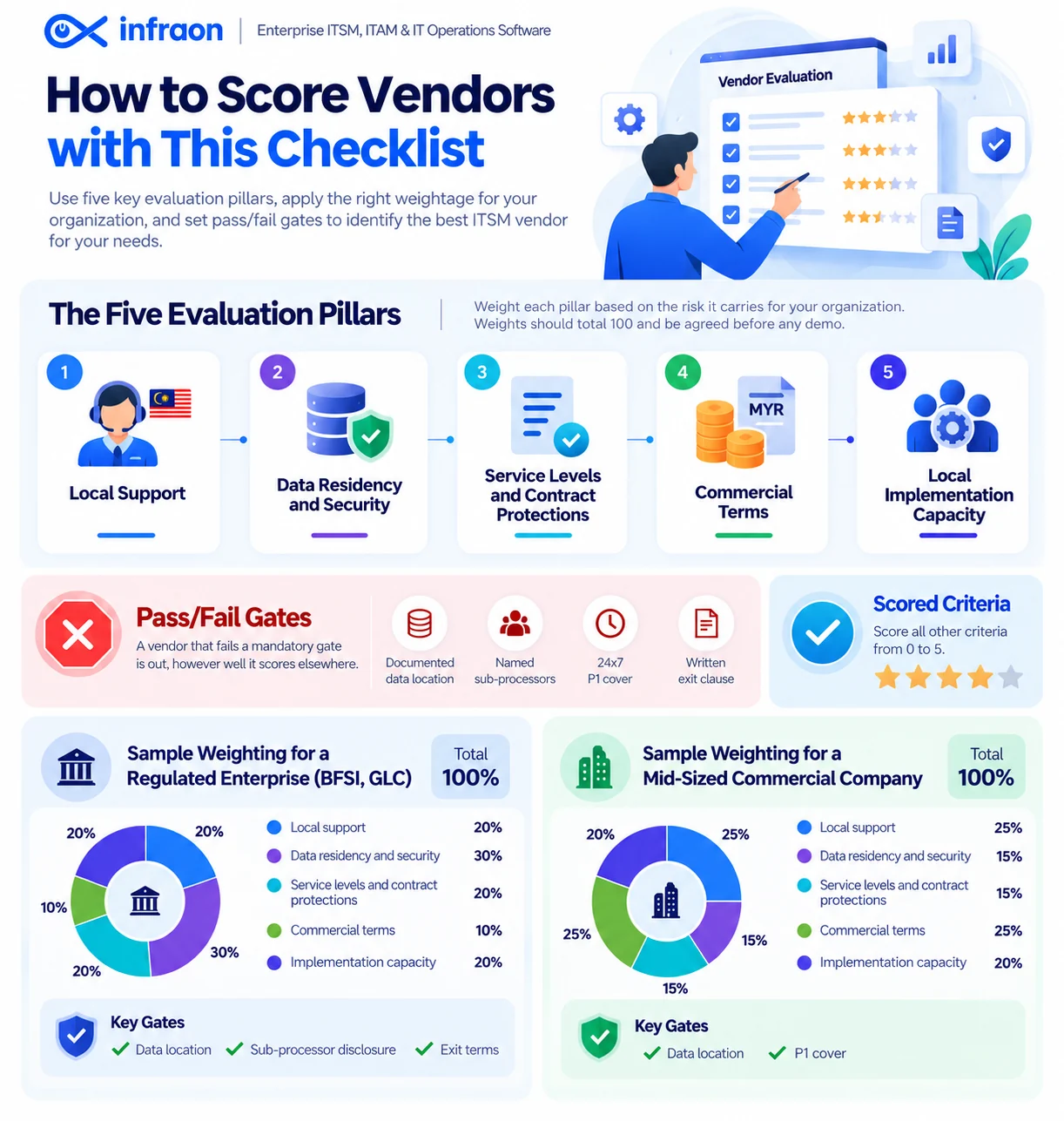
The five evaluation pillars and how to weight them
The checklist has five pillars: local support, data residency, service levels and contract protections, commercial terms, and local implementation capacity. Weight each by the risk it carries for your organization: a bank weights data residency heavily, while a mid-sized distributor may care more about price and adoption. Weights should total 100 and be agreed before any demo.
Pass/fail gates vs. scored criteria
Make non-negotiable gates: a vendor that fails one is out, however well it scores elsewhere. Typical gates are documented data location, named sub-processors, 24×7 P1 cover and a written exit clause. Score everything else from 0 to 5.
Sample weighting for a regulated enterprise (BFSI, GLC)
Local support 20%, data residency and security 30%, service levels and contract protections 20%, commercial terms 10%, implementation capacity 20%. Add gates for data location, sub-processor disclosure and exit terms.
Sample weighting for a mid-sized commercial company
Local support 25%, data residency and security 15%, service levels and contract protections 15%, commercial terms 25%, implementation capacity 20%. Keep one gate for data location and one for P1 cover.
Pillar 1 – ITSM Local Support in Malaysia
Support coverage in Malaysian business hours (MYT, UTC+8)
Ask for support hours stated in MYT, not “regional business hours”. Confirm that response targets apply inside those hours and that Malaysian customers do not queue behind another region’s day.
State weekend differences
Kedah, Kelantan and Terengganu work a Friday–Saturday weekend. Johor moved back to Saturday–Sunday on 1 January 2025, so older checklists may still list it wrongly. If you have branches in these states, ask whether the vendor’s support and SLA calendars can model each one.
Coverage for federal and state public holidays
Federal holidays are only part of the calendar. States add their own, and some skip holidays others observe. Ask whether support is staffed on the holidays that matter to you, and whether holiday calendars are configurable in the tool.
Local entity, certified partners, and on-ground engineers
A Malaysian legal entity or certified partner changes who you can call, contract with and hold accountable. Ask for engineer headcount in Malaysia and the partner’s certifications on the product.
Questions to ask: is support delivered from Malaysia or from offshore? Who handles P1 incidents at 2 a.m.?
- Is support delivered from Malaysia or from offshore?
- Who handles P1 incidents at 2 a.m., and what is the response time?
- Can on-site help be arranged within one business day?
Language support (Bahasa Malaysia, English, Mandarin, Tamil) in the portal, notifications, and agent support
Check each layer separately. The portal, notifications and live agents can each cover different languages, and end users may need Bahasa Malaysia or Mandarin even if agents work in English.
Escalation paths and named account management
Request the written escalation ladder, with roles and time limits at each level. A named account manager in a Malaysian time zone is a useful tiebreaker.
Pillar 2 – ITSM Data Residency in Malaysia
Where ticket, CMDB, attachment, and log data physically live
Tickets hold names, phone numbers and system details. Ask for a data flow diagram naming the country and facility for each data type.
Primary storage vs. backups vs. DR site
Vendors often answer for primary storage only. Ask separately about backups and disaster recovery, which are frequently hosted in another country.
Sub-processors and remote support access from outside Malaysia
Request the full sub-processor list. Also ask whether engineers outside Malaysia can view production data during support sessions, since remote access can raise the same transfer questions as storage.
Deployment options: Malaysian cloud region, private cloud, or on-premises
A vendor offering all three gives you room to meet stricter requirements later. Ask which features differ between them.
Cross-border transfer questions to put to every vendor
- Will any personal data in tickets, attachments or logs leave Malaysia, even temporarily?
- Which countries host backups, DR, analytics and AI services?
- Which sub-processors outside Malaysia can access the data, and under what safeguards?
- What contract clauses and assessment support do you provide for overseas transfers?
- How and how quickly will you notify us of a personal data breach?
For how these answers map to the law, read our guide to ITSM PDPA compliance in Malaysia.
Sector-specific expectations
BNM RMiT and outsourcing requirements for financial institutions
Bank Negara Malaysia issued a revised Risk Management in Technology (RMiT) policy document on 28 November 2025, covering areas such as third-party and cloud risk. BNM’s outsourcing requirements can add approval and contract expectations. Ask vendors about audit rights, exit plans and incident reporting, then have compliance confirm.
Public sector and NCII considerations under the Cyber Security Act 2024
The Cyber Security Act 2024 took effect on 26 August 2024 and covers 11 NCII sectors. Designated NCII entities must run risk assessments and audits and notify incidents, with an initial notice due within hours. If this is you, ask whether the vendor can supply incident records quickly and knows your sector’s code of practice.
Evidence to request: ISO/IEC 27001, SOC 2 reports, pen-test summaries, and a data flow diagram
Ask for current certificates with their scope statements, the latest SOC 2 report, a recent penetration test summary and the data flow diagram. Check that certificate scope covers the service and hosting location you will actually use, not just the vendor’s headquarters.
Pillar 3 – Service Levels and Contract Protections
SLA commitments to get in writing: uptime, response, resolution, RPO/RTO
Get uptime, response and resolution targets, plus recovery point and recovery time objectives, into the contract rather than a brochure. Ask how each is measured and by whom. For definitions, see our service level agreement guide.
Service credits: how they are calculated and paid in MYR
Check the credit formula, the claim process and the cap. Confirm credits are paid or offset in MYR, and whether they apply automatically or must be claimed.
Exit, data export, and deletion terms
Data return format and timelines
Require an export of tickets, CMDB and attachments in an open format within a stated number of days, followed by certified deletion.
Transition support at contract end
Ask what help is included at exit, what extra help costs, and how long the vendor keeps the service running during transition.
Pillar 4 – Commercial Terms for Malaysian Contracts
MYR-denominated pricing vs. USD contracts and FX exposure
Many international vendors list prices in USD. A multi-year USD contract exposes you to exchange-rate swings your budget may not absorb. Ask for MYR pricing, or a fixed-rate clause with a defined review mechanism.
SST treatment on invoices and local billing entity
Service tax is generally 8% on taxable services, and SaaS supplied by foreign providers falls under the digital services regime. If the supplier is not registered locally, Malaysian businesses may need to self-account for service tax on imported services. Ask which entity invoices you and whether SST is itemized, and confirm treatment with your tax adviser.
Renewal caps, license true-ups, and lock-in clauses
Look for a cap on annual renewal increases, clear rules for adding or removing users, and no penalty for true-downs. Watch for auto-renewal with long notice periods. For the full cost picture, see ITSM implementation cost in Malaysia.
Procurement paperwork: vendor registration, payment terms, and ePerolehan for government buyers
Ask early for company registration, tax details and, for government buyers, Ministry of Finance registration so the vendor can transact through ePerolehan. Agree payment terms before shortlisting.
Pillar 5 – Local Implementation and Adoption Capacity
Implementation partner track record in Malaysia
Ask how many deployments the partner has completed in Malaysia, and at what size. For the standard steps, see our ITSM implementation guide.
Malaysian reference customers in your industry
Request at least two references, ideally from your sector and of similar size. A global logo list says little about local delivery.
Training delivery: on-site options, local time zone, and whether training is HRD Corp-claimable
Check that training runs in Malaysian hours, on-site if needed, in your staff’s languages. Ask whether the provider is registered with HRD Corp, since claimability depends on provider and course eligibility.
Running the Evaluation: From Longlist to Signed Contract
Longlist and RFI with Malaysia-specific questions
Start with five or six vendors. Send an RFI that pairs the Malaysia-specific questions above with your core ITSM features requirements, and insist on written answers.
Shortlist demos and proof of concept
Cut to three. Run demos on your own scenarios, and use the 5-minute unified ITSM platform test to check the product is genuinely one platform. A short proof of concept with real tickets reveals more than a scripted demo.
Reference calls with Malaysian customers
Ask references about their worst incident, how local support behaved, and what changed after go-live.
Final scoring, negotiation, and sign-off
Score independently, then reconcile. Convert every verbal commitment into contract language before sign-off.
Red Flags During ITSM Vendor Selection in Malaysia
- Residency answers given verbally but not in the contract
- Reseller-only support with no SLA from the principal vendor
- USD-only pricing with no renewal cap
- No Malaysian references
- Sub-processors or offshore remote access that are not disclosed
- Support hours quoted in another region’s time zone
ITSM Vendor Selection Checklist Malaysia: Scorecard Template
How to use the scorecard
Agree weights first. Score each vendor 0–5 per criterion using the evidence listed, multiply by weight and total. A gate marked Y that scores 0 disqualifies the vendor. Adjust the default weights below using the samples above.

Scorecard table
| Criterion | Wt | Gate | Evidence required | Vendor A | Vendor B | Vendor C |
|---|---|---|---|---|---|---|
| Pillar 1: Local support | 20 | |||||
| Support hours in MYT, incl. state weekends and holidays | 6 | N | Written hours; calendar demo | |||
| P1 cover delivered from Malaysia, 24×7 | 6 | Y | Support policy; P1 contacts | |||
| Local entity, partners, engineers | 4 | N | Entity and partner proof | |||
| Language support in portal, notices, agents | 2 | N | Language list | |||
| Escalation ladder and named account manager | 2 | N | Escalation matrix | |||
| Pillar 2: Data residency | 25 | |||||
| Data location (primary, backup, DR) | 8 | Y | Data flow diagram; clause | |||
| Sub-processors, remote access disclosed | 5 | Y | Sub-processor list | |||
| Deployment options | 4 | N | Hosting sheet | |||
| ISO 27001, SOC 2, pen-test | 4 | N | Certificates and reports | |||
| Sector fit (RMiT, NCII) | 4 | N | Compliance mapping | |||
| Pillar 3: Service levels | 20 | |||||
| Uptime, response, RPO/RTO in contract | 8 | Y | Draft SLA schedule | |||
| Service credits paid in MYR | 4 | N | Credit formula | |||
| Exit, export and deletion terms | 8 | Y | Exit clause; export timeline | |||
| Pillar 4: Commercial terms | 15 | |||||
| MYR pricing or fixed-rate clause | 5 | N | Quote in MYR; FX clause | |||
| SST treatment and local billing entity | 4 | N | Sample invoice | |||
| Renewal caps, true-ups, lock-in | 6 | N | Commercial schedule | |||
| Pillar 5: Implementation | 20 | |||||
| Malaysian implementation record | 8 | N | Case list | |||
| Malaysian references in your industry | 6 | N | Two reference calls | |||
| Training delivery, HRD Corp eligibility | 6 | N | Training plan | |||
| Total | 100 |
How Infraon Measures Up Against This Checklist
| Pillar | What Infraon ensures | Confirm during evaluation |
|---|---|---|
| Local support | Malaysian phone line, 9am–6pm MYT contact hours; SLA calendars with per-region hours and holidays | Out-of-hours P1 cover, engineer location |
| Data residency | Malaysian cloud hosting with service data kept in region; on-premises and hybrid; AES-256, role-based access, access logging; ISO 27001 and SOC badges | Backup/DR locations, sub-processors, certificate scope |
| Service levels | Timestamped, exportable audit trail; ITIL 4 and PinkVERIFY certified | Contract uptime, RPO/RTO, MYR credits, exit terms |
| Commercial terms | Published per-user pricing from $19 per user a month | MYR billing, billing entity, SST, renewal caps |
| Implementation | Go-live in 4 weeks; pre-configured ITIL workflows; guided migration | Malaysian references, local training |
Want to know more? Visit our ITSM tool for Malaysian enterprises page
Frequently Asked Questions
What should an ITSM vendor evaluation checklist in Malaysia include?
It should cover local support, data residency, service levels and contract protections, commercial terms, and local implementation capacity. Add pass/fail gates for non-negotiables, score the rest on evidence, and put compliance, finance and procurement on the panel.
Does ITSM data have to stay in Malaysia?
Not as a blanket rule. The PDPA has no general data localization requirement, and since the 2024 amendments, overseas transfers are allowed where the destination has substantially similar protection or adequate safeguards, under the conditions in the Personal Data Protection Commissioner’s cross-border transfer guideline. However, sector rules, public-sector policies and your own internal policy may require local hosting or prior approval. Check with compliance before relying on an overseas region.
How do I verify ITSM local support in Malaysia before signing?
Get support hours in writing in MYT, raise a test ticket out of hours during the proof of concept, call Malaysian references, and write coverage and response times into the SLA.
Should Malaysian companies choose a local or a global ITSM vendor?
Neither by default. Global vendors may offer deeper ecosystems; local vendors may offer closer support and ringgit billing. Score both against the same five pillars. A global vendor with a Malaysian entity, local partners and in-country hosting can beat a thin local product, and vice versa.
How long does an ITSM vendor evaluation usually take?
Plan for roughly two to four months from RFI to signed contract, longer for regulated buyers who need compliance review.
Next Steps
Take the scorecard into your next vendor conversation and run Infraon through it first.
Book a demo to see how it answers each pillar.