


Inventory Management Software Dubai helps manufacturers reduce costly downtime by providing real-time visibility into assets and inventory. Unplanned downtime costs the average manufacturing facility $260,000 per hour, and for the world’s largest industrial operators, the combined annual toll reached $1.4 trillion in 2024, according to the Siemens True Cost of Downtime report.
For Dubai’s manufacturing sector, which is racing toward the ambitious GDP targets set out in the Dubai Industrial Strategy 2030, those numbers are not a distant benchmark. They represent real operational risk for CIOs and IT managers running complex, distributed asset estates across Jebel Ali, KIZAD, and Dubai Industrial City.
The pressure is compounding. As the UAE’s Operation 300bn strategy pushes industrial manufacturing contribution from AED 133 billion toward AED 300 billion by 2031, the asset density inside Dubai facilities is growing, with more machinery, more IT infrastructure, more IoT endpoints, and more regulatory oversight. Managing that complexity through spreadsheets and disconnected procurement systems is no longer a workable approach.
The answer is a unified asset management system that empowers teams with real-time visibility, automated compliance, and seamless integration with the ERP and CMMS tools already in use. That is precisely what is built to deliver.
Inventory Management Software Dubai: Why Manufacturers Need It
Dubai’s industrial growth and the asset complexity problem
The Dubai Industrial Strategy 2030 set out to grow the industrial sector’s GDP share from 14% to 25%, a target that carries direct implications for how facilities manage their physical and IT assets. The strategy has already attracted large-scale investment in aerospace, pharmaceuticals, advanced metals, and food manufacturing, all concentrated in industrial corridors that require centralized oversight to run without disruption.
The scale of what a typical enterprise manages today is significant. A mid-to-large manufacturer in the UAE commonly runs between 5,000 and 50,000 physical and IT assets across multiple sites. Each asset has an owner, a maintenance schedule, a warranty status, and a procurement history. When those records are spread across different teams using different systems, visibility collapses and the cost of operating blindly shows up in emergency procurement premiums, audit failures, and equipment sitting idle because no one knows its current status.
Multi-site operations across Jebel Ali, KIZAD, and Dubai Industrial City make centralized control not just useful but operationally necessary. A production manager in one zone cannot afford to wait for manual asset counts from another site before making a maintenance or procurement decision.
The hidden cost of disconnected inventory systems
Spreadsheets are not an asset management system. They are a liability disguised as a process. When procurement teams make ordering decisions based on data that was manually updated days or weeks ago, over-purchasing and duplicate orders are the predictable result. When technicians cannot confirm whether a spare part is in stock at another site, emergency procurement premiums add a cost layer that compounds over months and quarters.
The compliance exposure is equally serious. Organizations operating in the UAE’s manufacturing sector are subject to audit requirements from bodies including ADNOC, TDRA, and ISO certification bodies. Incomplete asset records, missing maintenance histories, and gaps in IT lifecycle documentation are among the most common audit findings, and the corrective actions that follow are expensive and time-consuming.
A connected asset management system eliminates those gaps by maintaining a living record of every asset from procurement through retirement.
Top Challenges Facing CIOs and IT Managers in UAE Industrial Operations
According to IDC research, organizations that lack centralized asset visibility lose an average of 20% of IT budget to redundant purchases and underutilized assets. For Dubai’s manufacturing CIOs, that figure lands on top of an already demanding operational agenda.
Challenge 1: Achieving real-time visibility without hardware rip-and-replace
Most Dubai manufacturers have invested in existing infrastructure (barcode systems, ERP platforms, CMMS tools) that cannot simply be discarded. The challenge is layering real-time asset visibility on top of what is already there without forcing a full infrastructure overhaul. Teams need a system that works alongside current tools, not one that demands replacing them.
Challenge 2: Passing audits without a dedicated compliance team
ISO 55001 asset management certification and TDRA IT asset lifecycle requirements both demand documented, exportable records. Most UAE manufacturing teams do not have a dedicated compliance function. When an audit is announced, the scramble to pull records from email chains, spreadsheets, and disconnected helpdesk tickets costs days of work and still produces incomplete documentation.
Challenge 3: Integrating asset data into existing ERP and CMMS without expensive consultancy
The cost of integration consultancy is one of the reasons many Dubai manufacturers delay moving away from spreadsheets. A new asset management system that requires months of custom API work and a specialist implementation partner is out of reach for most IT teams. The requirement is out-of-the-box connectors to SAP, Oracle, Microsoft Dynamics, and common CMMS platforms that do not require a systems integrator to make them work.
Challenge 4: Controlling shadow IT and rogue procurement across large workforces
In large UAE manufacturing facilities with mixed Arabic and English-speaking workforces, informal procurement channels are common. A site manager ordering equipment through a local supplier without raising a formal request, or a technician using an unlicensed software tool, introduces both spending risk and security exposure. Without role-based controls and a visible procurement workflow, these activities remain invisible until they surface in an audit or a security incident.
Challenge 5: Building the business case for asset management investment to the board
Many CIOs in the UAE manufacturing understand the operational need for a unified asset management system. The harder task is presenting a quantified ROI to a board that views IT spend as overhead rather than operational infrastructure. The business case needs specific numbers: downtime reduction, procurement savings, audit preparation time and technician productivity. Without a platform that tracks these outcomes, that conversation is difficult to have with credibility.
How Infraon’s Asset Management Software Addresses Every Pain Point for Dubai Companies
Real-time asset visibility across multiple plants in Dubai
Infraon Assets gives operations teams a live dashboard showing asset location, current status, assigned user, maintenance schedule, and warranty position, updated in real time. The for desktop and laptop assets, and agentless discovery for servers, network devices, and cloud resources, so teams can auto-discover up to 100 devices and build inventory within hours of going live.
For physical assets on the production floor, Infraon supports RFID, barcode, and QR code tracking. The right method depends on the asset type and environment. RFID works well for high-volume, fast-moving parts in warehouse settings where manual scanning is impractical. Barcode and QR scanning are better suited to fixed equipment, IT hardware, and tooling, where a technician scans during a maintenance visit or audit. Mobile scanning through the iOS and Android app updates records in real time without requiring a return to a desktop system.
Automated compliance and audit trail for UAE regulatory standards
Infraon Assets maintains a complete, time-stamped record of every asset event, from procurement and allocation through maintenance, configuration change, and retirement, in a format that maps directly to ISO 55001 asset management requirements. TDRA and UAE cybersecurity policy compliance for IT assets is supported through full lifecycle documentation and role-based access logs.
When an audit is scheduled, the team does not need to reconstruct records from multiple sources. Exportable audit reports are generated on demand in PDF format, covering the asset population, maintenance history, and compliance status required by the auditing body. AMC and warranty expiry alerts are automated, so the team is notified before a lapse becomes a compliance gap.
Seamless integration with your existing systems
Infraon Assets connects directly to SAP, Oracle, and Microsoft Dynamics ERP platforms, as well as to ITSM and helpdesk tools including ServiceNow, Jira, and Zendesk. For in-house or custom systems, a REST API is available. This means that asset data flows into the systems the business already uses for procurement, finance, and service management, without a custom integration project.
Key Features Designed for Large-Scale Manufacturing Environments
| Feature | What It Does | Why It Matters in Dubai Manufacturing |
|---|---|---|
| Asset discovery and auto-inventory | Agent-based scanning for endpoints and agentless discovery for servers, network devices, and cloud resources. Builds full inventory within 72 hours of deployment. | Dubai manufacturers managing 5,000+ assets across multi-site operations need inventory built fast, not over weeks of manual data entry. |
| Predictive maintenance engine | Tracks maintenance schedules, warranty status, and AMC expiry. Automated alerts notify teams before a deadline is missed. | Reduces unplanned downtime by moving maintenance from reactive to scheduled, directly addressing the $260,000 per hour cost of unexpected stoppages. |
| Multi-site asset map | Live map view of all asset locations across sites, floors, and remote locations. Location updates in real time via mobile scanning. | Gives operations managers in Jebel Ali, KIZAD, and Dubai Industrial City a single view of assets spread across geographically separate facilities. |
| Procurement intelligence | Tracks spend against budget, flags underused assets, and routes procurement requests through approval workflows tied to cost and management level. | Eliminates rogue procurement and over-purchasing, two of the most common budget leaks in large UAE manufacturing operations. |
| Role-Based access control | Configurable access by role, department, site, and management level. Audit logs capture every action taken on an asset record. | Supports mixed-team environments across Arabic and English-speaking staff, and satisfies TDRA IT governance requirements for access control. |
| Arabic & English UI | Full platform interface available in both Arabic and English, switchable at the user level. | Removes the language barrier for UAE national staff and ensures adoption across multilingual teams without training overhead. |
| Mobile app (iOS & Android) | Native mobile application for asset scanning, record updates, maintenance logging, and approval actions, synced to the platform in real time. | Field technicians and site managers can complete asset work during a facility walkthrough without returning to a desktop terminal. |
The Business Case: ROI of Asset Management Software in Dubai
The figures below are based on published industry benchmarks and Infraon customer outcomes across enterprise deployments managing 1,000 or more assets.
| ROI Lever | Typical Impact (Enterprise, 1,000+ Assets) |
|---|---|
| Reduction in unplanned downtime | 25–40% reduction in unplanned stoppages through predictive maintenance alerts and real-time asset health visibility. At an average cost of $260,000 per hour of downtime, a single avoided incident per month delivers substantial annual savings. |
| Procurement cost reduction | 15–25% reduction in procurement spend through elimination of duplicate orders, better visibility into spare parts inventory, and approval workflows that prevent rogue purchasing. |
| Audit preparation time | Audit preparation time reduced from days to under two hours through on-demand, exportable PDF reports covering asset status, maintenance history, and compliance records. |
| Shadow IT elimination | Role-based access controls and a self-service request portal reduce informal procurement channels and unlicensed software usage, cutting both spend leakage and security exposure. |
| Technician productivity | Field technicians recover 30–45 minutes per shift through mobile scanning and real-time record updates, eliminating manual paperwork and return trips to desktop terminals. |
| Typical payback period | 6–12 months for enterprise deployments of 1,000+ assets, based on combined savings from downtime reduction, procurement efficiency, and audit cost avoidance. |
Infraon vs. Legacy Systems: A Practical Comparison
| Capability | Spreadsheets / Legacy Tools | Infraon Assets |
|---|---|---|
| Real-time asset visibility | Manual updates; data is always behind | Live dashboard updated automatically via agent and agentless discovery |
| Predictive maintenance | Relies on memory or calendar reminders; reactive by default | Automated alerts for maintenance schedules, AMC expiry, and warranty deadlines |
| Multi-site management | Separate files or tabs per site; no consolidated view | Single platform view across all sites with location-level drill-down |
| Compliance reporting | Manual document assembly before each audit; error-prone | On-demand exportable PDF audit reports; ISO 55001 and TDRA aligned |
| ERP/CMMS integration | Manual data transfer or custom scripts; high maintenance | Native connectors to SAP, Oracle, Microsoft Dynamics, ServiceNow, Jira |
| Mobile access | Not available or through consumer apps with no record sync | Native iOS and Android app with real-time record updates |
| Implementation time | Days to set up a spreadsheet; months to expand and maintain | Full inventory in 72 hours; complete rollout in under 30 days |
| Scalability | Breaks down as asset count grows; version control issues | Scales from 250 to 10,000+ assets with no structural change required |
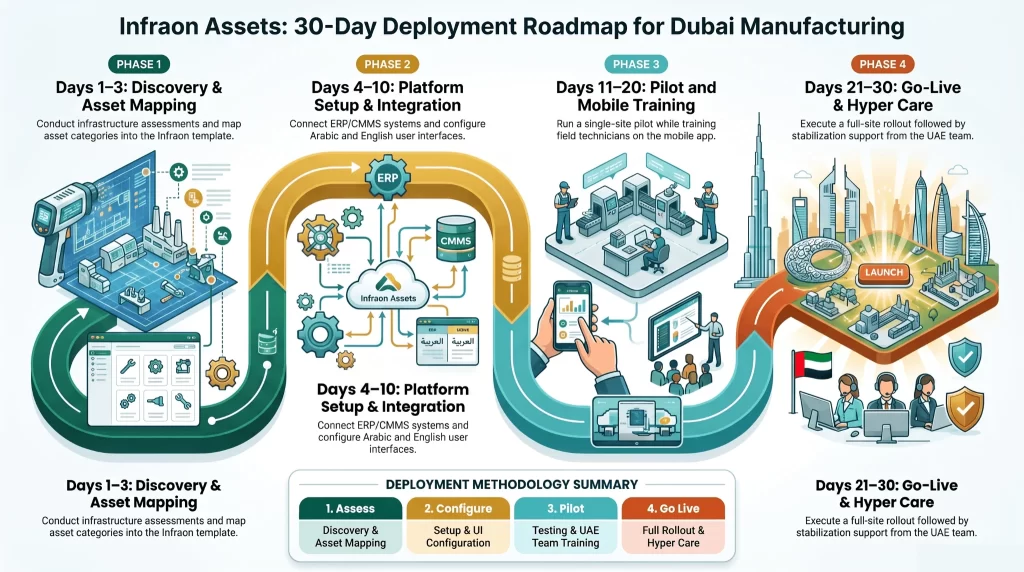
Getting Started: How Dubai Manufacturers Deploy Infraon in Under 30 Days
The Infraon onboarding journey
| Phase | Timeline | What Happens |
|---|---|---|
| Phase 1 | Day 1–3 | Discovery call, infrastructure assessment, and data import template provided to the customer team. Infraon maps existing asset categories to the platform structure. |
| Phase 2 | Day 4–10 | Platform configuration, ERP and CMMS connector setup, and user provisioning across roles and sites. Arabic and English UI configured per team preference. |
| Phase 3 | Day 11–20 | Pilot on one production line or one site. Team training delivered by the UAE-based Infraon support team. Mobile app deployed to field technicians. |
| Phase 4 | Day 21–30 | Full rollout, go-live across all sites, and hyper care support from the UAE team during the stabilization period. |
Deploy Infraon Assets Across Dubai Manufacturing Sites in 30 Days
DAYS 1-3: Discovery & Asset Mapping
- Discovery call
- Infrastructure assessment
- Data import template shared
- Asset categories mapped into Infraon
DAYS 4–10: Platform Setup
- ERP connector setup
- CMMS connector setup
- Users added by role and site
- Arabic and English UI configured
DAYS 11–20: Pilot and Training
- Pilot run on one line or site
- UAE support team training
- Mobile app deployed for field technicians
DAYS 21–30: Go-Live & Hyper Care
- Full site rollout
- Go-live across all sites
- UAE team support during stabilization
Frequently Asked Questions
What is inventory management software, and why do Dubai manufacturers need it?
Inventory management software tracks every physical and IT asset across a facility: what it is, where it is, who owns it, and what condition it is in. For Dubai manufacturers operating under the asset density demands of the Dubai Industrial Strategy 2030 and the UAE’s Operation 300bn program, that visibility is the difference between planned maintenance and expensive unplanned stoppages.
How is an asset management system different from an inventory management system?
Inventory management tracks the count and location of stock, specifically how many of something you have and where it is. An asset management system goes further: it tracks the full lifecycle of each asset from procurement through retirement, including maintenance history, depreciation, warranty status, assigned user, and compliance documentation. For manufacturing environments, the lifecycle data is what drives maintenance decisions, audit readiness, and capital planning.
Can asset management software integrate with our existing SAP or Oracle ERP?
Yes. It includes native connectors for SAP, Oracle, and Microsoft Dynamics. Asset data flows between the platforms without custom integration work, so procurement records, depreciation data, and maintenance costs remain aligned between the asset system and the ERP. For in-house or custom systems, a REST API is available.
Is Infraon’s asset management software suitable for large enterprises in the UAE with 1,000+ employees?
Infraon Assets is designed for enterprise scale. Pricing tiers cover asset populations from 250 to 10,000 and above, with an Enterprise plan for organizations that need bulk discounts, advanced security, SLAs, and custom configuration. Role-based access control, multi-site management, and Arabic and English UI support make it practical for large, multilingual UAE workforces.
How long does it take to implement an asset management system in a Dubai manufacturing facility?
Infraon’s standard onboarding timeline is 30 days from discovery call to full go-live. The first 72 hours are typically enough to establish initial inventory through agent-based and agentless discovery. A pilot on one production line or one site runs through the middle of the period, with full rollout and hyper care support completing the process in week four.
Does the software support the Arabic language and UAE regulatory compliance?
The platform is available in both Arabic and English, switchable at the user level. For compliance, Infraon Assets maintains audit-ready records aligned to ISO 55001 asset management requirements and TDRA IT asset lifecycle standards. Exportable PDF audit reports can be generated on demand, covering asset status, maintenance history, and access logs.
What is the typical ROI of deploying asset management software in UAE’s manufacturing sector?
Enterprise deployments managing 1,000 or more assets typically see payback within 6 to 12 months. The primary drivers are reduced unplanned downtime through predictive maintenance alerts, lower procurement spend through elimination of duplicate orders and rogue purchasing, and reduced audit preparation time through on-demand reporting.
Can I get a demo of Infraon’s inventory management software tailored to our Dubai facility?
Yes. Infraon offers a 30-minute personalized walkthrough with a product expert who covers your specific infrastructure, asset types, and integration requirements. No commitment is required.