


Enterprise IT asset management is hard to run through periodic inventory checks and spreadsheets. Technology now spans employee devices, software, SaaS subscriptions, cloud resources, connected equipment, and infrastructure that may be distributed between offices, homes, data centers, and third-party environments.
That expansion changes the management problem. Leaders need a reliable record of what the organization owns or uses, who is responsible for each asset, what it costs, where it is in its lifecycle, and what action comes next. Enterprise ITAM brings those records and operating processes together so procurement, IT operations, finance, security, and audit teams can work from the same asset data.
What Is Enterprise IT Asset Management, Really?
Enterprise IT asset management is the discipline of recording, managing, and governing technology assets from planning through retirement. The goal is continuous accountability over ownership, cost, usage, lifecycle status, risk, and disposal.
At enterprise scale, the challenge comes from volume and movement. Thousands of assets can change users, locations, configurations, licenses, support status, and financial value over time. If those changes reach the asset record late, purchasing and operational decisions begin with stale information.
The Full IT Asset Lifecycle
A useful lifecycle model follows five stages.
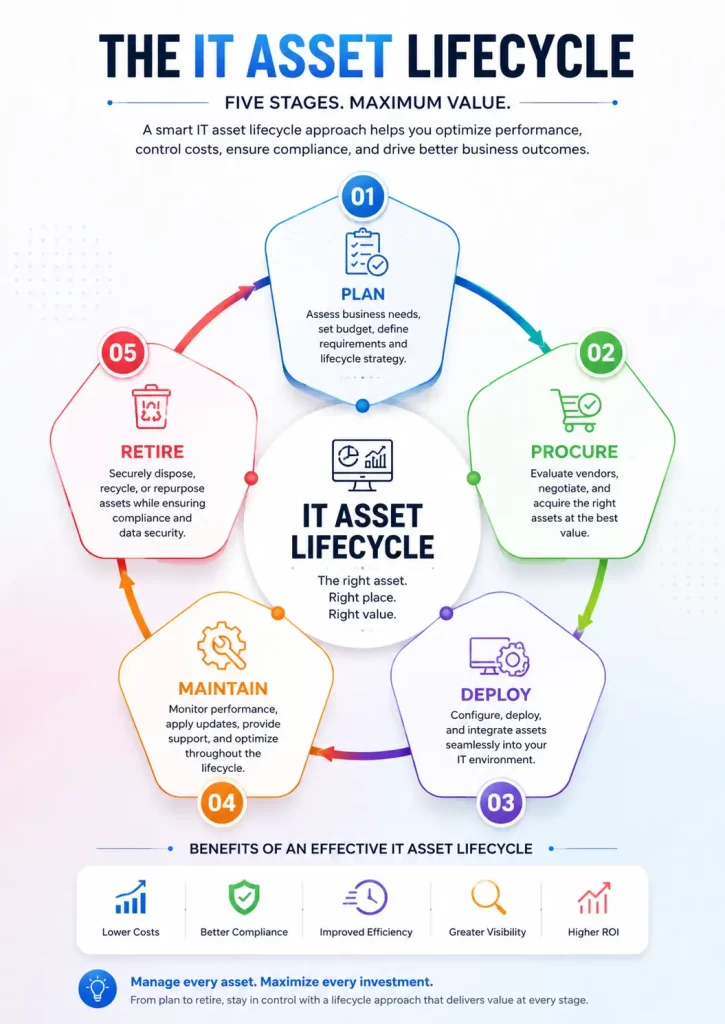
Each stage answers a different management question.
- Plan what capacity, equipment, software, and budget the organization needs
- Procure with approved vendors, ownership records, contract data, and expected lifecycle costs
- Deploy with asset assignment, location, configuration, and user accountability recorded from day one
- Maintain warranty, repair, support, usage, license, and asset health records through service life
- Retire with decommissioning, data handling, disposal, financial closure, and audit evidence recorded
The value comes from continuity between those stages. Purchase data should carry into deployment. Deployment records should feed service and audit work. Retirement should close the asset record and remove equipment or licenses from active inventory when they leave service.
What Counts as an IT Asset in 2026?
Enterprise inventories now cover several technology categories, each with a different ownership and cost model.
| Asset category | Examples | Management concern |
|---|---|---|
| Hardware | Laptops, desktops, servers, network equipment, peripherals | Assignment, location, warranty, maintenance, depreciation, retirement |
| Software | Installed applications, enterprise licenses, operating systems | Entitlement, deployment, usage, renewal, compliance |
| SaaS | Subscription applications and cloud-delivered business tools | Ownership, access, usage, spend, renewal |
| Cloud | Virtual machines, hosted resources, cloud services | Consumption, ownership, cost, lifecycle |
| IoT | Connected sensors, cameras, controllers, and smart devices | Inventory, ownership, security status, maintenance |
This broader inventory makes enterprise ITAM a cross-functional discipline. Finance cares about capital and recurring spend. Security needs asset accountability. IT operations needs current technical records. Procurement needs demand and contract context. Each function reads a different part of the same asset history.
ITAM vs. EAM vs. SAM vs. CMDB
These disciplines overlap, which can create confusion during software evaluation.
| Discipline | Primary focus | Typical coverage | Main business question |
|---|---|---|---|
| ITAM | Technology assets through their lifecycle | Hardware, software, SaaS, cloud, IoT | What technology do we own or use, who owns it, what does it cost, and where is it in its lifecycle? |
| EAM | Physical enterprise assets | Facilities, machinery, equipment, fleets | How should physical assets be maintained and used through their service life? |
| SAM | Software rights and usage | Installed software, licenses, entitlements, subscriptions | Are software rights, deployments, usage, and renewals under control? |
| CMDB | Configuration items and relationships | Services, applications, servers, devices, dependencies | How do configuration items relate to services and operational changes? |
An enterprise may use all four disciplines. ITAM provides commercial and lifecycle context for technology assets, SAM goes deeper into software rights and consumption, and a CMDB records operational relationships between configuration items. EAM usually has a wider physical-asset remit.
Why Enterprises Need Disciplined ITAM in 2026
Asset data becomes financially useful when leaders can trust it during purchasing, renewals, audits, security events, and retirement decisions. Weak records force teams to rebuild that picture whenever a decision arrives.
The Real Cost of Ghost Assets and Shadow IT
Ghost assets remain in records even though their real status is unclear. Some have been retired, lost, reassigned, or removed from service without a matching update. Shadow IT creates the opposite problem. A technology resource is in use while central IT lacks a complete record of its ownership, spend, access, or lifecycle.
Both problems distort decision-making. Ghost records can inflate inventory and support assumptions. Unrecorded technology can create duplicate spend, renewal exposure, weak ownership, and audit gaps. Automated discovery and regular reconciliation reduce the gap between recorded inventory and the environment that teams are actually managing.
Audit Season Without Reliable ITAM
Audit pressure exposes every gap that daily operations can temporarily work around. Teams may need to establish who owns a device, why software is installed, which contract covers it, when a purchase occurred, or how retired hardware was handled.
If those records live in separate files and systems, the audit becomes a reconstruction exercise during IT asset management. A current asset repository changes that workload by keeping lifecycle events, assignments, license data, purchase records, and retirement history available throughout the year.
The Numbers That Should Worry Your CFO
Internal asset metrics often give CFOs a clearer warning than industry averages.
- Assets with no current owner or assigned user
- Paid software with little or zero recorded usage
- Duplicate purchases made while usable inventory remains available
- Devices missing a recent inventory confirmation
- Assets operating past warranty, support, or planned retirement dates
- SaaS renewals with unclear ownership or business usage
- Retired equipment that remains active in financial or IT records
These figures connect ITAM directly with spending discipline. They show where asset data quality can influence procurement, renewal, support, and replacement decisions.
The 4 Biggest IT Asset Management Challenges (And What They’re Costing You)
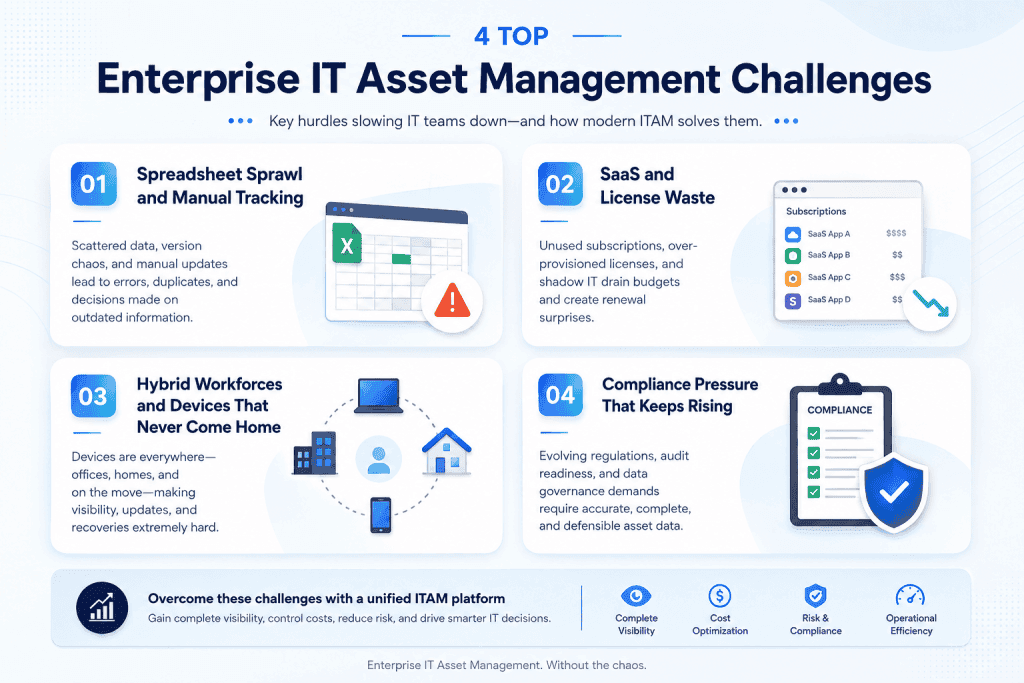
Enterprise ITAM problems usually become visible as a cost, an audit issue, or an operational delay. The brief identifies four areas that deserve direct attention.
Spreadsheet Sprawl and Manual Tracking
Spreadsheets work well as local records, but enterprise asset management creates too many changes for manual updates to remain dependable. User transfers, device swaps, repairs, new purchases, software deployments, and retirements can occur every day.
The cost appears through reconciliation time and purchasing decisions made from outdated inventory. Automated discovery and lifecycle updates reduce manual entry while giving asset managers a current operational record.
SaaS and License Waste
Software spending can grow quietly when licenses are purchased by different departments, former users remain assigned, duplicate applications cover the same requirement, or renewals proceed with weak usage data.
Asset and software management records help leaders compare entitlement, assignment, usage, ownership, and renewal information before committing budget. That makes license governance part of routine financial management instead of a last-minute renewal exercise.
Hybrid Workforces and Devices That Never Come Home
Hybrid work expands the distance between IT teams and the devices they manage. Equipment may move between offices and homes, remain with employees after role changes, or miss physical audit cycles.
This makes ownership records, user assignment, remote discovery, recovery workflows, and lifecycle status central to asset control. The financial issue becomes larger when missing equipment triggers unnecessary replacement purchases or leaves retired devices open in inventory.
Compliance Pressure That Keeps Rising
Audit and regulatory work depends on evidence. Asset records can support that evidence by showing what systems exist, who owns them, when they changed, and how they were retired.
The main risk is assuming an ITAM platform creates compliance by itself. It provides records and controls that support compliance work, while legal, security, privacy, and audit teams remain responsible for interpreting and applying each requirement.
Enterprise IT Asset Management Practices That Actually Work
Good ITAM depends on the quality of the operating process behind the software. Five practices in the brief address the points where enterprise asset records commonly break down.
Start With Automated Asset Discovery
Discovery creates the initial inventory and keeps checking the environment for devices, software, servers, and other technology resources. Agent-based, agentless, directory-based, and network methods can cover different asset types.
The important operating decision is reconciliation. Discovered data needs to connect with purchasing, ownership, location, and lifecycle records so the organization gains a usable asset record instead of a second inventory list.
Build a Single Source of Truth
A central repository gives procurement, operations, service, finance, and audit teams a shared asset record. That record should include ownership, lifecycle status, location, purchase context, warranty, support data, license information, and relevant history.
Governance matters here. Decide which system owns each field, who can change it, and which events trigger updates. A central database becomes valuable only when the data remains current.
Track the Whole Lifecycle
Purchasing is one event in a much longer asset history. Deployment, reassignment, maintenance, upgrades, recovery, retirement, and disposal all affect financial and operational decisions.
Lifecycle tracking should therefore follow assets after purchase and continue until the organization has completed decommissioning and disposal. Closing that final stage prevents retired assets from remaining active in inventory, support, or financial records.
Automate Compliance and Audit Readiness
Automation can capture lifecycle events, maintain audit trails, issue reminders for expiring contracts or warranties, and generate reports from current asset records. This reduces the amount of evidence teams need to reconstruct before an audit.
The automation should support defined control requirements. Audit teams still need documented ownership, review rules, and evidence standards around the data produced.
Connect ITAM With ITSM and the CMDB
ITAM records commercial and lifecycle context, while ITSM records service activity and the CMDB records configuration relationships. Connecting them gives service teams asset ownership and history when an incident arrives, while asset teams gain service context that can influence repair, replacement, and retirement decisions.
That connection also reduces duplicate record maintenance. A lifecycle update can feed related service and configuration records according to the organization’s governance rules.
Compliance Across India, Southeast Asia, and the Gulf
Regional operations add another layer because asset data, device ownership, disposal, and technology governance can intersect with cybersecurity, privacy, and environmental requirements.
India and CERT-In, E-Waste Rules, and ISO 27001
CERT-In directions require covered cyber incidents to be reported within six hours of being noticed. Current asset ownership, system records, and inventory history can support the internal identification work that precedes reporting. India’s E-Waste Management Rules 2022 and later amendments also make end-of-life electronic equipment an important governance consideration. ISO/IEC 27001 adds a widely used information security management framework that organizations may adopt alongside statutory requirements.
ITAM contributes by maintaining hardware inventories, ownership records, lifecycle status, and disposal evidence. Those records support security response and retirement governance while remaining one component of the wider compliance program.
Indonesia and Malaysia
Indonesia’s Law No. 27 of 2022 governs personal data protection, while Malaysia’s Personal Data Protection Act 2010 regulates personal data processing in commercial transactions and was amended in 2024.
Asset repositories can contain user assignments, device ownership, access details, and administrator information. Enterprises operating in these markets therefore need to govern asset records with the same attention given to other business systems that process personal data. Hosting location, transfers, access control, retention, and vendor arrangements should be assessed under the rules that apply to the organization and sector.
UAE and Saudi Arabia
The UAE’s federal Personal Data Protection Law governs personal data processing at the federal level, while Saudi Arabia’s PDPL defines controller obligations for personal data. Saudi Arabia’s NCA also maintains cybersecurity controls, including ECC 2-2024, for organizations within its scope.
For ITAM leaders, the practical issue is evidence and accountability around technology resources that store, process, or provide access to regulated data. Saudi Vision 2030 provides the wider digital transformation context, while PDPL and NCA controls provide the direct governance requirements relevant to data and cybersecurity.
What Comes Next for AI, Sustainability, and ITAM
Enterprise ITAM is moving toward stronger use of operational data in three areas already named in the brief.
AI-Driven Discovery and Predictive Asset Health
AI can analyze asset records, discovery data, service history, and usage patterns to identify anomalies or indicate where an asset may need attention. Predictive asset health extends that idea by using historical and current data to support maintenance or replacement planning.
The practical value depends on input quality. Weak inventory data produces weak recommendations, so AI adoption makes asset data governance even harder to ignore.
Green ITAM, E-Waste, ESG, and Circular IT
Sustainability makes retirement a management decision that includes reuse, reassignment, refurbishment, recycling, and disposal under applicable environmental requirements.
ITAM gives sustainability programs the lifecycle records needed to examine device age, usage, repair history, retirement timing, and disposal evidence. That creates a stronger factual basis for e-waste reporting and circular IT programs.
FinOps Meets ITAM
FinOps focuses on cloud financial management, while ITAM tracks lifecycle, ownership, and cost across enterprise technology. Their intersection gives leaders a broader way to examine technology spending alongside usage and accountability.
The connection is useful when hardware, software, SaaS, and cloud spending are reviewed together. Leaders can then compare technology demand with actual use before approving purchases, renewals, or resource expansion.
How to Choose Enterprise Asset Management Software
Buying ITAM software should begin with the operating problems the organization needs to solve. A long feature list can hide gaps in discovery coverage, lifecycle management, integrations, reporting, or regional support.
Must-Have Capabilities and Nice-to-Have Capabilities
Start by separating capabilities required for daily governance from features that can wait.
Core capabilities
- Automated discovery for the asset types used by the organization
- Central asset repository with ownership, location, lifecycle, and financial context
- Hardware and software lifecycle management
- License and entitlement management
- Audit trails and compliance reporting
- ITSM and CMDB integration
- Retirement and disposal records
Secondary capabilities
- Advanced AI recommendations
- Sustainability reporting layers
- Specialized dashboards for individual stakeholder groups
- Optional mobile workflows for selected asset processes
The dividing line should come from business requirements, operating scale, audit needs, and existing system architecture.
Questions to Ask Every Vendor
A useful evaluation goes deeper than a product demonstration.
- Which asset types can discovery identify automatically?
- How are duplicate and conflicting records reconciled?
- Which lifecycle events can trigger automated workflows?
- How does the product connect with ITSM and CMDB records?
- What audit history is retained for asset changes?
- How are software entitlement and usage records handled?
- Which deployment and data-hosting options are available for each target region?
- How does the product handle retirement and disposal evidence?
- What implementation work is required to migrate existing inventory data?
These questions test the operating model behind the feature list.
Red Flags That Predict a Failed Rollout
Problems often appear before implementation begins.
- Discovery coverage is unclear during evaluation
- Ownership of asset data fields has never been defined
- Existing spreadsheet data will be migrated without reconciliation
- ITAM is being deployed separately from ITSM, CMDB, procurement, and finance processes
- Success is measured by the number of imported records instead of asset data quality and business outcomes
- Retirement and disposal receive little attention during process design
A successful rollout needs a data ownership model, integration plan, lifecycle process, and clear measures for asset accuracy, cost control, audit readiness, and user accountability.
How Infraon Handles Enterprise IT Asset Management
Infraon Assets addresses the enterprise IT asset management lifecycle described in this article through automated discovery, asset records, software management, tracking, ITSM integration, and retirement workflows. Infraon states that its ITAM capabilities cover the lifecycle from requisition and purchasing through retirement or disposal. Its discovery options include agent-based, agentless, and Active Directory-based methods.
Discovery to Disposal in One Platform
The product combines automated discovery with an asset repository that records location, availability, lifecycle status, warranties, and related asset data. Barcode and QR tracking can support physical inventory processes, while ITSM and CMDB connections bring service and configuration context into asset management.
This approach follows the lifecycle model in the brief. Discovery establishes what exists, asset records maintain accountability during use, and retirement workflows close the lifecycle when equipment leaves service.
Built for Compliance-Heavy, Fast-Growing Markets
Infraon’s asset records, audit trails, lifecycle workflows, discovery, and compliance reporting can support organizations that need consistent asset evidence across distributed operations. The platform also offers asset tracking and centralized reporting for multi-location environments.
Regional legal obligations still require separate assessment by each organization. ITAM provides asset evidence and governance controls that can contribute to that work.
What Results Look Like
Infraon reports that Velocis, an Indian system integrator with 1,200+ professionals and 130+ locations, achieved a 40% productivity increase and an 80% reduction in training time after using Infraon ITAM for pan-India asset and support operations. The case study attributes the results to bulk asset uploads, barcode and QR tracking, automated SLA management, and centralized multi-customer reporting.
That example shows the operational value of keeping inventory, tracking, lifecycle work, and support activity connected when an organization manages assets at scale.
From Asset Chaos to Enterprise Control
Enterprise ITAM gives leaders a way to govern technology as a lifecycle portfolio. Discovery, ownership, usage, service history, financial context, audit evidence, and retirement records become parts of the same management process.
The strongest programs keep that process continuous. They discover assets, reconcile records, connect lifecycle data with service and configuration systems, review spending against usage, and close the record at retirement. That operating discipline is what turns an asset inventory into a dependable source for financial, operational, security, and audit decisions.
FAQs on Enterprise IT Asset Management
What is enterprise IT asset management?
Enterprise ITAM manages technology assets through planning, procurement, deployment, maintenance, reassignment, and retirement. It combines asset records with ownership, cost, usage, lifecycle, and audit information.
What is the difference between ITAM and EAM?
ITAM focuses on technology assets such as hardware, software, SaaS, cloud resources, and connected devices. EAM usually covers a wider range of physical enterprise assets such as facilities, machinery, equipment, and fleets.
What does enterprise asset management software do?
Enterprise IT asset management software discovers and records technology assets, tracks ownership and lifecycle status, manages hardware and software information, supports audit work, and connects asset data with related business systems.
How much does poor IT asset management cost a company?
The cost depends on the organization. Common sources include duplicate purchases, unused licenses, missing equipment, unnecessary renewals, audit labor, support spending on retired assets, and replacement purchases caused by unreliable inventory data.
How does ITAM help with compliance audits?
ITAM maintains asset inventories, ownership data, change history, lifecycle records, license information, and retirement evidence. Auditors and internal teams can use those records as supporting evidence for controls that depend on technology accountability.
Is ITAM still needed in a fully cloud or SaaS environment?
Yes. Cloud and SaaS environments still create ownership, usage, cost, access, renewal, lifecycle, and governance questions. The asset categories change, while the need for accountability continues.
How does AI improve IT asset management?
AI can examine discovery, inventory, usage, and service data to identify anomalies, support asset health analysis, and recommend maintenance, reassignment, or replacement actions. Its value depends heavily on the quality and currency of the underlying asset data.