


Indonesian enterprises face a unique digital landscape. Rapid adoption of cloud infrastructure, remote work across thousands of islands, and stricter regulatory oversight create pressure on IT departments. In 2026, selecting an ITSM tool is no longer a technical footnote. It is a strategic decision that affects revenue, compliance, and employee productivity.
The market offers many solutions. Some focus on incident tracking alone. Others bundle IT operations management with service desks. The right choice depends on localization needs, data residency rules, and AI-driven automation.
Let’s find out exactly what enterprise leaders in Jakarta, Surabaya, and Medan should evaluate.
Why ITSM is Critical for Indonesian Enterprises
Digital transformation in Indonesia
Manufacturing, banking, and logistics sectors are digitizing rapidly. Point of sale systems, supply chain platforms, and customer portals must stay online. Without a formal ITSM framework, each digital failure becomes a firefighting exercise. ITSM introduces structured incident handling. It routes tickets automatically, escalates based on impact, and tracks resolution steps. This turns chaos into a repeatable process.
Multi-location IT complexity
A single enterprise may operate offices in Batam, Balikpapan, and Makassar. Each location has its own network hardware, local vendors, and user behavior patterns. An ITSM tool centralizes logging of all IT requests. A technician in Jakarta can view a printer failure in Manado without switching systems. Such cross-island visibility reduces finger-pointing and speeds up repairs.
Compliance and SLA pressure
Indonesian financial services face OJK regulations that demand audit trails for IT changes. E-commerce platforms must meet service level agreements with payment gateways. ITSM software automatically records who approved a change, when it happened, and whether testing succeeded. It satisfies auditors without manual report writing. SLA dashboards show real-time compliance percentages, so managers can intervene before breaches occur.
Key Challenges Faced by IT Leaders in Indonesia
Distributed workforce across islands
IT teams are not concentrated in one city. A help desk might be based in Bandung while users are spread across Nusa Tenggara. Language and time zone differences delay resolution. A robust ITSM tool provides a single portal accessible from any device. Users describe problems in Bahasa Indonesia. Attachments and screen recordings travel with the ticket, not through separate email threads.
Lack of centralized IT visibility
Many enterprises discover a server issue only after dozens of complaints arrive. Without central monitoring, root causes stay hidden. ITSM platforms integrate with network monitoring tools. They correlate alerts with open incidents. A switch failure in an office automatically creates a ticket and notifies local staff. This visibility prevents the same problem from being reported multiple times.
High incident resolution time
Manual ticket assignment leads to bottlenecks. Level 1 agents pick tasks arbitrarily. Complex issues sit untouched. ITSM tools use rules-based routing. Password reset requests go to a specific queue. Database failures reach senior engineers directly. Automated notifications remind assignees of pending tickets. Average resolution time drops from days to hours.
Tool fragmentation
A typical enterprise uses separate systems for help desk, change management, and asset inventory. Agents toggle between three or four interfaces. Data does not sync. A laptop assigned to an employee still appears as available in the asset tool. Integrated ITSM platforms eliminate these gaps. Asset records link directly to incident history. When a change request is approved, the asset database updates automatically.
Compliance and audit risks
Internal audits often reveal unapproved configuration changes. Someone modifies a firewall rule on a Friday evening, and no record exists. ITSM software forces every change through a workflow. Approvers must sign off before execution. After deployment, a verification step confirms success or rollback. This closed-loop process gives auditors a complete timeline.
What is an ITSM Tool?

Definition of ITSM
ITSM stands for IT service management. A tool in this category designs, executes, and tracks IT services from request to resolution. Unlike basic ticketing systems, an ITSM platform includes process automation, knowledge bases, and performance analytics.
Core modules
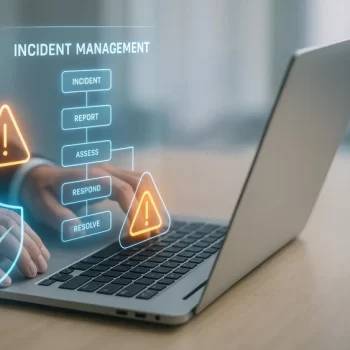
Incident management: When a user reports a broken application or a slow network, an incident is born. The tool captures priority, category, and description. Automated workflows assign the incident to the right team. Agents document troubleshooting steps. A timer tracks time to resolution. After closure, a satisfaction survey collects feedback.
Change management: Any modification to the IT infrastructure requires a change request. This includes applying security patches, upgrading servers, or altering network configurations. The ITSM tool evaluates risk levels. Low-risk changes follow a fast path with one approval. High-risk changes need a change advisory board review. All changes include rollback plans and scheduled windows.
Asset management: Every laptop, monitor, switch, and software license is an IT asset. The tool maintains a lifecycle record for each asset. Purchase date, warranty expiry, assigned user, and maintenance history live in one database. This prevents overspending on new hardware when unused devices exist elsewhere.
Service catalog: Employees request IT services through a self-service portal. The catalog lists available services like new account creation, VPN access, or software installation. Each service has a form to collect necessary details. The catalog reduces back-and-forth emails. Requesters see estimated delivery times and current status.
What to Look for in ITSM Tools in Indonesia
Cloud vs. on-premise (data residency)
Cloud ITSM solutions: Software as a service models require no hardware investment. Updates happen automatically. Teams access the platform from any internet connection. Data residency becomes the main concern. Some global providers store data outside Indonesia. For banking and government sectors, this violates local regulations. Check where the cloud tenant resides. AWS Jakarta region or equivalent local hosting is mandatory for regulated industries.
On-premise ITSM: The software runs inside a company’s own data center. Full control over data location satisfies strict compliance rules. However, your team must manage updates, backups, and server uptime. On-premises systems require upfront hardware purchases and dedicated administrators. Choose this path only if you have mature internal IT operations.
Bahasa Indonesia support: Local language interface reduces training time for help desk agents. Users feel more comfortable describing technical issues in Bahasa Indonesia. Ticket forms, knowledge base articles, and automated email notifications should all support Indonesian characters and grammar. Look for tools that include Indonesian translations for standard IT terms.
AI-driven automation: Modern ITSM tools embed machine learning for pattern recognition. The AI learns which incidents are similar. It suggests solutions from past resolutions. For repetitive requests like password resets, the AI performs the action without human intervention. This shrinks ticket volume for level 1 agents. Predictive analytics flags potential outages before users notice.
Integration with existing tools: Your enterprise already uses Active Directory, Slack, Microsoft Teams, etc. An ITSM tool must pull user identities from Active Directory. It should create tickets from Teams messages. Integration with monitoring tools automatically turns alerts into incidents. Without APIs and webhooks, the ITSM platform becomes another silo.
Scalability for 1000+ employees: A tool suitable for 200 employees may break under 2000. Evaluate database performance, concurrent user limits, and reporting speed. The architecture should support horizontal scaling. Cloud native solutions typically handle growth better than legacy on-premises systems. Request reference customers who operate at your scale or larger.
Best ITSM Tools in Indonesia (Enterprise Comparison)
Infraon ITSM
Infraon ITSM leads the 2026 guide for Indonesian enterprises. The platform combines IT service management, IT operations management, and IT asset management in one unified interface. AI-driven automation reduces manual ticket handling. The system deploys in weeks, not months. Pricing remains competitive compared to global alternatives. Bahasa Indonesia support is baked in from the start. Data residency options include local cloud hosting and on-premises installation.
ServiceNow
ServiceNow remains a global heavyweight. Its modular architecture covers ITSM, HR service delivery, and security operations. Large multinationals in Indonesia adopt ServiceNow for cross-department workflows. However, implementation costs are high. Customization requires specialized consultants. Deployment cycles often exceed six months. For enterprises with massive scale and budget, ServiceNow works well.
Jira Service Management
Atlassian built this tool for DevOps-friendly organizations. It shares the same backend as Jira Software. Integration with Confluence, Bitbucket, and Opsgenie is seamless. Developers appreciate the familiar interface. However, asset management features are less mature than dedicated ITSM platforms. Reporting can feel rigid. First-time ITSM users may struggle with configuration.
Freshservice
Freshservice offers a clean, modern interface. The ticketing system includes gamification to motivate agents. Automation workflows are visual and easy to build. Freshservice works well for small to medium enterprises. At a large scale with complex change management requirements, some teams outgrow their capabilities. Data residency outside Indonesia can be a compliance barrier.
ManageEngine
ManageEngine provides a broad suite of enterprise IT tools. ServiceDesk Plus is the ITSM component. On-premises deployment is straightforward. Pricing is lower than ServiceNow and Freshservice. The trade-off is a dated user interface and slower support response times. For cost-conscious organizations with internal IT expertise, ManageEngine remains a valid option.
Why Infraon is Built for Modern ITSM in Indonesia
Unified ITSM plus ITOM plus ITAM
Many vendors sell separate modules that do not talk to each other. Infraon delivers a single platform. When a monitoring sensor detects high CPU usage, the system creates an incident. That incident links to the affected server asset. A change request to reboot the server references both the incident and the asset. This closed loop eliminates blind spots.
AI-based automation
Infraon ITSM’s AI engine categorizes incoming tickets without rules. It extracts intent from user descriptions. For example, a ticket saying “tablet won’t connect to Wi-Fi” goes to the network team. The AI suggests articles from the knowledge base. If the same error repeats across ten devices, the system escalates proactively to problem management.
Fast deployment
Traditional ITSM implementations require lengthy discovery workshops. Infraon uses automated discovery agents that scan your network in hours. Default workflows comply with ITIL best practices. Your team can adjust them after go-live. Most enterprises complete the rollout within four weeks.
Cost-effective vs. global tools
Licensing for ServiceNow or Freshworks often includes per-user per-month fees that scale quickly. Infraon offers predictable pricing based on active agents and assets. No hidden costs for API access or basic modules. Indonesian enterprises get enterprise-grade features without currency exchange volatility.
Benefits of Implementing ITSM Software
5 Practical Benefits of ITSM Software
Reduced downtime
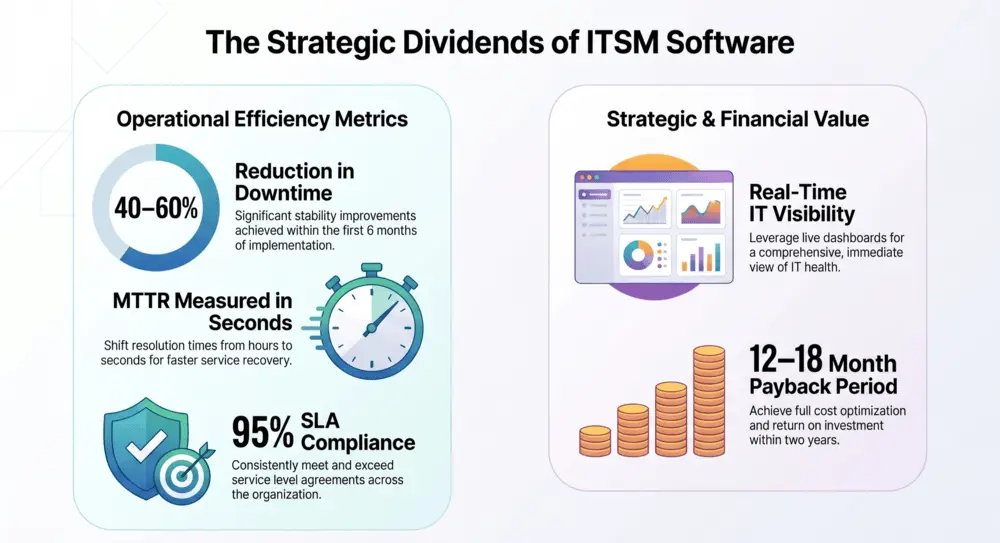
Each minute of unplanned downtime costs revenue and trust. ITSM software enforces proactive monitoring. Incident response becomes systematic. Average downtime drops by 40 to 60 percent within six months.
Faster MTTR
Mean time to repair shrinks because tickets route directly to skilled engineers. Knowledge base articles give agents step-by-step solutions. Automation resolves common issues like account unlocks in seconds.
Improved SLA compliance
Service level agreements with business units become measurable. Dashboards show open tickets by priority and age. Automated alerts warn managers before SLA breaches happen. Compliance rates rise above 95 percent.
Better IT visibility
Executives gain a real-time view of IT health. Reports show which teams handle the most tickets, which systems generate repeated incidents, and where the budget should go for training or upgrades. This visibility supports data-driven decisions.
Cost optimization
Asset management prevents unnecessary hardware purchases. Automation reduces headcount needs for repetitive tasks. Lower downtime keeps production systems running. ROI calculations typically show payback within 12 to 18 months.
How to Choose the Right ITSM Software
Define business goals
Write down three measurable outcomes. Examples: reduce average incident resolution from 8 hours to 4 hours, achieve 99 percent SLA compliance, or eliminate manual asset tracking spreadsheets. Each goal narrows the candidate list.
Evaluate scalability
Ask vendors for reference customers at twice your employee count. Test the system with a simulated load. Check how long reports take to generate with full historical data. A tool that slows down at scale will frustrate your team.
Check integrations
List every system your IT team uses daily. Active Directory, email, chat, monitoring, backup, and identity management. Provide the list to each vendor. Watch live demos of those integrations. Beware of promises about future roadmap support.
Request a demo and proof of concept
A 30-minute demo shows surface features. A proof of concept runs for two weeks on your actual data. You will discover hidden limitations in reporting, automation rules, or multilingual support. Insist on a PoC before signing any contract.
Compare the total cost of ownership.
Look beyond the first-year license fee. Include implementation services, training, integration development, and ongoing administration. On-premises solutions add server hardware and backup costs. Cloud solutions might charge for extra API calls or storage. Calculate a three-year TCO.
Final Thoughts
Selecting an ITSM tool in 2026 defines how your enterprise handles digital growth. The right platform unifies service desk, asset management, and operations monitoring. It respects Indonesian data residency rules and speaks Bahasa Indonesia at every user touchpoint. Infraon delivers this combination without global enterprise price tags.
Request a personalized demo focused on your industry. Run a pilot with your actual incident data. See the difference in resolution speed and team satisfaction.
FAQs
What does ITSM mean for Indonesian Enterprises?
ITSM solutions can be tailored for businesses operating in Indonesia, considering localization, compliance, and scalability needs. These tools support Bahasa Indonesia, local data hosting, and integration with commonly used enterprise systems.
Which is the best ITSM tool in Indonesia?
The best ITSM tool depends on enterprise needs, but solutions like Infraon, ServiceNow, and Jira Service Management are widely used. Infraon leads for unified ITSM plus ITOM in local deployments.
Why do enterprises need ITSM software?
ITSM software helps automate IT processes, reduce downtime, and improve service delivery. It provides audit trails for compliance and reduces manual effort for support teams.
Is cloud ITSM suitable for Indonesia?
Yes, cloud ITSM is widely adopted, especially for scalability and remote workforce management. Choose providers with data centers in Indonesia if you operate in regulated sectors like finance or healthcare.