


Recurring service issues seldom begin as one large failure. They usually grow from small signals that never receive enough attention. A missed handoff becomes a slow response. An overdue response becomes an SLA breach. A knowledge gap becomes a repeat ticket. After a while, the service desk spends its day reacting to patterns that should have been fixed earlier.
This is where Continual Service Improvement in ITIL gives ITSM leaders a disciplined way to work. CSI turns performance data, service reviews, user feedback, and incident history into a repeatable improvement cycle. The aim is to find weak points, set measurable goals, take action, review results, and make the better way of working part of normal operations.
ITIL 4 modernizes this thinking by treating improvement as a shared management practice rather than a final activity at the edge of service delivery. This is necessary for organizations dealing with hybrid infrastructure, rising service expectations, tighter SLA commitments, and faster business change.
What Is Continual Service Improvement in ITIL?
Definition of CSI
Continual Service Improvement, or CSI, is the ITIL discipline used to improve IT services, workflows, service management practices, and user outcomes through repeated measurement and review. It asks IT organizations to treat improvement as an ongoing operating habit rather than an occasional repair exercise after service quality drops.
In ITSM, CSI connects service data alongside business objectives. Incident records, SLA trends, backlog patterns, customer satisfaction scores, change outcomes, and knowledge usage all become inputs. Service owners can then decide which issue deserves attention first and which action will create measurable value.
Why CSI matters in ITSM
Service management loses control when every issue receives the same urgency, as well as when decisions depend only on individual judgment. CSI develops a shared method for choosing the right improvement area, backing that choice with data, and checking whether the chosen action changes results.
The value is visible during daily operations. Fewer repeat tickets reach the service desk. SLA owners can spot risk earlier. Knowledge articles become easier to use. Incident management becomes less dependent on memory. Business leaders also gain a better view of how service management investments affect stability and user experience.
Difference Between Continual Improvement and Continuous Improvement
Continual improvement works through repeated review cycles. It checks the current service position, identifies gaps, selects an action, measures results, and repeats the cycle. The pace can vary by service, risk level, and business priority.
Continuous improvement suggests change that runs all the time inside an active process. In ITSM writing, both terms frequently appear together. CSI uses the continual approach because enterprise service management needs measurement, governance, and control. Every change should have a reason, an owner, a target, and a way to prove progress.
| Area | Continual Improvement | Continuous Improvement |
| How it works | Uses repeated review cycles with goals, owners, measures, and review windows. | Runs as ongoing change inside an active service process. |
| ITSM use | Suits service review, governance, SLA analysis, and controlled service improvement work. | Suits frequent process tuning where changes happen during day-to-day execution. |
| CSI link | Matches the ITIL CSI style because every action has a target and proof of progress. | A related improvement term, often used beside CSI in service management writing. |
CSI in ITIL v3 vs. ITIL 4
ITIL v3 placed Continual Service Improvement as one stage in the service lifecycle. It came after service strategy, service design, service transition, and service operation. This structure helped organizations review service performance after delivery and make adjustments over time.
ITIL 4 extends the idea into the Service Value System. Continual improvement becomes part of how value is planned, delivered, measured, and improved. This modernization makes CSI relevant to service desks, operations, product ownership, governance, and executive planning.
Why Continual Service Improvement is Critical in Modern ITSM
Modern ITSM work carries a higher service burden than older ticketing models. Users expect fast answers, leadership expects SLA discipline, and digital services depend on stable workflows behind the scenes. CSI gives service management leaders a repeatable way to control repeated problems before they turn into service debt.
- Recurring incidents drop when root patterns are reviewed instead of handled as isolated tickets.
- SLA compliance improves because risk can be seen through response, resolution, backlog, and escalation data.
- Customer satisfaction rises when users experience faster resolution, better communication, and fewer repeat disruptions.
- Service desk output grows when repetitive tasks move into automation and knowledge workflows.
- Digital transformation gains firmer operating discipline because new services come with measurement, review, and improvement cycles.
The deeper value lies in behavior change. CSI encourages service owners to ask better questions, such as:
- Which tickets keep returning?
- Which SLA targets remain at risk?
- Which workflow adds delay?
- Which knowledge gap makes users dependent on agents?
The 7 Continual Service Improvement Steps Explained
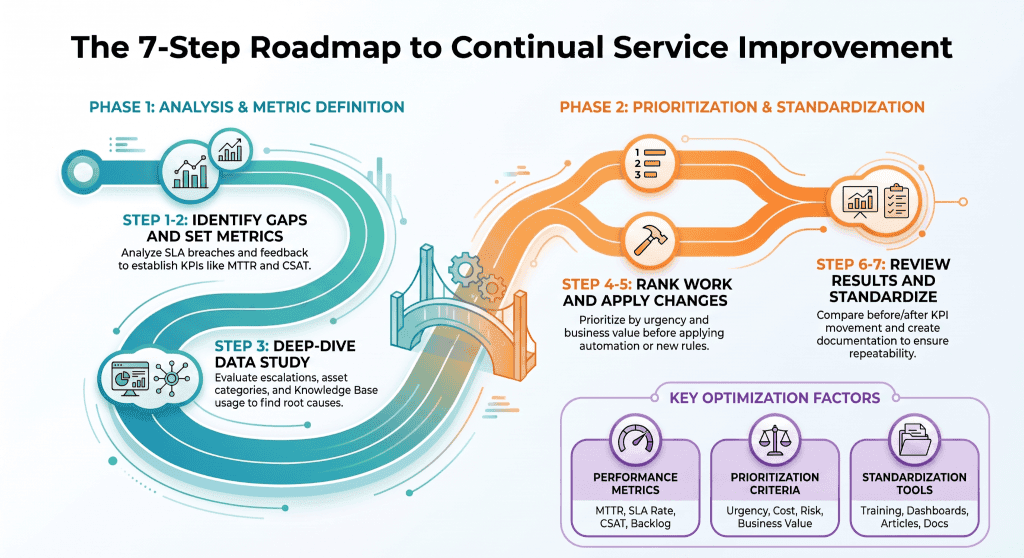
Step 1: Identify improvement opportunities
The first step is to decide where improvement should begin. This can come from SLA breach reports, incident trends, user feedback, audit findings, service review notes, or recurring change failures. The right opportunity should connect to service performance and business impact.
A service desk may find that password requests consume too much agent time. An infrastructure group may see repeated incidents around a business application. A service owner may spot an SLA pattern tied to delayed escalation. CSI gives each of those findings a path into action.
Step 2: Define measurable goals
Improvement goals need numbers. A general aim, such as better service quality, gives people little direction. A measurable goal gives the initiative shape. It may target MTTR reduction, SLA compliance rate, first contact resolution, ticket backlog, or CSAT movement.
The goal should also include a baseline. If the service desk wants to reduce MTTR, it must know the current figure, the desired figure, the review window, and the services included in the measurement.
Step 3: Analyze service performance
Analysis turns raw service data into insight. Incident volume alone rarely tells the full story. Service owners need to compare issue categories, escalation routes, affected assets, knowledge usage, time of day, user group, and SLA risk.
This step helps separate symptoms from causes. A backlog spike may come from too many tickets, slow assignment, weak routing rules, missing knowledge, or a change that created new errors. CSI depends on that distinction.
Step 4: Prioritize improvement initiatives
Every service desk has many possible improvements. CSI helps leaders choose based on impact, urgency, cost, effort, risk, and business value. A small workflow change that removes a common delay may deserve attention ahead of a larger idea with a slower payoff.
Prioritization also protects the service organization from scattered activity. A ranked backlog of improvement work gives leaders a way to focus resources and explain decisions to business stakeholders.
Step 5: Implement process improvements
Implementation turns the chosen improvement into a working change. This may involve revising escalation rules, creating a knowledge article, adding automation, changing ticket categorization, adjusting SLA thresholds, or improving handoffs between service roles.
The change should be controlled. Owners need to communicate what is changing, who is affected, how agents should work after the change, and which measurement will confirm progress.
Step 6: Monitor results and KPIs
Monitoring confirms whether the improvement produced the intended result. CSI uses KPIs to compare performance before and after the change. If MTTR falls, SLA compliance rises, or repeat tickets reduce, leaders gain evidence that the action worked.
Monitoring also protects service management from assumptions. If a change improves one metric while harming another, leaders can adjust the workflow before the issue grows.
Step 7: Standardize and repeat
Successful improvements should become normal practice. That may mean updating process documents, training agents, adjusting dashboards, changing automation rules, or adding the new workflow to a service review routine.
Then the cycle begins again. CSI creates momentum because each completed improvement reveals the next area worth reviewing.
The ITIL Continual Improvement Model Explained
What is the ITIL continual improvement model?
The ITIL continual improvement model is a structured way to move from service ambition to measurable progress. It helps organizations ask the right questions before taking action, during action, and after action. This keeps improvement connected to business value rather than individual preference.
Key stages of the model:
- What is the vision? Define the business and service outcome.
- Where are we now? Review current performance, risks, gaps, and user experience.
- Where do we want to be? Set measurable targets and agree on the desired service position.
- How do we get there? Choose actions, owners, sequence, and resources.
- Take action. Apply the improvement through a controlled workflow.
- Did we get there? Measure results against the agreed target.
- How do we keep the momentum progressing? Standardize and select the next opportunity.
How ITSM teams apply it in real operations
In daily ITSM work, the model gives structure to decisions that often feel urgent and fragmented. A service desk leader can use it during monthly reviews. A problem manager can use it while addressing recurring incidents. A change manager can use it after failed or delayed changes.
The model also connects different roles. Service desk agents provide issue patterns. Service owners define outcomes. Managers set priorities. Leadership connects improvement work to business goals. That shared rhythm helps CSI move from a document into a working operating habit.
Common CSI Metrics and KPIs IT Teams Should Track
SLA compliance rate
SLA compliance rate shows how often the service organization meets agreed response and resolution targets. It is one of the most direct ways to see whether CSI is improving service reliability.
Mean Time to Resolution (MTTR)
Mean time to resolution, or MTTR, measures how long it takes to resolve incidents. A rising MTTR can reveal slow routing, weak escalation, missing knowledge, or process delay.
First Contact Resolution (FCR)
First contact resolution, or FCR, tracks how many issues are resolved during the first interaction. It shows whether agents have the knowledge, access, and workflow guidance required to close common requests quickly.
Ticket backlog trends
Backlog trends show whether unresolved work is growing, shrinking, or holding at a manageable level. CSI uses backlog data to identify staffing gaps, workflow friction, category spikes, and aging tickets.
Customer Satisfaction Score (CSAT)
Customer satisfaction score, or CSAT, connects service performance with user perception. A service can meet SLA targets and still annoy users if communication, ownership, or resolution quality is weak. CSAT helps reveal that gap.
Real Examples of Continual Service Improvement in ITSM
Improving incident response times
A service desk may find that high-priority incidents spend too long in triage before assignment. CSI would commence by reviewing timestamps, queue movement, escalation rules, and category accuracy. The improvement may involve updated routing rules, priority-based alerts, or defined ownership between resolver groups.
Reducing recurring tickets through automation
Repeat tickets often point to manual work that can be automated. Password resets, access requests, status updates, and standard service requests can move through predefined workflows. CSI helps decide which workflow deserves automation first by comparing ticket volume, agent time, user impact, and SLA risk.
Optimizing self-service portal adoption
A self-service portal can reduce service desk load only when users find useful answers. CSI reviews search terms, article usage, ticket deflection, feedback, and failed searches. The improvement may involve rewriting articles, improving categories, adding guided request forms, or connecting portal content to common incident types.
Enhancing change management success rates
Change failures frequently create incidents, outages, and SLA pressure. CSI can review failed changes, approval delays, rollback frequency, and communication lapses. The improvement may involve better risk scoring, updated approval paths, deeper pre-change checks, or post-change reviews aligned with measurable outcomes.
CSI Best Practices for Enterprise IT Teams
Enterprise IT organizations need CSI to work at scale. That means improvement has to run using shared ownership rather than one motivated manager or a quarterly assessment deck. It needs data discipline, ownership, automation, and business alignment.
- Build a data-driven culture where service decisions use ticket history, SLA data, incident trends, and user feedback
- Automate repetitive workflows that consume agent time and add delay to common service requests
- Perform regular service reviews with service owners, support leads, and business stakeholders
- Align IT goals with enterprise objectives so improvement work targets service value rather than activity volume
- Use AI and analytics to identify patterns, predict SLA risk, and recommend proactive actions
The best CSI programs also keep scope manageable. Leaders gain better outcomes when they solve one measurable issue fully, standardize the change, and then move to the next service priority.
Common Challenges in Continual Service Improvement
Resistance to change
People may resist CSI when improvement feels like criticism. Leaders need to frame CSI around service value, user experience, and shared outcomes. The goal is better work, lower friction, and fewer recurring problems.
Poor data quality
Weak data can damage improvement decisions. If tickets are wrongly categorized, SLA timestamps are inaccurate, or closure notes are vague, leaders may choose the wrong action. Data hygiene is a foundation for useful CSI.
Lack of executive buy-in
CSI needs leadership sponsorship because many improvements require funding, policy changes, workflow redesign, or cooperation between departments. Executive backing gives service leaders the authority to turn findings into action.
Inconsistent KPI tracking
KPIs lose value when definitions change from one report to another. CSI needs agreed measures, shared dashboards, review cadence, and owners who can explain what changed and why.
How ITSM Tools Support Continual Service Improvement
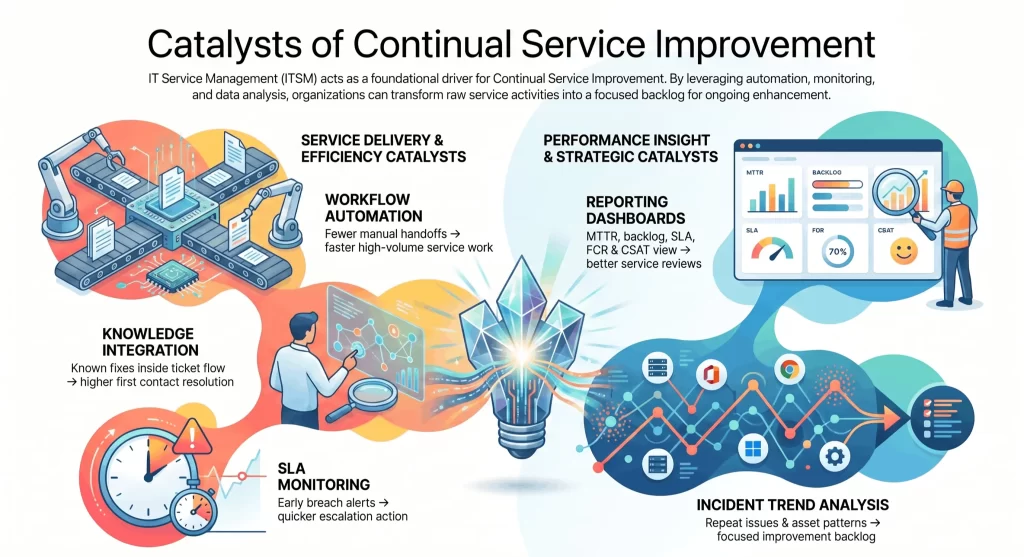
ITSM tools like Infraon ITSM give CSI the operating system it needs. They collect service data, route work, track SLA commitments, store knowledge, and show performance results. A mature tool setup makes improvement visible inside the same workflows used for daily service delivery.
- Workflow automation: Automation decreases manual steps in routing, approvals, notifications, assignments, escalations, and standard requests. This helps service desks remove avoidable delay from high-volume processes.
- SLA monitoring: SLA monitoring gives leaders real-time visibility into response and resolution commitments. Alerts can flag at-risk tickets before breach windows are reached.
- Reporting dashboards: Dashboards bring KPI tracking into review meetings and daily operations. Leaders can compare MTTR, backlog, SLA compliance, FCR, and CSAT trends from one view.
- Incident trend analysis: Incident trend analysis helps service owners find repeat issues, rising categories, impacted assets, and problem areas that need deeper review.
- Knowledge management integration: Knowledge management connects known fixes, service requests, and self-service content to the incident flow. This improves first contact resolution and reduces repeat work for service desk agents.
How Infraon Helps IT Teams Drive Continual Service Improvement
Infraon ITSM helps IT organizations connect CSI with live service management work. Instead of treating improvement as a separate reporting exercise, This software module brings workflows, automation, analytics, SLA tracking, incident handling, and knowledge into a singular ITSM environment.
· Unified ITSM workflows: Infraon connects incident, request, change, SLA, asset, and knowledge workflows so service leaders can review performance with the right service environment.
- Intelligent automation: Automation helps route tickets, trigger escalations, reduce manual updates, and guide common requests through repeatable paths. This gives CSI a firmer operational base for reducing recurring delays.
- Real-time analytics and reporting: Real-time reporting helps leaders track SLA risk, ticket categories, resolution time, backlog, and user feedback. Those insights become the evidence base for improvement decisions.
- SLA and incident management: SLA and incident management capabilities help service desks act before breach windows become business issues. Escalation alerts, incident ownership, and performance visibility create a better path for meeting commitments.
- AI-powered service optimization: AI-powered service management helps observe patterns, recommend actions, speed routing, and improve knowledge discovery. This gives IT leaders a forward-looking path for CSI in a service environment where volume and complexity keep rising.
Explore the Infraon ITSM Tool to connect SLA monitoring, incident handling, workflow automation, analytics, and knowledge management in a unified service management flow.
Frequently Asked Questions About Continual Service Improvement
What is continual service improvement in ITIL?
Continual service improvement in ITIL is the practice of reviewing service performance, identifying improvement opportunities, taking controlled action, and measuring results. It helps ITSM organizations improve service quality, SLA outcomes, user experience, and operational maturity.
What are the 7 steps of continual service improvement?
The 7 steps are identifying improvement opportunities, defining measurable goals, analyzing service performance, prioritizing improvement initiatives, implementing process improvements, monitoring KPIs, and standardizing successful changes before repeating the cycle.
What is the difference between CSI and continual improvement?
CSI is the ITIL v3 term commonly linked to continual service improvement. ITIL 4 uses continual improvement as a more extensive management practice within the Service Value System. Both focus on measured service progress and repeated improvement cycles.
Why Is CSI important in ITSM?
CSI is important because ITSM work depends on repeatable service quality. It helps organizations reduce recurring incidents, improve SLA compliance, raise customer satisfaction, improve service desk output, and align IT work with enterprise goals.
Which KPIs are used in CSI?
Common CSI KPIs include SLA compliance rate, MTTR, FCR, ticket backlog trends, CSAT, incident volume, escalation rate, change success rate, and self-service adoption.
Final Thoughts
Continual Service Improvement gives ITSM leaders a way to turn operational signals into service progress. When recurring incidents, SLA risk, backlog growth, and user feedback enter a repeatable review cycle, improvement becomes part of daily service management rather than a delayed reaction.
ITIL 4 reinforces this approach by placing continual improvement inside modern service value thinking. With AI-driven ITSM maturing constantly, organizations will have better ways to detect service patterns, recommend action, and act earlier.
The culture behind CSI remains the same. Measure what is important, improve what creates value, and repeat the cycle with discipline.