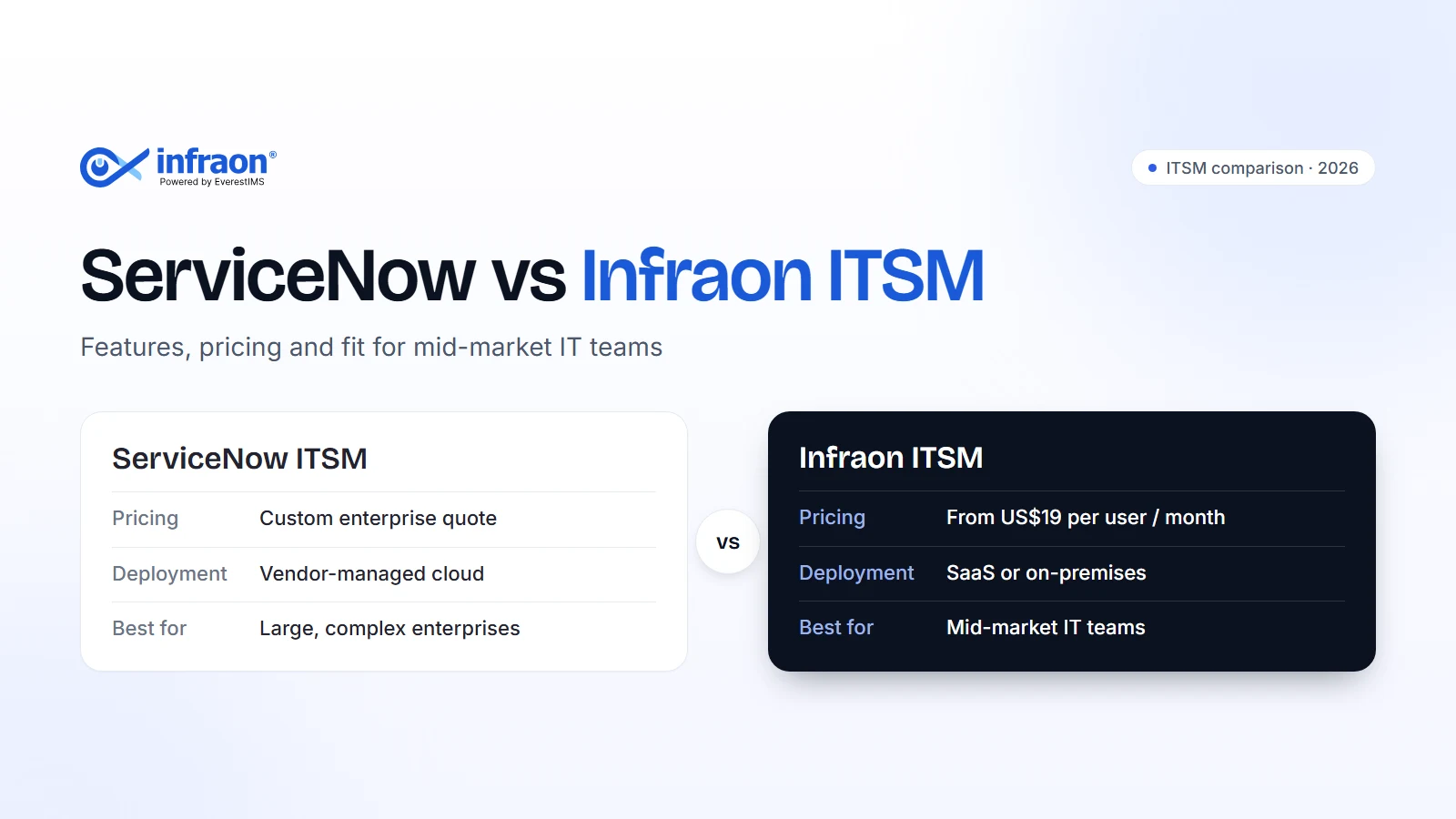

ServiceNow vs Infraon ITSM comes down to operational complexity and internal resources. The decision also depends on which service processes need standard workflows and which demand custom development, along with the team responsible for administration.
ServiceNow suits enterprises seeking advanced workflow development and a global partner ecosystem. Infraon ITSM appeals to mid-market teams connecting service processes with assets and infrastructure operations. ServiceNow extends into complex enterprise applications, while Infraon Infinity connects ITSM, asset records, and infrastructure monitoring in a unified environment.
Ultimately, licensing, deployment, administration, and integration demands should determine the shortlist. Buyers should examine package entitlements, deployment choices, migration demands, and three-year ownership costs. Testing real tickets and asset records can expose differences that appear minor in a product demonstration.
ServiceNow vs Infraon at a Glance
Quick Comparison Table
| Decision area | ServiceNow ITSM | Infraon ITSM |
|---|---|---|
| Best for | Large enterprises with complex cross-department processes | Mid-market and distributed IT teams seeking unified service and asset operations |
| Deployment | Vendor-managed cloud; exceptional customer-managed arrangements subject to contract | SaaS and on-premises options; discuss private or hybrid requirements |
| Pricing model | Custom enterprise quotation; Foundation, Advanced, Prime packages | Per-agent subscription; Essential, Standard, Professional; Enterprise pricing on request |
| AI | ServiceNow Otto capabilities vary by package and contracted entitlements | AI-assisted ticket intake, knowledge search, incident handling, and automation |
| Rollout time | Guided Foundation setups can begin in weeks; complex programs can take months | Preconfigured workflows enable faster phased launches; scope determines schedule |
| Admin skills | Platform administration, integration design, workflow development | Service administration, configuration, integrations, asset governance |
| ITAM and monitoring | ITAM and ITOM capabilities within broader ServiceNow product portfolio | ITSM, Infraon Assets, and monitoring – all within one platform: Infraon Infinity |
Choose ServiceNow If…
- Multiple business functions need advanced enterprise workflows, approvals, and application development
- An established ServiceNow team already manages integrations, governance, and upgrades
- Complex service mapping, enterprise-scale reporting, and a broad partner network influence procurement
- AI agent orchestration and deeper cross-functional workflows justify higher implementation overhead
Choose Infraon ITSM If…
- Service desk teams need incidents, requests, assets, and operations data connected in daily workflows
- Deployment flexibility and administrative simplicity carry substantial weight
- A clearly priced agent subscription helps the finance team assess recurring expenditure
- ITSM, ITAM, and infrastructure monitoring are candidates for consolidation on Infraon Infinity
What the Platforms Are Built For
ServiceNow ITSM in Brief
ServiceNow ITSM connects service records, shared configuration information, analytics, and workflows on the Now Platform. Foundation, Advanced, and Prime packages span core ticketing through problem, change, and AI-led operations. Enterprises can extend the platform into HR, customer service, procurement, and custom applications, creating greater governance and training demands.
Infraon ITSM and the Infinity Platform in Brief
Infraon ITSM connects incident handling, requests, knowledge, change controls, and SLA tracking with asset context. The Infraon Infinity platform links service management, asset records, monitoring, and event correlation. Teams can begin with a service desk and expand adjacent capabilities later.
Feature-by-Feature Comparison
Incident, Problem and Change Management
ServiceNow provides incident workflows, plus formal problem, change, major incident, and on-call processes in Advanced and Prime.
Infraon covers the incident management process and includes problem, release, and change management in Professional. Compare fault identification, configuration links, and approval routing with actual tickets.
Workflow Automation and No-Code Configuration
ServiceNow offers visual workflows and developer tools for advanced extensions, bringing governance duties for scripts and custom applications.
Infraon emphasizes configurable routing, approval rules, email intake, and templates. Ask both vendors to configure an incident escalation and change approval live; count the steps and code involved.
ITIL 4 Process Alignment
Both address ITIL-oriented practices. Check verified practices and package entitlements. ServiceNow Foundation concentrates on core incidents and requests, while Advanced expands formal problem and change coverage.
Infraon Professional includes problem and change management.
Service Catalog and Self-Service Portal
ServiceNow Employee Center and catalog functions address multi-department requests.
Infraon provides a self-service portal with knowledge search and configurable requests. Have a new employee submit an access request unaided, separately from the analyst-console test.
CMDB and Asset Visibility
ServiceNow CMDB and Common Service Data Model serve complex configuration governance.
Infraon connects tickets with asset and configuration records. Compare discovery rules, affected service relationships, and the staff needed to maintain accurate records.
Discovery and Data Accuracy
Test unmanaged endpoints, duplicate configuration items, and device-to-service outage tracing. Check discovery entitlements and connector costs. Stale dependencies or missing ownership information can undermine incident triage.
Built-In IT Asset Management (Infraon Assets)
Infraon Assets includes agent-based endpoint discovery, agentless infrastructure scanning, software-license governance, contracts, and lifecycle records.
ServiceNow has hardware and software asset-management products with procurement and entitlement controls; advanced functionality depends on product licensing. Check asset discovery, integrations, and repository governance in the contracted scope.
AI Capabilities
Use real tickets to measure AI categorization, resolution suggestions, and escalation to humans. Check the audit history and knowledge-access controls before granting any automated action.
ServiceNow Otto
ServiceNow Otto provides AI-assisted incident summaries, suggested resolutions, response drafting, and workflow automation. Availability and usage conditions depend on the contracted ServiceNow package and AI entitlements.
Infraon AI Features
Infraon offers AI-assisted intake, conversational knowledge search, routing, and automation, with event correlation in its wider ITOps environment. Test historical tickets for categorization and handoff quality, then confirm plan entitlements.
Monitoring and Operations Connection
ServiceNow brings ITSM and operations data together through its wider product family, including ITOM and discovery capabilities where licensed. Enterprises with mature service mapping can connect infrastructure signals with service-impact records.
Infraon Infinity links ITSM with monitoring, event correlation, and asset information in one operating environment. Teams considering ITSM vs. ITOM should evaluate the speed with which a device alarm produces an incident containing owner, service, and equipment history.
Reporting, Dashboards and SLA Tracking
ServiceNow offers dashboards and deeper process analysis in higher packages.
Infraon tracks SLAs, escalations, and service metrics. Ask both vendors to produce a report on open incidents, breach risk, and repeated equipment faults; compare the configuration effort.
Integrations and APIs
ServiceNow has an extensive connector ecosystem.
Infraon provides APIs and marketplace connections, with tier-dependent access. Test existing identity, monitoring, and asset systems; assess connector fees, API limits, and maintenance.
Pricing Model and Total Cost of Ownership
How ServiceNow Licensing Works
ServiceNow sells Foundation, Advanced, and Prime through custom contracts. Process entitlements, AI usage, discovery, integrations, and additional products affect charges. Request separate commercial lines for ITSM, assets, operations, and implementation when reviewing ServiceNow pricing.
How Infraon Pricing Works
Infraon ITSM starts at US$19 per user monthly. Standard costs US$47 and Professional US$57 per user monthly; Enterprise terms are negotiated. Essential covers incidents, portals, SLAs, and knowledge. Standard adds requests; Professional adds problem, release, and change processes. Asset and monitoring contracts require separate review.
Additional Ownership Costs
Implementation Partners and Consulting
Complex imports, approval redesign, third-party connections, and governance workshops can increase setup bills. ServiceNow customers frequently use specialist implementation teams; Infraon buyers may need service configuration, migration, and integration assistance. Ask for a fixed statement of work, acceptance criteria, and documented responsibilities.
Platform Admins and Developers
A highly customized ServiceNow estate may require platform administrators, developers, testing capacity, and upgrade governance. Infraon usually emphasizes configuration-led administration, although complex integrations and data governance still require skilled staff. Compare internal labor over the contract term rather than counting license invoices alone.
Add-On Modules
Discovery, advanced asset governance, monitoring, AI usage, premium integrations, and analytics can affect procurement cost. Confirm what the chosen subscription includes and obtain separate charges for capabilities outside the core service-management contract.
Three-Year Licensing and Cost Components for a 25-Agent Team
A 25-agent IT department requires incident, request, problem, and change processes over 36 months, plus asset visibility and two external integrations. Infraon Professional subscriptions total US$51,300 at US$57 per agent per month. ServiceNow pricing requires a vendor quotation for a comparable subscription scope.
| Cost element | ServiceNow | Infraon ITSM |
|---|---|---|
| ITSM agent licenses, 25 agents × 36 months | Contract quotation required | US$51,300 at US$57 per agent/month |
| Incident, request, problem and change | Confirm package and contracted entitlements | Professional ITSM plan |
| Asset management and discovery | Confirm ITAM and Discovery products | Quote Infraon Assets and any additional scope |
| Two external integrations | Verify connector and API charges | Verify connector and API charges |
| Implementation and migration | Scope-based services quotation | Scope-based services quotation |
| Administration over 36 months | Internal staffing requirement | Internal staffing requirement |
| Base ITSM subscription over 36 months | Vendor quotation required | US$51,300 in base ITSM licensing; additional costs quoted separately |
The US$51,300 figure covers Infraon’s ITSM subscriptions only. A complete three-year ownership comparison requires written ServiceNow pricing and equivalent costs for asset management, integrations, migration, implementation, and administration.
Deployment, Data Residency and Compliance
Cloud, On-Premise and Hybrid Options
ServiceNow primarily uses vendor-managed SaaS, with customer-managed hosting possible under exceptional contracts. Infraon offers SaaS and on-premises paths. Confirm responsibility for upgrades, backups, encryption, and recovery testing.
Data Residency for India, GCC and Southeast Asia
Data residency covers tickets, attachments, backups, and audit exports. ServiceNow operates international hosting regions; Infraon offers regional options, including Malaysia. Teams in India, GCC countries, and Southeast Asia should contractually verify storage country, backup location, subcontractors, and transfer terms. Review ITSM data residency alongside procurement requirements.
Security and Compliance Certifications
Both offer access controls and audit records. Request certification scope, validity, hosting entity, and evidence of retention and approval controls. Product practice verification and corporate security certification address separate requirements.
Implementation Time and Admin Effort
Typical ServiceNow Rollout
ServiceNow Foundation can launch a focused desk in weeks. Complex CMDB imports, cross-department workflows, and integrations can extend rollout for months. Include security reviews, acceptance testing, and training in contractual milestones.
Typical Infraon Rollout
Infraon provides preconfigured workflows and guided migration. Deployments typically take four weeks. However, historical data, integrations, and approval requirements can extend delivery.
Skills Needed to Run the Platforms
ServiceNow requires ownership of platform rules, integrations, and custom development. Infraon teams need process, catalog, and asset-data owners. Assign accountability for reporting, upgrades, and training.
Ease of Use for Agents and End Users
Agent productivity depends on the number of screens needed to resolve common tickets, the quality of search results, and the effort required to capture asset context. ServiceNow can deliver sophisticated task experiences and enterprise employee services. Infraon offers integrated ticket, SLA, knowledge, and equipment views oriented toward service-desk operations.
A side-by-side evaluation should include a new employee submitting a request unaided, an analyst routing an urgent incident, and a manager investigating an approaching SLA breach. Record task completion time, failed attempts, and the amount of training required. User adoption often exposes problems missed in an administrator-led demonstration.
Support, Partners and Community
ServiceNow has a broad global consulting and developer ecosystem. Infraon offers vendor-led onboarding and regional partners. Ask both for comparable reference customers, local response arrangements, escalation terms, and accountable implementation leads.
Where ServiceNow Is the Better Choice
Large enterprises can gain from ServiceNow’s application-development capacity, specialist ecosystem, cross-department workflows, and advanced AI packages, especially where teams already administer the platform.
A platform change can create retraining, integration, and migration expense. Buyers seeking a different approach can examine ServiceNow alternatives.
Moving From ServiceNow to Infraon
What You Can Migrate (Tickets, CMDB, Catalog, Knowledge Base)
Tickets, users, groups, knowledge, catalog records, and configuration items can be mapped for migration. Permissions, attachments, historical approvals, and service relationships require validation before cutover.
Migration Steps at a Glance
- Inventory workflows, integrations, user roles, and custom fields before setting the migration scope
- Export a representative set of tickets, configuration items, knowledge articles, and request templates
- Map identities, attachments, ownership, SLA history, and catalog dependencies
- Test incident, request, change, reporting, and security workflows with migrated data
- Run parallel operations, reconcile mismatches, and switch after acceptance criteria are met
The cost of switching ITSM platforms rises when historical data is inconsistent or business-critical integrations have undocumented dependencies. Assign a process owner to sign off on data quality and operational readiness.
Final Verdict: Which Platform Should You Choose?
ServiceNow serves advanced enterprise workflows and global partner-led programs. Infraon suits buyers seeking connected service, asset, and monitoring operations with accessible subscription rates. Test the same workflows, residency terms, integrations, and three-year commitments.
Frequently Asked Questions
Is Infraon ITSM cheaper than ServiceNow?
Infraon provides per-agent monthly prices, while ServiceNow uses custom contracts, so a universal price ranking would be misleading. For 25 Infraon Professional users, 36 months of ITSM subscriptions cost US$51,300 before services and adjacent products. Request ServiceNow and Infraon quotations covering the identical workflows, integrations, and deployment requirements.
Can Infraon replace ServiceNow ITSM for a mid-sized company?
Infraon can cover core incident, request, problem, change, knowledge, SLA, and asset-linked service processes. Replacement suitability depends on the number of custom ServiceNow workflows, third-party connections, historical records, and broader enterprise applications. Test the three most important processes with real data before approving migration.
Does Infraon offer on-premise deployment?
Yes. Infraon ITSM has SaaS and on-premises deployment options. Buyers with private hosting, hybrid networks, or location-specific data obligations should confirm the architecture, backup geography, security responsibilities, and commercial terms in the deployment agreement.
How long does migration from ServiceNow to Infraon take?
Migration can span several weeks or several months depending on data volume, custom processes, approvals, and integration complexity. A focused service desk with clean records is quicker than a heavily extended enterprise estate. Plan a test import, workflow validation, user acceptance, and a controlled cutover.
Does Infraon support ITIL 4 processes?
Infraon offers incident, request, problem, change, release, and related service practices, with plan-specific entitlements. The Professional ITSM subscription includes problem, change, and release management. Confirm practice coverage and any relevant third-party verification for the contracted version before purchasing.
Can I run ITSM and IT asset management on one Infraon platform?
Yes. Infraon Infinity brings service workflows and Infraon Assets into a connected operating environment, with monitoring capabilities also available. The commercial terms for ITAM and related services should be checked separately from the ITSM agent subscription.
See Infraon ITSM beside your existing ServiceNow environment.