


Enterprise software assets have become harder to govern because applications now enter the business through many routes. Some are purchased by IT, some through procurement, some through business functions, and many through SaaS subscriptions that begin with a simple sign-up.
The result is a software environment where spend, access, usage, entitlement, renewal, and risk data can sit in separate systems.
Enterprise Software Asset Management, or enterprise SAM, creates a disciplined way to see and control that environment. It helps leaders understand what software exists, who uses it, which licenses are owned, where spend is rising, and where risk is forming.
What Is Enterprise Software Asset Management?
Enterprise SAM in simple terms
Enterprise SAM is the process of managing software assets across a large organization. It covers software discovery, inventory, licensing, entitlements, usage, renewals, compliance, cost optimization, and retirement.
What software assets does enterprise SAM cover?
Enterprise SAM covers installed applications, enterprise software, SaaS subscriptions, cloud-based software, user licenses, device licenses, entitlements, contracts, renewals, and consumption-based software products.
How enterprise SAM differs from traditional software license management
Traditional software license management mainly focused on purchased licenses and audit exposure. Enterprise SAM covers a wider operating picture, including SaaS growth, decentralized buying, usage intelligence, cost optimization, security visibility, AI applications, and workflow control.
Why Enterprise Software Asset Management Matters in 2026
Software spend is becoming harder to see
Software spend now spreads across departments, cards, contracts, SaaS renewals, cloud marketplaces, and bundled agreements. Enterprise SAM gives leaders a way to connect those costs with ownership and actual usage.
SaaS and shadow IT are changing the SAM landscape
SaaS and shadow IT make software easier to adopt and harder to govern. Enterprise SAM helps identify applications outside central control and bring them into review.
Software licenses are now a security and compliance issue
Software records can reveal unauthorized tools, unsupported applications, inactive access, and audit exposure. License governance now supports risk management as much as cost control.
AI is creating a new software management problem
AI applications and consumption-based pricing create new questions around access, usage, data exposure, spend, and ownership. Enterprise SAM helps organizations review these tools separately instead of treating them like ordinary renewals.
Enterprise SAM vs ITAM vs SaaS Management vs FinOps
| Discipline | Primary focus | Typical assets | Main stakeholder |
|---|---|---|---|
| SAM | Software | Licenses, applications, entitlements | SAM/IT |
| ITAM | IT assets | Hardware + software | IT |
| SaaS Management | SaaS | Cloud applications/subscriptions | IT/Procurement |
| FinOps | Cloud/technology cost | Cloud + usage | Finance/IT |
| ITSM | IT services | Services/configurations | IT Operations |
Why enterprises increasingly need these disciplines connected
These disciplines often depend on the same data. SAM needs usage and entitlement details, ITAM needs lifecycle visibility, SaaS management needs subscription and owner data, FinOps needs consumption insight, and ITSM needs service context. Connecting them helps the enterprise reduce duplicate records and make better software decisions.
The Enterprise Software Asset Lifecycle
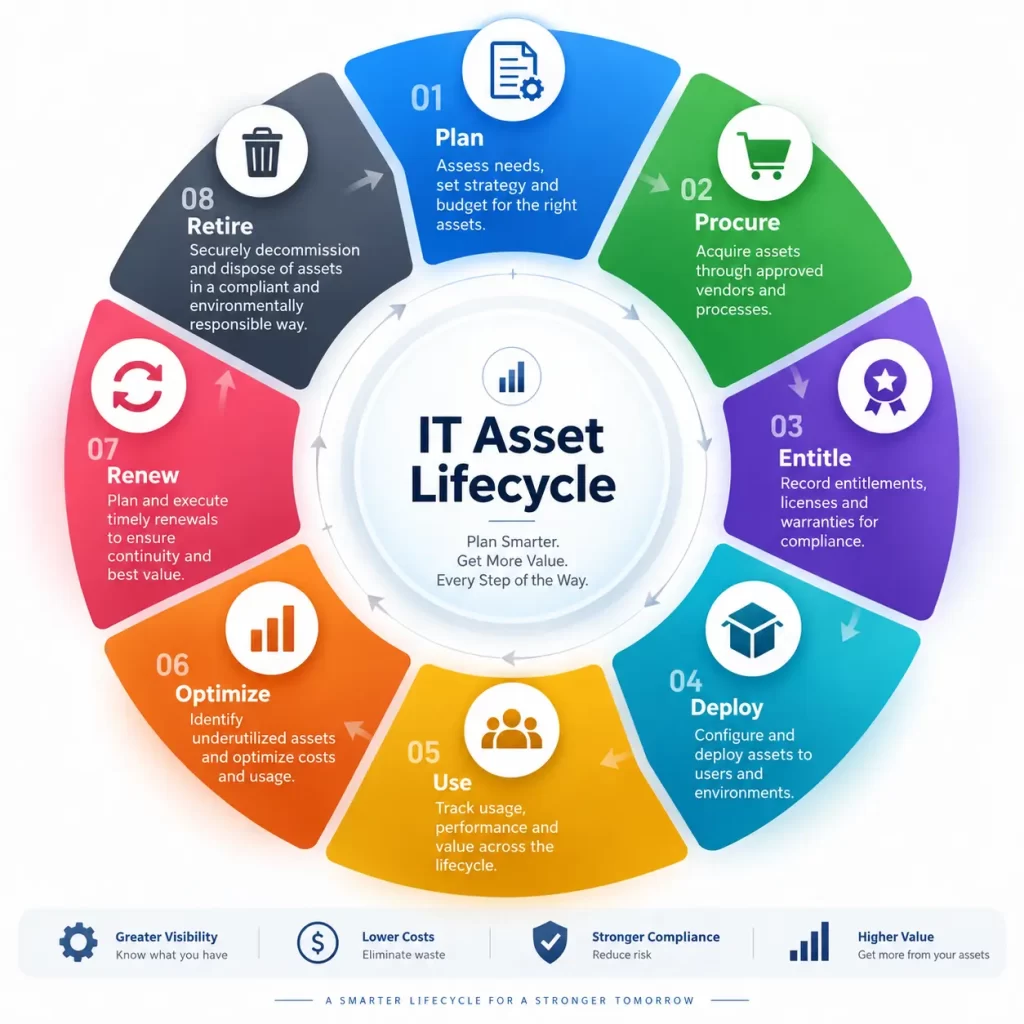
Plan
Planning defines business need, software category, budget, ownership, risk, approval path, and expected usage before software enters the environment.
Procure
Procurement creates the commercial record, vendor agreement, subscription, purchase order, or contract path connected to the software need.
Entitle
Entitlement records show what the organization has the right to use. They include license type, quantity, term, user rights, device rights, and contract terms.
Deploy
Deployment makes software available to users, devices, or business units. It should connect assignment with the entitlement record and approval history.
Measure usage
Usage measurement shows which applications are active, underused, unused, growing, or assigned to the wrong users.
Optimize
Optimization turns usage and entitlement data into actions such as reclaiming licenses, consolidating tools, changing tiers, or correcting assignments.
Renew or renegotiate
Renewal review compares usage, entitlement, cost, business need, and vendor terms before the next contract decision.
Retire and reclaim
Retirement removes software that is unused, replaced, unsupported, risky, or no longer needed. Reclamation returns licenses or subscriptions to the available pool.
10 Biggest Enterprise Software Asset Management Challenges
1. Incomplete software discovery
Incomplete discovery leaves applications outside the official software record. This weakens cost review, security checks, license governance, and audit readiness.
2. Shadow IT and decentralized purchasing
Shadow IT and decentralized purchasing create software records that IT or SAM owners may see only after spend, data, or compliance risk has already grown.
3. Unused and underused licenses
Unused and underused licenses lock budget into software that provides limited value. Usage intelligence helps identify what can be reclaimed or reassigned.
4. Complex license models
License models can vary by user, device, consumption, tier, geography, virtualization, or contract clause. SAM needs clean entitlement and usage data to interpret them.
5. SaaS renewal surprises
SaaS renewals can catch organizations off guard when contracts, owners, usage, and notice periods are spread across several functions.
6. Poor entitlement data
Poor entitlement data makes it difficult to know what the organization owns, what it can use, and which terms govern the software.
7. Vendor audit pressure
Vendor audits create pressure when discovery, deployment, entitlement, and usage records are incomplete. Audit readiness depends on evidence that can be trusted.
8. Fragmented procurement and finance data
Procurement and finance data often explain spend, but SAM also needs usage, access, contracts, and ownership to make sense of it.
9. Security and compliance blind spots
Unknown software can create data, access, vulnerability, and regulatory concerns. SAM supports visibility into applications that need review.
10. AI and consumption-based software
AI and consumption-based software can expand spend and access quickly. SAM must track usage, ownership, and cost signals with closer review.
What Should Enterprise SAM Software Actually Do?
Enterprise SAM software should cover richer work than storing a list of applications. It should connect discovery, inventory, licenses, contracts, usage, renewals, compliance, workflows, and analytics into one operating view.
Automated software discovery
Automated discovery identifies installed software, SaaS applications, and software signals that need classification or ownership review.
Software inventory and normalization
Inventory and normalization turn raw software data into clean application records, reducing duplicates and naming confusion.
License and entitlement management
License and entitlement management stores rights, quantities, terms, contract details, and assignment rules so usage can be compared with ownership.
Software usage intelligence
Usage intelligence shows who uses software, how often it is used, and where assigned licenses create low value.
SaaS discovery and shadow IT detection
SaaS discovery helps identify cloud applications and subscriptions that may exist outside central procurement or IT control.
License optimization
License optimization helps reclaim unused licenses, rebalance assignments, consolidate tools, and reduce avoidable spend.
Contract and renewal management
Contract and renewal management tracks terms, dates, notice periods, owners, and usage evidence needed before renegotiation.
Software compliance and audit readiness
Compliance and audit readiness depend on accurate deployment, entitlement, usage, and ownership records that can support vendor review.
Procurement and approval workflows
Procurement and approval workflows control how software is requested, reviewed, purchased, assigned, renewed, and retired.
Integration with ITSM, CMDB, IAM, HR and finance
Integrations connect SAM with tickets, configuration records, identity, employee data, purchasing, invoices, and budgets.
AI-powered recommendations and automation
AI-powered recommendations can highlight reclamation opportunities, unusual usage, renewal risk, and workflow actions that need review.
15 Enterprise SAM Metrics Every CIO Should Track
- Software spend visibility: Shows how clearly the organization can identify software cost by application, vendor, department, contract, and usage pattern
- License utilization rate: Shows how much assigned license capacity is actively used.
- Unused license percentage: Shows the share of licenses that can be reviewed for reclamation, reassignment, or removal.
- Cost per active user”: Connects software spend with actual user activity rather than assignment count alone.
- Renewal savings: Shows savings created through renegotiation, reclamation, consolidation, or tier changes before renewal.
- License compliance rate: Shows the degree to which software usage aligns with entitlement terms and contract rights.
- Unauthorized application count: Shows how many applications need review because they were discovered outside approved channels.
- Shadow IT discovery rate: Shows how frequently SAM identifies applications outside central software governance.
- Software reclamation rate: Shows how often unused software is recovered and returned for reuse or cost reduction.
- Vendor concentration: Shows how much software spend is concentrated with major vendors, which helps negotiation and risk review.
- Contract coverage: Shows how much of the software estate has current contract, renewal, owner, and entitlement records.
- Audit preparation time: Shows how long the organization needs to gather evidence for vendor or internal software audits.
- Time to provision software: Shows how quickly approved software reaches users after request approval.
- Time to deprovision: Shows how quickly access and licenses are removed when users change roles or leave.
- SAM ROI: Shows the return created by savings, risk reduction, audit readiness, reclaimed licenses, and improved software governance.
How AI Is Changing Enterprise Software Asset Management
AI is changing enterprise SAM by helping organizations find patterns in software data that would take too long to review manually. Its value is strongest when recommendations are tied to usage, entitlement, contract, security, and workflow context.
AI-powered software discovery
AI-powered discovery can identify software records, group similar applications, and flag items that need owner or category review.
AI-based license optimization
AI-based optimization can compare usage with entitlements and recommend reclamation, tier changes, or reassignment.
Predicting software renewals
Renewal prediction can combine contract dates, usage trends, spend data, and owner activity to highlight renewals that need attention.
Detecting anomalous software usage
Anomaly detection can identify unusual access, sudden consumption growth, unexpected application use, or patterns that need security or cost review.
AI-powered procurement recommendations
AI-powered procurement recommendations can suggest reuse, approval paths, contract review, or purchasing decisions based on existing software data.
Autonomous license reclamation
Autonomous reclamation can recover unused licenses through governed workflows, approvals, notifications, and exception handling.
Managing AI applications and consumption-based pricing
AI applications often bring variable usage and cost models. SAM needs separate review of consumption, ownership, policy, and business value.
How to Choose Enterprise Software Asset Management Software
Start with your software environment
Begin by mapping the software estate, including installed applications, SaaS, cloud tools, enterprise contracts, AI applications, and high-cost vendors.
Evaluate discovery depth
Discovery should capture software from endpoints, SaaS usage, procurement records, identity systems, contracts, and other relevant sources.
Check license intelligence
License intelligence should support entitlement records, usage comparison, license models, contract terms, and compliance review.
Assess SaaS visibility
SaaS visibility should show active applications, owners, subscriptions, usage, spend, renewals, and shadow IT signals.
Validate integrations
Validate integrations with ITSM, CMDB, IAM, HR, procurement, finance, security, and reporting systems.
Examine automation
Examine automation for request approvals, license assignment, reclamation, renewal alerts, exception handling, and workflow updates.
Check security and compliance
Check access control, audit trails, unauthorized application reporting, data handling, and compliance evidence features.
Evaluate reporting and analytics
Reporting should give leaders visibility into spend, usage, compliance, renewal risk, reclamation, and software portfolio health.
Understand implementation requirements
Review data migration, integration work, role design, governance setup, training, configuration, and administration needs.
Calculate total cost of ownership
Calculate subscription, implementation, integrations, migration, training, support, administration, and future expansion costs.
Enterprise Software Asset Management Best Practices
Make SAM a cross-functional program
Enterprise SAM should involve IT, procurement, finance, security, compliance, and business owners because software decisions affect cost, risk, access, and operations.
Maintain a single source of truth
A single source of truth keeps software, entitlement, usage, owner, contract, renewal, and compliance records aligned.
Automate discovery continuously
Continuous discovery helps organizations see new software, changed deployments, SaaS activity, and unauthorized applications sooner.
Measure usage before renewing
Usage should be reviewed before renewals so the business understands what is active, inactive, underused, or worth renegotiating.
Reclaim before buying
Reclamation should happen before new purchases when existing licenses can meet demand.
Connect procurement with IT
Procurement and IT should share software request, approval, contract, ownership, and deployment data.
Treat SaaS as part of the software portfolio
SaaS should be managed with the same discipline as installed software because it affects spend, access, security, and renewal planning.
Build audit readiness continuously
Audit readiness should be built into daily SAM operations through accurate discovery, entitlements, usage data, and evidence records.
Review AI software separately
AI software should be reviewed for usage, cost model, data exposure, ownership, and consumption risk.
Measure outcomes, not inventory volume
SAM success should be judged by savings, compliance, reclamation, renewal decisions, audit readiness, and software control instead of record count alone.
Enterprise SAM vs Spreadsheets: When Should You Make the Switch?
| Area | Enterprise SAM | Spreadsheets |
|---|---|---|
| Discovery | Automated software and SaaS discovery | Manual entries and periodic updates |
| Usage visibility | Connected usage, assignment, and entitlement data | Difficult to connect activity with rights |
| Renewals | Alerts, owners, contracts, and evidence in one workflow | Dates and owners can be missed or outdated |
| Compliance | Audit trails and license position support | Evidence gathering is slow and manual |
| Automation | Reclamation, approvals, alerts, and workflows | Manual follow-up and file updates |
When spreadsheets stop scaling
Spreadsheets stop scaling when software records change faster than users can update them. The issue usually appears in renewals, compliance evidence, entitlement confusion, and unclear ownership.
Warning signs your SAM process needs automation
Warning signs include missed renewals, unused licenses, vendor audit stress, shadow IT growth, manual reconciliation, unclear contracts, and difficulty proving who uses which software.
What automation should replace first
Automation should first replace discovery gaps, renewal reminders, license reclamation, request approvals, entitlement checks, and usage reporting. These areas create high repeat effort and clear business value.
How Infraon Supports Enterprise Software Asset Management
Automated discovery and inventory
Infraon supports enterprise SAM by helping organizations discover software and maintain a clearer inventory of applications, assets, and usage-related records.
Software license governance
Software license governance helps organizations manage entitlements, assignments, renewals, and compliance-related records with better control.
Hardware + software lifecycle visibility
Hardware and software lifecycle visibility connects devices, users, applications, ownership, and lifecycle stages so software decisions have asset context.
Workflow automation
Workflow automation helps route software requests, approvals, reclamation, renewal actions, and exception handling through controlled steps.
Analytics and cost optimization
Analytics and cost optimization help leaders review software usage, underused licenses, spend patterns, and opportunities to reduce avoidable cost.
ITSM and CMDB integration
ITSM and CMDB integration connects software assets with services, tickets, configurations, users, and operational records.
Enterprise deployment and support
Enterprise deployment and support help large organizations introduce SAM controls across locations, functions, and software categories with clearer governance.
FAQs: Enterprise Software Asset Management
What is enterprise software asset management?
Enterprise software asset management is the process of managing software discovery, inventory, licenses, entitlements, usage, renewals, compliance, cost, and retirement across a large organization.
What does an enterprise SAM platform do?
An enterprise SAM platform helps discover software, normalize inventory, manage licenses, track usage, detect SaaS and shadow IT, support renewals, improve compliance, and automate workflows.
What is the difference between SAM and ITAM?
SAM focuses on software assets, licenses, applications, entitlements, and usage. ITAM covers the broader IT asset estate, including hardware and software.
What is the difference between SAM and SaaS management?
SAM covers software assets across installed, enterprise, SaaS, and entitlement models. SaaS management focuses on cloud applications, subscriptions, owners, usage, and renewals.
Why do enterprises need software asset management?
Enterprises need SAM to control software spend, reduce unused licenses, prepare for audits, manage renewals, reduce shadow IT, and improve software governance.
How does SAM reduce software costs?
SAM reduces costs by identifying unused licenses, reclaiming assignments, avoiding duplicate purchases, improving renewal decisions, and supporting vendor negotiations.
How does SAM help with software audits?
SAM helps audits by maintaining discovery, deployment, entitlement, usage, contract, and assignment records that support compliance evidence.
Can SAM manage SaaS applications?
Yes. SAM can manage SaaS applications by tracking subscriptions, owners, usage, renewals, spend, and shadow IT signals.
How does AI improve software asset management?
AI improves SAM by supporting discovery, license optimization, renewal prediction, anomaly detection, procurement recommendations, and license reclamation.
What should I look for in enterprise SAM software?
Look for discovery depth, license intelligence, SaaS visibility, integrations, automation, security, compliance support, reporting, implementation fit, and total cost.
How long does enterprise SAM implementation take?
Implementation time depends on software estate size, data quality, integrations, governance, migration, stakeholder alignment, and automation scope.
How do I calculate SAM ROI?
SAM ROI can be calculated by comparing software savings, reclaimed licenses, renewal reductions, audit risk reduction, and process gains against the total SAM program cost.