



Most IT departments did not choose to run 300 different applications. It happened one Slack workspace, one design tool trial, one finance team subscription at a time, until someone finally pulled a spend report and asked how half of these tools got approved in the first place. That question is why SaaS IT management software has moved from a nice-to-have to a line item that finance, security and IT all fight to own.
In this guide, you’ll learn what the category actually covers, why 2026 is a different moment for it than 2023 was, the eight platforms IT leaders, and how to pick one without getting talked into more platform than the job needs.
What Is SaaS IT Management Software
SaaS IT management software is the layer that gives an organization one place to see, control and pay for every cloud application its people use, whether that application was purchased through procurement or signed up for with a company credit card on a Tuesday afternoon. The category is usually called a SaaS management platform, or SMP, and its job is threefold. It finds every application in use across the company. It tracks who has access to each one and what that access costs. It automates the repetitive parts of managing that portfolio, from onboarding a new hire’s app stack to pulling back a license the moment someone leaves.
None of this existed as a distinct software category a decade ago because it did not need to. IT bought software, IT installed software, IT retired software. Cloud subscriptions broke that model. A marketing manager can now spin up a paid tool with a company card and never tell anyone, and by the time renewal season arrives, nobody remembers why the subscription exists or who still uses it. SaaS management software exists to close that gap between what a company is paying for and what it actually knows about.
SaaS Management vs. SaaS Asset Management (SAM) vs. ITAM, What Is the Difference
These three terms get used almost interchangeably in vendor marketing, which causes real confusion during procurement conversations.
IT asset management, or ITAM, is the oldest of the three and covers the full inventory of an organization’s technology, physical and digital alike. Laptops, network switches, on-premise servers and software licenses all fall under its umbrella, and it has historically leaned toward hardware lifecycle tracking.
Software asset management, or SAM, narrows that scope to software specifically, including on-premise licenses, perpetual software and cloud subscriptions, with a strong focus on license compliance and audit defense against vendors like Microsoft or Oracle.
SaaS management is the newest and narrowest of the three, and it deals only with cloud-delivered applications. It cares less about license entitlement paperwork and more about live usage data, active discovery of unsanctioned tools and automated user lifecycle actions. A large enterprise running a mix of on-premise ERP, licensed desktop software and hundreds of cloud apps will often run a SAM or ITAM tool for the legacy estate alongside a dedicated SMP for the cloud side, though newer platforms like Infraon and Flexera One are built to cover both under one roof.
How a SaaS Management Platform (SMP) Actually Works
Underneath the dashboard, an SMP typically pulls data from three or four sources at once. Single sign-on and identity provider logs reveal which applications employees actually authenticate into. Finance system and expense report integrations catch subscriptions bought outside procurement. Browser extensions and network traffic analysis pick up tools that never touch SSO at all. Direct API connections to major SaaS vendors add granular usage detail, such as which features inside an application are actually opened.
Once that data is pulled together, the platform normalizes it into a single application inventory, flags duplicate or redundant tools, calculates spend per app and per department, and runs automation rules for onboarding, offboarding and access reviews. The output most IT leaders care about first is a simple one, a live, accurate answer to the question “what software do we actually have, and who is using it.”
Why Your Organization Needs a SaaS Management Solution in 2026
Three forces are pushing SaaS management from optional to necessary this year, and none of them are slowing down. Application sprawl keeps growing even as headcount growth flattens. Regulators across Asia and the Gulf have moved from drafting privacy law to actively enforcing it. And AI agents have added an entirely new category of non-human user that most access reviews were never designed to catch.
The Real Cost of Shadow IT and Unused Licenses
The numbers here are large enough that most finance leaders assume they are exaggerated, until they run the audit themselves. Industry research from Zylo’s 2026 SaaS Management Index puts average annual waste from unused licenses at close to twenty million dollars for a typical large organization, and separate research from BetterCloud found that just under half of purchased SaaS licenses are actively used in any given month. Gartner has estimated that a majority of enterprise SaaS spend now falls outside direct IT control, acquired by individual teams without a formal review.
The practical effect shows up in three places at once.
- Renewal cycles lock in subscriptions nobody remembers approving, because nobody flagged them before the auto-renewal date
- Duplicate tools solve the same problem for different departments, often at different price points negotiated separately
- Departed employees keep active licenses for weeks or months after their last day, because deprovisioning depends on someone remembering to do it manually
None of these problems are exotic. They are what happens when application growth outpaces the manual processes IT built to track a much smaller software estate.
Compliance and Security Risks of Unmanaged SaaS
Every SaaS application an employee signs up for without review is also a new place company data can leak, and a new gap in whatever access certification an auditor is about to ask for. A tool nobody in IT knows exists cannot be included in a security review, cannot be checked against a data residency requirement, and will not appear in the evidence pack a compliance team hands to a regulator during an audit.
This matters more in 2026 than it did even two years ago, because India’s DPDP Act, Saudi Arabia’s PDPL and Malaysia’s amended PDPA have all moved into active enforcement, with real fines attached to real violations rather than theoretical ones. An unmanaged SaaS estate makes it close to impossible to answer the two questions every one of these laws asks of an organization, namely where personal data is stored and who currently has access to it.
Governing AI Agents and Non-Human Identities, the Next Challenge
The identity conversation used to be about people. That has changed fast. Palo Alto Networks’ 2026 identity security research, drawn from nearly three thousand cybersecurity decision-makers, found that machine identities, AI agents included, now outnumber human identities by roughly 109 to 1 across the average enterprise, up sharply from about 82 to 1 the year before. Most of that growth is coming from autonomous AI agents connecting to internal systems through APIs, browser extensions and integration platforms, often provisioned quickly to unblock a project with little thought given to what happens when the project ends.
Traditional identity governance was built around joiner, mover and leaver events for human employees. It was not built to track an AI agent that was spun up for a three-week pilot and never decommissioned, still holding write access to a customer database eighteen months later. SaaS management platforms are the tool set best positioned to close this gap, since discovering and governing every connected identity, human or not, is already their core function. The platforms reviewed later in this piece differ noticeably in how far along they are on this specific capability, and it is worth asking pointed questions about it during any 2026 evaluation.
Key Features to Look for in a SaaS IT Management Platform
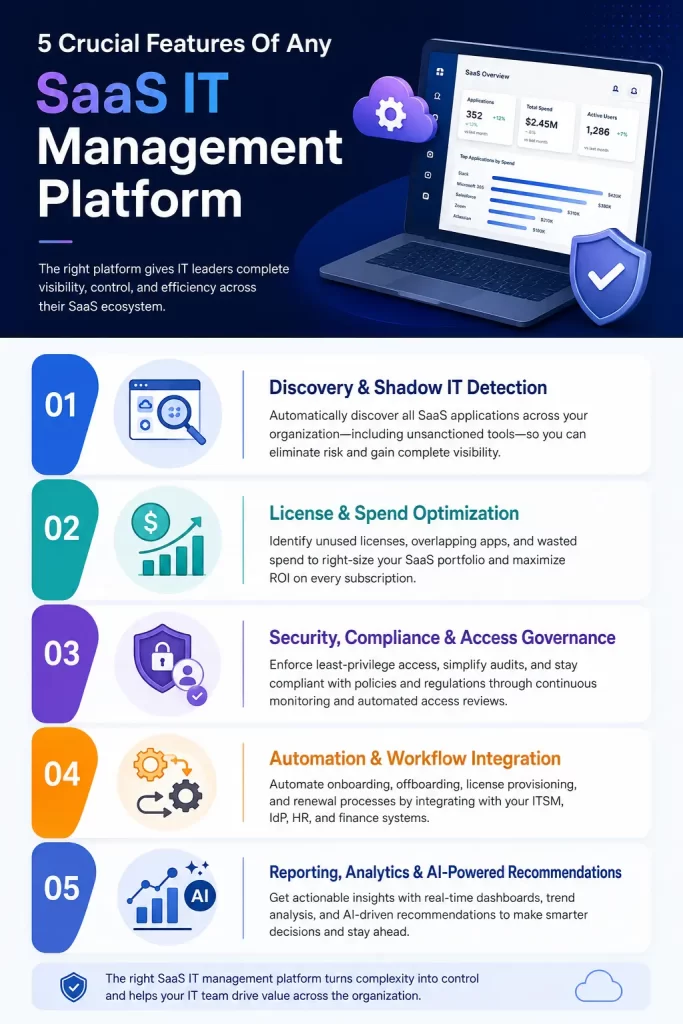
Vendor feature lists tend to blur together after the third demo call. Underneath the marketing language, the capabilities that actually separate a strong platform from a mediocre one fall into five groups.
Discovery and Shadow IT Detection
A platform is only as useful as the completeness of what it finds, and discovery methods vary more than most buyers realize. Weak discovery relies on a single source, usually SSO logs, which misses every application an employee accesses without going through the identity provider. Strong discovery combines SSO data, expense report scanning, browser-level detection, direct API integrations and network traffic analysis, catching tools regardless of how they were purchased or accessed. When evaluating this feature, ask a vendor for a live discovery scan against your own environment rather than a canned demo, since the gap between marketing claims and actual coverage shows up quickly once real data is involved.
License and Spend Optimization
Once an organization can see its full SaaS inventory, the next question is what it is paying for versus what it needs. Good platforms flag unused seats, duplicate tools serving the same function, and licenses on premium tiers when a cheaper tier would cover actual usage. The stronger platforms go further and benchmark spend against similar organizations, giving procurement teams real leverage during renewal negotiations rather than guesswork.
Security, Compliance and Access Governance
This is where SaaS management overlaps most directly with identity governance. Look for automated access reviews that flag excessive or stale permissions, role-based access controls that map clearly to how your organization is actually organized, and audit-ready reporting that can be handed to a regulator or auditor without days of manual reformatting. For organizations in India, the Gulf or Southeast Asia, confirm the platform can generate reports mapped to local requirements, not only to GDPR or SOC 2 templates built primarily for a US or EU audience.
Automation and Workflow Integration
Automation is where a platform either saves an IT team real hours or becomes another dashboard nobody logs into after the first month. The features worth testing directly are automated onboarding and offboarding linked to HR system triggers, no-code or low-code workflow builders that let non-developers configure rules, and integrations with the ticketing, HR and identity systems already in use rather than ones that require replacing them.
Reporting, Analytics and AI-Powered Recommendations
Most platforms now market some form of AI-generated recommendation, and the quality gap between vendors here is wide. Useful recommendations are specific and actionable, naming an exact license to reclaim or an exact renewal to renegotiate with a dollar figure attached. Weak ones are generic advice a junior analyst could have written without touching the underlying usage data. Ask to see a sample recommendation output during any demo before taking a vendor’s AI claims at face value.
SaaS IT Management Software, a Quick Comparison Table
Ratings below reflect public review data from G2 as reviewed in 2026 and will continue to move as new reviews come in, so treat them as a starting point for research rather than a final verdict.
| Product | Best For | Standout Feature | G2 Rating |
|---|---|---|---|
| Infraon | Indian and Gulf enterprises that want ITSM, ITAM and SaaS discovery in one platform | Unified operations suite with compliance reporting built for regional frameworks | 4.6 / 5 |
| Josys | Distributed APAC teams managing devices and SaaS through a single console | Combines employee device and SaaS lifecycle management in one dashboard | 4.4 / 5 |
| Zluri | Mid-market to enterprise IT teams wanting deep automation | Over 800 direct integrations paired with automated access reviews | 4.6 / 5 |
| Torii | Lean IT teams that want an open, flexible SMP | Named a Leader in the 2026 Gartner Magic Quadrant for SaaS management platforms | 4.5 / 5 |
| BetterCloud | Google Workspace and Microsoft 365-heavy organizations | No-code workflow automation recognized as a G2 category leader across most SMP segments | 4.4 / 5 |
| Productiv | Enterprises concerned about shadow AI tool adoption | App and feature-level usage data built for governing AI tools inside the SaaS stack | 4.6 / 5 |
| Flexera One | Large hybrid enterprises managing SaaS alongside on-premise and cloud licensing | Single view spanning SaaS, hardware, cloud and traditional software license compliance | 4.3 / 5 |
| Lumos | Fast-growing technology companies wanting self-serve access | Employee app store paired with AI-driven, delta-based access reviews | 4.7 / 5 |
The Top 8 SaaS IT Management Platforms, Reviewed
1. Infraon
Infraon Infinity is a SaaS management platform built around the idea that IT teams should not need three separate tools for service management, asset tracking and SaaS discovery. Its Infraon Infinity suite brings ITSM, ITAM, network monitoring and SaaS visibility into one console, and the company has built a customer base spanning telecom, manufacturing, real estate and logistics companies across India, the UAE and Saudi Arabia specifically. It is SOC 2 certified and GDPR compliant, and it publishes compliance reporting mapped to Gulf-region frameworks including UAE ECC and CBUAE technology risk requirements, a detail most Western-built SMPs do not prioritize.
Best for. Organizations in India, the UAE or Saudi Arabia that want unified ITSM, ITAM and SaaS management rather than three separate subscriptions to stitch together.
Key features
- Combined ITSM, ITAM and SaaS discovery accessible from a single admin console
- Agent-based and agentless asset discovery across on-premise, cloud and hybrid environments
- Compliance reporting templates aligned to UAE, Saudi and Indian regulatory frameworks
- AI-assisted anomaly detection across IT operations, not limited to SaaS spend alone
- Multi-language support including Arabic and Hindi, useful for regional deployment teams
Pros
- Single vendor covers a wider operational scope than most SaaS-only competitors
- Regional compliance depth that global competitors rarely match
- Competitive pricing relative to enterprise-only Western platforms
Cons
- Newer brand recognition outside India and the Gulf compared with legacy global players
- SaaS-specific feature depth still growing relative to pure-play SMPs like Zluri or Torii
2. Josys
Josys started as an employee IT lifecycle platform out of NTT Finance’s innovation arm and has since repositioned itself as an automated identity governance and administration platform, discovering and securing every identity across SaaS, on-premise and shadow AI environments. It holds a 4.4 rating on G2 from just over a hundred reviews, with users consistently calling out its visibility into who has access to what and the reduced manual burden it creates for IT and managed service providers.
Best for. APAC-headquartered or distributed organizations that want device management and SaaS access management under the same roof, especially those already working with an MSP.
Key features
- Unified employee IT lifecycle covering both hardware devices and SaaS accounts
- Automated provisioning and deprovisioning linked to HR system events
- Action Center that consolidates daily IT tasks into a single inbox
- Open API supporting integration with hundreds of applications
Pros
- Strong 360-degree employee profile view combining apps and devices
- Well suited to organizations managing subsidiaries or recent acquisitions
- Straightforward shadow IT enforcement through browser extension controls
Cons
- Some reviewers cite limited flexibility in custom field and integration configuration
- Update notifications and department data upkeep need manual attention over time
3. Zluri
Zluri has built one of the broader integration footprints in the category, connecting directly to more than 800 applications and maintaining a database of over 225,000 known SaaS products for discovery matching. It holds a 4.6 rating on G2 from more than 175 reviews, with reviewers regularly praising its real-time visibility into spend and its intuitive onboarding experience. The company markets savings of up to 45 percent on SaaS spend for customers that fully adopt its optimization workflows.
Best for. Mid-market and enterprise IT teams that want a deep, automation-first SMP with strong access review capabilities baked in.
Key features
- Discovery engine drawing on 800-plus direct integrations plus a large known-app database
- One-click onboarding and offboarding automation
- Built-in workflow engine for scheduling and triggering compliance-driven access reviews
- Customizable dashboards aimed at IT, finance and procurement audiences separately
Pros
- Rapid deployment, often completed in weeks rather than months
- Highly rated customer support and onboarding assistance
- Strong match for SOX, HIPAA and SOC 2-driven access review requirements
Cons
- Custom pricing model means procurement cannot get a quick self-serve estimate
- Feature depth depends heavily on whether a given internal system has a native integration
4. Torii
Torii built its reputation on being the most open platform in the category, and that positioning has paid off in recent recognition, including a spot as a Leader in the 2026 Gartner Magic Quadrant for SaaS management platforms. It holds a 4.5 rating on G2 across close to 300 reviews, with a notably high proportion of five-star ratings and strong marks for ease of use and quality of support.
Best for. Lean, mid-market IT teams that want an SMP flexible enough to plug into whatever stack they already run, without heavy professional services involvement.
Key features
- Deep integrations with identity, HR and productivity tools including Okta, Google Workspace and BambooHR
- Canvas-style visual workflow builder for automation
- Combined SaaS spend and operations management in one product rather than split tools
- Real-time detection of new application sign-ups as they happen
Pros
- Consistently high user satisfaction scores across both spend and operations categories
- Fast, hands-on onboarding that mid-market teams can run without heavy vendor involvement
- Strong choice for organizations wanting a single system of record for their SaaS stack
Cons
- Less enterprise-scale identity governance depth than platforms built specifically for IGA
- Smaller regional presence in the Middle East compared with locally headquartered vendors
5. BetterCloud
BetterCloud has held its position as one of the category’s most consistently recognized platforms, and in 2026 it was named a leader in both IT Management and Data Privacy categories in G2’s Best Software Awards, a rare dual recognition in the SMP space. It holds a 4.4 rating on G2 from close to 500 reviews, one of the larger review volumes in the category, and its customer base reportedly manages more than 35 billion dollars in annual SaaS transactions through the platform.
Best for. Organizations running heavily on Google Workspace or Microsoft 365 that want no-code automation covering both productivity suite administration and broader SaaS governance.
Key features
- No-code workflow automation for policy enforcement, onboarding and access changes
- Deep native administration for Google Workspace and Microsoft 365 environments
- Insider threat and sensitive data discovery capabilities built into the core platform
- Recognition across five separate G2 SMP-related categories in recent grid reports
Pros
- Large, mature review base giving buyers strong reference-checking confidence
- Automation reduces IT ticket volume noticeably according to repeated customer feedback
- Strong security posture with recognized data privacy leadership
Cons
- Entry-level pricing billed per user per year, which can climb quickly at scale
- Some reviewers note a learning curve for advanced workflow configuration
6. Productiv
Productiv has repositioned itself around one of the sharper problems IT and security leaders face in 2026, namely how to say yes to AI adoption inside the business without losing visibility into what those AI tools can access. It holds a 4.6 rating on G2, and its differentiator is feature-level usage analytics that go past simple login tracking to show which specific capabilities inside an application employees actually use.
Best for. Enterprises where shadow AI adoption, not just shadow SaaS, has become the primary governance concern for IT and security leadership.
Key features
- Single system of record pulling together SSO, expense, contract and security signals per application
- Feature and team-level usage analytics rather than login-only tracking
- AI risk review workflows purpose-built for evaluating newly adopted AI tools
- Contract renewal tracking with spend forecasting based on signed terms
Pros
- Genuinely differentiated depth on AI governance compared with most competitors
- Strong contract management capability valued by finance and procurement teams together
- Intuitive interface that reviewers repeatedly describe as easy for non-technical stakeholders
Cons
- Smaller review base than category leaders, so recent, high-volume reference data is limited
- Best suited to organizations with the scale to justify enterprise-tier pricing
7. Flexera One
Flexera is the platform in this list with the longest history, having built its reputation in traditional software asset management and IT asset optimization long before SaaS management existed as a category. Flexera One extends that heritage across hybrid environments, giving organizations one view spanning SaaS subscriptions, on-premise software licensing, and public and private cloud costs. It holds a 4.3 rating on G2 from over 120 reviews, with reviewers consistently highlighting its centralized visibility and its integration with tools like ServiceNow.
Best for. Large enterprises with a genuinely hybrid estate, meaning meaningful on-premise software alongside cloud and SaaS, that need one compliance-grade view across all three.
Key features
- Combined SaaS, cloud and on-premise software license management in one platform
- Audit defense capabilities built from decades of software license compliance experience
- Deep integrations with Tier 1, Tier 2 and Tier 3 SaaS publisher admin platforms
- FinOps-oriented cloud cost optimization alongside traditional SAM functions
Pros
- Unmatched breadth for organizations still running significant on-premise software
- Strong audit and license compliance track record with major software vendors
- Detailed, defensible reporting that reduces audit-related risk exposure
Cons
- Steeper learning curve and longer setup time than pure-play SMPs
- Can feel like more platform than a SaaS-only organization actually needs
8. Lumos
Lumos entered the category from the identity governance side rather than the SaaS spend side, and that origin still defines its strongest feature, an employee-facing app store where staff request access and approvals route automatically with policy guardrails attached. It holds a 4.7 rating on G2, the highest of the eight platforms reviewed here, drawn from a smaller but consistently positive review base of around 70 reviews.
Best for. Fast-growing technology companies that want self-serve access requests paired with lightweight, AI-assisted identity governance rather than a heavyweight enterprise IGA deployment.
Key features
- Self-serve internal app store for employee access requests with automated approval routing
- AI-powered delta access reviews that focus only on what changed since the last cycle
- Joiner, mover, leaver automation linked to HR system events
- License reclamation opportunities identified through the same data used for access governance
Pros
- Genuinely reduces IT ticket volume for routine access requests
- Access review fatigue drops noticeably with delta-based reviews instead of full re-certification
- Simple, intuitive interface that both technical and non-technical staff navigate easily
Cons
- Deep provisioning connectors for legacy on-premise systems still maturing relative to established IGA vendors
- Smaller company and review base than the more established platforms on this list
How to Choose the Right SaaS Management Platform for Your Region
Every platform above will demo well. The differences that matter most for IT leaders in India, the Gulf and Southeast Asia usually only become visible once you ask about local compliance, data residency and support coverage specifically, rather than trusting a generic sales deck.
India, DPDP Act Compliance and Local Vendor Support
India’s Digital Personal Data Protection Act, in force since 2023 and given operational teeth by the DPDP Rules notified in November 2025, puts most SaaS-using organizations into a dual role, acting as a data fiduciary for their own employee and account data while simultaneously acting as a data processor for any customer data flowing through their platforms. Penalties can reach up to 250 crore rupees per violation, and the Data Protection Board of India became operational in 2026, meaning enforcement is no longer a distant possibility. When shortlisting an SMP for an Indian deployment, confirm the vendor can support consent-tracking workflows, maintain a current sub-processor list, and generate breach documentation fast enough to meet the Act’s notification expectations. Local support hours and a vendor with genuine India presence, rather than a follow-the-sun ticket queue routed through another time zone, also matter more here than buyers initially expect.
UAE, Data Residency, DIFC and Federal Compliance Needs
The UAE runs three overlapping data protection regimes at once, the federal PDPL covering mainland entities, and separate independent frameworks inside the DIFC and ADGM free zones. The DIFC’s Data Protection Law was materially amended in mid-2025, adding mandatory documented adequacy assessments for cross-border transfers and a new private right of action for data subjects. Regulated sectors carry stricter obligations still, with banking data required to remain within the UAE under Central Bank rules and health data required to be kept in-country under the Health ICT Law. A SaaS management platform operating here needs to support region-specific hosting where required, and ideally offer reporting mapped to CBUAE technology risk and UAE ECC evidence requirements rather than only GDPR-style templates.
Saudi Arabia, SDAIA and PDPL Requirements
Saudi Arabia’s Personal Data Protection Law came into full enforcement in September 2024, with the Saudi Data and Artificial Intelligence Authority, or SDAIA, acting as the regulator. SDAIA does not impose a blanket data localization mandate, but it has signaled a clear preference for keeping sensitive and personally identifiable data within the Kingdom, and sector rules in finance, telecom and healthcare go further and require it outright. Fines for repeat violations can reach 10 million Saudi riyals, and SDAIA has already issued dozens of enforcement decisions since the law came fully into force. Organizations evaluating an SMP for Saudi operations should confirm hosting options within the Kingdom or a clear data transfer safeguard, along with the vendor’s ability to support the risk assessment documentation SDAIA increasingly expects to see during an audit.
Malaysia, PDPA Considerations
Malaysia’s Personal Data Protection Act received its most significant overhaul in over a decade through the 2024 Amendment Act, rolled out in phases through mid-2025. The changes introduced mandatory 72-hour breach notification, a formal Data Protection Officer requirement, and, notably for this category, direct accountability for cloud and SaaS vendors acting as data processors rather than only the organizations that hire them. Maximum fines rose to a million ringgit per offense, and the regulator has already published a list of penalized organizations, signaling active enforcement rather than a paper requirement. A vendor’s own Data Processing Agreement and its ability to support breach detection and notification within that 72-hour window are worth confirming directly rather than assuming from a generic security page.
Indonesia, PP 71/2019 and Data Protection Rules
Indonesia’s Personal Data Protection Law, known locally as UU PDP, became fully enforceable in October 2024 after a two-year transition period, and it borrows heavily from GDPR in its consent and data subject rights framework. Running in parallel, Government Regulation 71 of 2019 continues to govern electronic systems more broadly and imposes data localization requirements on certain categories of strategic data managed by public electronic system operators, with sector rules for healthcare and banking going further still and requiring in-country data centers outright. Penalties under UU PDP can reach 2 billion rupiah or 2 percent of annual revenue. Because Indonesia’s implementing regulation for UU PDP was still being finalized as of 2026, organizations here benefit from an SMP vendor that tracks regulatory updates actively rather than one working from a static compliance page written a year earlier.
SaaS Management Platform vs. Adjacent Tools
Procurement conversations often stall because an SMP gets compared against tools solving an adjacent but different problem. Two comparisons come up constantly enough to address directly.
SMP vs ITSM Platforms
An ITSM platform, think ServiceNow or Infraon’s own service desk module, manages the human side of IT support, handling incident tickets, change requests and service catalogs. An SMP manages the application side, tracking what SaaS tools exist, who has access, and what they cost. The two overlap at exactly one point, provisioning and deprovisioning workflows, which is why some vendors, Infraon among them, have started building both capabilities into a single platform rather than requiring two separate purchases and an integration project to connect them.
SMP vs Identity Governance (IGA) Tools
Identity governance platforms like SailPoint or Saviynt focus deeply on access certification, segregation of duties enforcement and compliance-grade audit trails, typically across both cloud and on-premise systems including legacy Active Directory environments. SMPs cover a narrower but often more immediately useful slice for most mid-market organizations, namely discovery of the SaaS estate itself and lighter-weight access reviews layered on top.
Organizations under strict regulatory mandates such as SOX or heavy financial services oversight often need a dedicated IGA tool eventually, but for the majority of companies an SMP with strong access review features, Zluri, Josys and Lumos all being relevant examples here, covers the requirement without the implementation overhead a full IGA deployment demands.
Which SaaS Management Platform Works Best for Your Company
There is no single best answer here, only the best match for a given company’s size, existing stack and compliance obligations.
- A company under 200 employees running mostly on Google Workspace should look first at BetterCloud or Torii for straightforward automation without enterprise complexity
- A regulated enterprise in India, the UAE or Saudi Arabia should prioritize Infraon or Flexera One for regional compliance depth and unified operational coverage
- A fast-growing technology company wrestling with access requests should evaluate Lumos or Zluri for their self-serve and automated review strengths
- An organization more worried about shadow AI than shadow SaaS should put Productiv at the top of its shortlist
- A distributed APAC organization managing both devices and SaaS through an MSP relationship should look closely at Josys
Whichever shortlist a company builds, running a live discovery scan against real company data before signing anything remains the single most useful step in the entire evaluation process. Marketing claims about integration counts and AI capability are far less informative than watching a platform actually find your organization’s shadow IT in real time.
How Infraon Approaches SaaS IT Management
Infraon Infinity was built on a simple observation about how most mid-sized and enterprise IT teams in India, the Gulf and Southeast Asia actually operate, which is that they rarely have the headcount to run three or four separate specialist tools and stitch the data between them manually. The platform combines SaaS discovery, IT service management and IT asset management inside one console rather than treating them as separate product lines requiring separate logins and separate integration projects.
Key Capabilities
- Automated SaaS and shadow IT discovery running alongside broader IT asset discovery across hybrid environments
- License and spend optimization reporting that feeds directly into the same dashboard IT teams already use for service management
- Compliance reporting templates mapped specifically to Indian, UAE and Saudi regulatory frameworks rather than generic global templates
- AI-assisted anomaly detection spanning IT operations broadly, not limited to SaaS cost alone
- SOC 2 certification and GDPR compliance built into the underlying platform architecture
Why Teams in India, MENA and SEA Choose Infraon
Regional presence changes what a compliance conversation looks like in practice. When an auditor in Riyadh or Dubai asks for evidence mapped to a local framework, a vendor that already understands SDAIA or CBUAE requirements can produce it without a lengthy translation exercise between global templates and local expectations. Infraon’s customer base across telecom, real estate, manufacturing and system integration companies in these markets reflects that same practical advantage, along with multi-language support and support hours aligned to regional business days rather than a distant time zone. For an IT team that would rather run one unified platform than coordinate renewal dates and support tickets across three specialist vendors, that combination carries real weight during evaluation.
Frequently Asked Questions
What is the difference between SaaS management and IT asset management?
IT asset management covers an organization’s full technology inventory, hardware included, with roots in physical asset tracking. SaaS management focuses only on cloud-delivered applications and puts more weight on live usage data and automated discovery than on the license entitlement paperwork ITAM traditionally emphasizes.
How much can a company save using a SaaS management platform?
Published figures vary by vendor and by how disciplined an organization is about acting on the recommendations a platform generates, but industry data consistently points to 20 to 30 percent of SaaS spend being recoverable through better license optimization alone. Some vendors advertise savings as high as 45 percent for customers.
Is SaaS management software suitable for small businesses?
Yes, though the right platform for a 50-person company looks different from the right platform for a 5,000-person enterprise. Smaller organizations generally do better with lighter, faster-to-deploy tools.
Can SaaS management tools detect shadow IT automatically?
The strongest platforms can, by combining several discovery methods at once, including SSO logs, expense report scanning, browser-level detection and direct API connections to known SaaS vendors.
Do SaaS management platforms support compliance in the Middle East and Asia?
Coverage varies significantly by vendor. Global platforms built primarily for a US or EU audience often support GDPR and SOC 2 reporting well but offer little specific to India’s DPDP Act, Saudi Arabia’s PDPL or UAE data residency rules. Regionally headquartered or regionally focused vendors, Infraon being a direct example, tend to build reporting templates mapped to these specific frameworks rather than requiring a compliance team to translate generic output manually.
How do SaaS management platforms handle AI agents and API-based access?
This is the fastest-moving part of the category right now. A smaller number of platforms, have started treating AI agents and API-based service accounts as identities requiring the same discovery, review and de-provisioning discipline applied to human employees. Many platforms are still catching up, so this capability is worth testing directly during a demo rather than taking a vendor’s roadmap slide at face value.
What is the average cost of a SaaS management platform?
Pricing is almost always custom and scales with the number of applications discovered and the number of employees managed, so published price lists are rare across this category. Smaller platforms aimed at SMBs can start in the low thousands of dollars annually, while enterprise deployments commonly run into six figures once implementation and premium support tiers are included.
How long does implementation typically take?
Lighter platforms report full deployment within a few weeks, largely because their discovery methods work with minimal manual configuration. Heavier platforms with deeper on-premise or hybrid coverage tend to run longer, sometimes several months, because they touch a wider range of legacy systems that require more careful mapping during setup.
Which SaaS management platform is best for a specific region?
For India, the UAE and Saudi Arabia specifically, Infraon’s regional compliance depth and unified platform approach give it a real edge over global competitors that treat these markets as an afterthought. For Southeast Asia broadly, Josys carries a genuine home-market advantage given its APAC origins, though Zluri and Torii both maintain a strong presence and healthy customer base across the region as well.
What is the difference between an SMP and an IGA tool?
An SMP focuses on discovering and managing the SaaS applications themselves, spend included, with lighter access review capability layered on top. An IGA tool focuses deeply on access certification, segregation of duties and compliance-grade audit trails, usually across both cloud and on-premise systems including legacy directory services.
Conclusion
Choosing the Right SaaS Management Partner for 2026
The eight platforms covered here solve the same underlying problem from genuinely different angles. Zluri and Torii lean hardest into automation depth. BetterCloud and Josys lean into workflow breadth across devices and apps together. Productiv and Lumos each carve out a sharper identity, one on AI governance, the other on self-serve access. Flexera One brings the deepest hybrid coverage for organizations still carrying real on-premise weight.
Infraon brings something the others largely do not, a platform built from the ground up with India, UAE and Saudi compliance requirements as a starting assumption rather than an afterthought bolted on for a later market expansion.
The right choice depends less on which vendor has the longest feature list and more on which one matches the compliance obligations, existing tech stack and team size an organization is actually working with today. Whatever shortlist a company builds, insisting on a live discovery scan against real company data before signing anything remains the one step worth never skipping, because it is the only part of the evaluation that shows exactly what a platform will find inside your organization rather than what a sales deck promises it can find.