



The IT manager has finished the shortlist. A SaaS service desk meets the workflow requirements, procurement is comfortable with the commercial terms, and the rollout plan looks manageable. Then risk asks a question that changes the meeting: where will the ticket data physically exist?
In Indonesia, the honest answer depends on the operator category, the sector regulator, and the information stored inside those tickets. A government institution faces a different hosting rule from a private enterprise.
A commercial bank has another layer of OJK requirements. Personal data can trigger cross-border transfer duties even when the service desk itself is hosted locally.
This blog works through those three questions, compares on-premise, cloud and hybrid deployment and turns the regulatory requirements into a practical ITSM data residency Indonesia decision path.
What “Data Residency” Actually Means For A Service Desk
Data residency describes where data is physically stored at rest. Data localization refers to a legal requirement that specified data remain within a country. Data sovereignty concerns the laws and government powers that can apply to data based on where it is stored, processed or controlled. Those ideas overlap during procurement, but they answer different questions.
A service desk also holds far richer information than its low-risk internal-tool label suggests. Tickets can contain employee names, phone numbers and email addresses. Screenshots and log attachments can expose system details. Asset and CMDB records can map servers, endpoints, applications and dependencies.
Users sometimes paste credentials into ticket bodies. Approval chains reveal authority relationships, while knowledge articles can describe internal systems and recovery procedures. Over time, the platform can become both a personal-data repository and a map of the technology estate.
The Three Rules That Decide Where Your ITSM Data Can Live
PP 71/2019 – Are You A Public Scope Or Private Scope Operator?
Public Scope operators generally keep electronic systems and electronic data in Indonesia, while Private Scope operators can use infrastructure inside or outside Indonesia subject to supervisory and law-enforcement access.
PP 71/2019 separates electronic system operators into Public Scope and Private Scope categories. Article 20 requires Public Scope operators to manage, process and store their electronic systems and electronic data in Indonesia, with a limited exception where the required storage technology is unavailable domestically.
Article 21 gives Private Scope operators greater location choice, while requiring overseas arrangements to preserve supervisory and law-enforcement access. PP 71/2019 also requires an audit trail for electronic-system activity under Article 22.
UU PDP – What Happens When Tickets Contain Personal Data
Once an ITSM ticket contains personal data, UU No. 27 Tahun 2022 governs how that data is processed, protected and transferred.
Names, contact details and other information that identifies a person can bring service-desk records within Indonesia’s Personal Data Protection Law. Controllers must process personal data lawfully and transparently, record processing activity, protect it from unauthorized access and meet applicable deletion or correction duties.
Article 56 governs transfers outside Indonesia: the controller must first assess the destination’s protection level and, where that route cannot be used, move through the safeguards set out in the law. UU No. 27 Tahun 2022 therefore makes the data path as relevant as the application’s hosting address.
Sector Rules – OJK, And Why Banks Are A Different Conversation
Commercial banks start from an onshore DC and DRC requirement, with offshore placement requiring the OJK permission route for qualifying systems.
The banking position is governed by POJK 11/POJK.03/2022 and the operating guidance in PADK OJK No. 1 Tahun 2026, which took effect on March 1, 2026. The framework covers permission for electronic systems and IT-based transaction processing outside Indonesia, alongside governance, risk management, data protection, providers and internal audit. A bank evaluating an offshore SaaS service desk therefore needs to establish which data and functions sit in the system, how they fit OJK’s criteria, and which approvals apply before architecture is finalized.
Non-bank financial institutions follow a separate track under POJK 4/POJK.05/2021, which also addresses data-center and disaster-recovery placement and OJK approval for qualifying offshore arrangements.
On-Premise, Cloud or Hybrid – The Honest Trade-Offs
| Decision Factor | On-Premise | Cloud (SaaS) | Hybrid |
|---|---|---|---|
| Data location control | Highest direct control over server and storage location | Depends on contracted cloud region and vendor architecture | Sensitive workloads can stay local while selected workflows use managed cloud |
| Regulatory fit by operator type | Strong fit where onshore placement is mandatory | Strong fit for many Private Scope operators; sector rules can narrow choices | Useful for mixed estates and regulated subsidiaries |
| Time to go live | Usually longer because infrastructure and platform operations sit with the customer | Usually fastest because infrastructure is vendor-managed | Middle ground; design work is needed to separate workloads |
| Upgrade and patch burden | Customer owns patching, upgrades and platform operations | Vendor owns platform patching and upgrades | Responsibility is split between local and managed components |
| Cost shape | Higher CapEx plus internal operations | OpEx subscription model | Mixed CapEx and OpEx |
| DR and failover | Customer designs, funds and tests DR | Vendor architecture carries much of the platform burden; contract evidence still matters | DR design must cover both local and cloud components |
| AI feature availability | Can be constrained by local model and compute choices | Usually receives vendor AI features first | AI can be separated from regulated data paths if the architecture supports it |
| Audit evidence effort | High internal evidence burden | Vendor evidence plus customer configuration and process records | Highest coordination burden because evidence spans two environments |
On-premise is a poor fit for a thin IT team without disciplined patching, backup testing and platform administration. Keeping data inside the company’s own facility can satisfy a location requirement while creating a security problem if servers, middleware or the ITSM application remain unpatched for long periods.
Cloud SaaS is a poor fit when the required data location, regulator approval or audit access cannot be written into the contract. A fast rollout has little value if procurement discovers late that the vendor cannot commit to the required region, disclose subprocessors or provide evidence during an examination.
Hybrid is a poor fit when the organization lacks a clear data-classification model. Splitting workloads only works when teams know which tickets, attachments, configuration records and integrations must remain local. Otherwise the design can create duplicate records, unclear ownership and a cross-border path nobody documented.
Which Model Fits Your Organization? A Decision Path
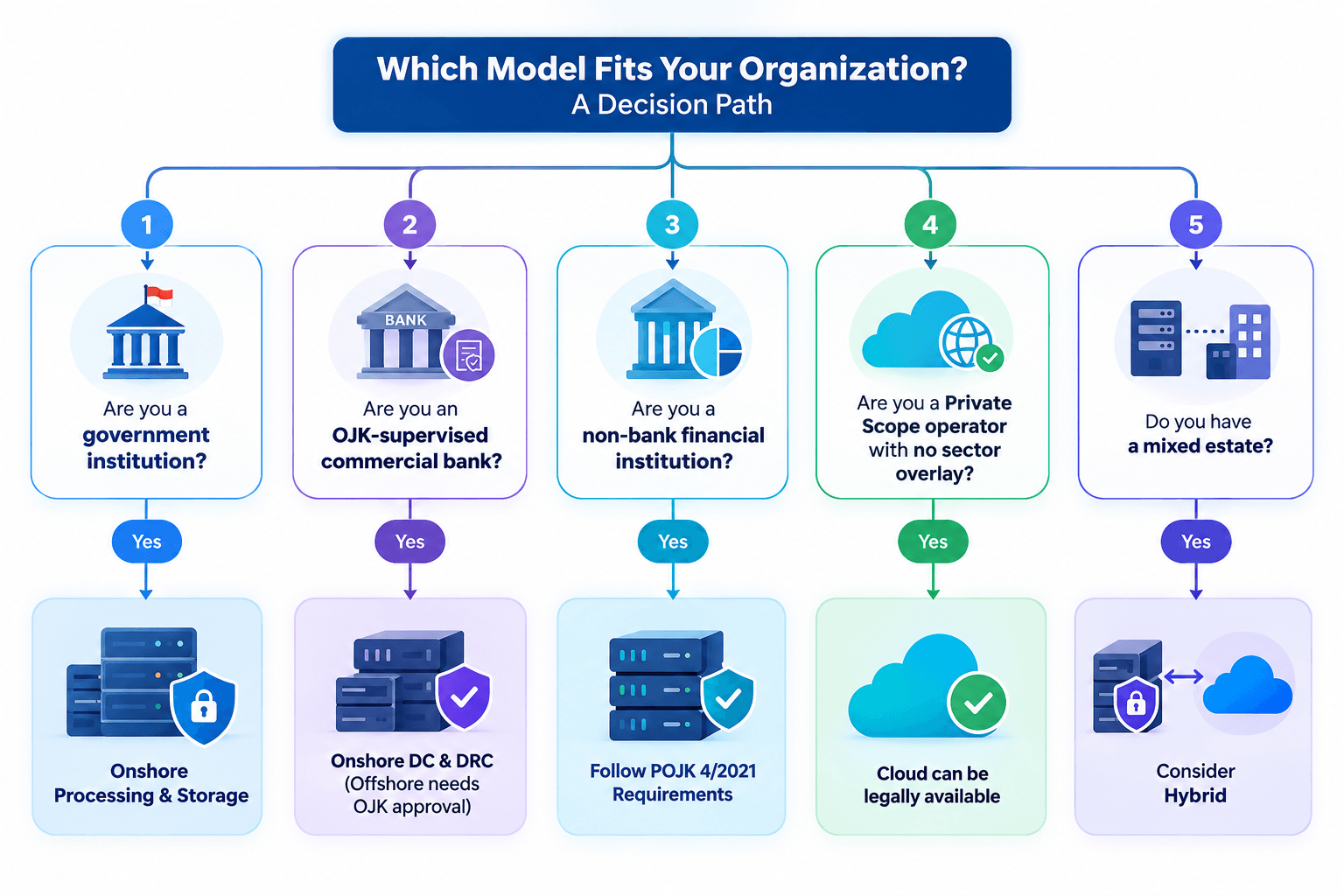
- Are you a government institution, or operating an electronic system on behalf of one? Public Scope points to onshore processing and storage, using on-premise infrastructure or an in-country cloud that meets the applicable requirements.
- Are you an OJK-supervised commercial bank? Start with the onshore DC and DRC rule. Treat offshore placement as an approval question under POJK 11/2022 and PADK OJK No. 1 Tahun 2026, rather than a default SaaS choice.
- Are you a non-bank financial institution? Follow the POJK 4/2021 track and establish the OJK conditions that apply to DC, DRC and any proposed offshore placement.
- Are you a Private Scope operator with no sector overlay? Cloud can be legally available. Confirm supervisory access under PP 71/2019 and apply UU PDP Article 56 to personal-data transfers outside Indonesia.
- Do you have a mixed estate, such as a regulated subsidiary alongside a general enterprise environment? Consider hybrid. Keep regulated-entity tickets, sensitive attachments and required CMDB records onshore, while general employee-request workflows and reporting use a managed tenant where the data classification permits it.
The Question Procurement Forgets – Where Does The AI Run?
An onshore application can still create an offshore data flow. If an AI assistant sends ticket text, attachments or knowledge content to a model endpoint in another country, personal data in that prompt has crossed a border. The architecture therefore needs two location answers: where the ITSM application stores data and where the AI layer processes it. UU PDP Article 56 becomes relevant to that second hop when personal data is transferred outside Indonesia.
OJK added another governance signal for banks in April 2025 by publishing Artificial Intelligence Governance for Indonesian Banks. The guidance addresses responsible AI development and use through risk management and prudential principles. At national level, Komdigi reported in May 2026 that cross-ministerial discussion of draft Presidential Regulations on AI ethics and the 2026–2029 national AI roadmap had been completed before submission to the President. The drafts were still moving through the regulatory process at that point.
Ask every vendor where inference occurs, which model provider receives prompts, how long prompts and outputs are retained, which subprocessors can access them, and if the AI layer can be disabled or kept in-region independently of the application.
Infraon can answer those architecture questions directly during procurement rather than treating AI as a single feature toggle.
What An Indonesian Auditor Will Ask You To Produce
- Documented operator classification showing why the organization is treated as Public Scope, Private Scope or subject to a sector-specific rule
- Data-center and disaster-recovery locations backed by contracts, architecture records or provider evidence
- Documented failover test results showing that the DRC can support recovery rather than merely proving that a secondary site has been purchased
- Cross-border transfer documentation covering the legal route, receiving parties and data path where personal data leaves Indonesia
- Audit trails covering approvals, changes, assignments, escalations and closure, consistent with the PP 71/2019 audit-trail duty
- A breach-response runbook that can produce the written notification required by UU PDP Article 46 within 3 x 24 hours, with ownership, timestamps, exposed-data details and recovery actions intact
Evaluating ITSM Vendors on Residency – 8 Questions To Send Them
- Which country and which specific data-center facility or cloud region will store our production ITSM data?
- Will you commit to that data location in the contract, including the conditions under which it could change?
- Where is the disaster-recovery replica located, and can you provide evidence of failover testing?
- Where are backups stored, how long are they retained, and can backup location differ from the primary tenant?
- Where does the AI layer process ticket text, attachments and prompts, and are prompts or model outputs retained?
- Which sub-processors can access or process our ITSM data, in which countries, and how are changes to that list communicated?
- Can you support an OJK or Komdigi examination request with audit records, architecture evidence and access required by the applicable rules?
- Is the on-premise edition the same current product line as the cloud service, with the same security and upgrade path, or is it a legacy build?
Deployment choice varies sharply between ITSM vendors. A cloud-only platform with no Indonesian residency path can be eliminated early where the operator or sector rule requires onshore placement. The same test should be applied to DR, backup, AI inference and subprocessors rather than stopping at the primary database location.
How Infraon ITSM Fits
Infraon ITSM supports on-premise, cloud and hybrid deployment, giving Indonesian teams room to map the platform architecture to operator classification and sector requirements. Infraon ITSM’s SaaS offering can be hosted in Indonesia, while on-premise deployment runs inside the customer’s own data center. The platform is ITIL 4/PinkVERIFY certified and aligned to SOC 2 and ISO 27001.
For audit work, Infraon records assignments, approvals, changes, escalations and related activity through the service workflow. That can give governance teams a single history to export and review when they need to reconstruct how a request, incident or change moved from intake to closure.
Infraon’s pricing starts from $19 per user per month, with a four-week go-live target, compared with 6–18 months for legacy enterprise ITSM in its own comparison. Those figures should be treated as vendor-published benchmarks and tested against the proposed scope, migration volume, integrations and deployment model.
If data location, DR architecture and AI processing are part of the buying decision, request an Infraon ITSM demo with those questions included in the agenda.
Frequently Asked Questions
Does Indonesian Law Require ITSM Data To Be Stored In Indonesia?
Indonesia has no one universal onshore rule for every ITSM deployment. PP 71/2019 requires Public Scope operators to keep electronic systems and electronic data in Indonesia, subject to its stated exception. Private Scope operators can use overseas infrastructure, while financial-sector rules and UU PDP cross-border duties can add separate conditions.
What Is The Difference Between A Public Scope And Private Scope Electronic System Operator?
PP 71/2019 defines Public Scope around state-administration institutions and institutions appointed by them, while Private Scope covers persons, businesses and community operators in the categories set by the regulation. The distinction directly affects hosting because Article 20 and Article 21 apply different location rules to the two groups.
Can A Bank In Indonesia Use A Cloud-Based ITSM Platform?
Yes, but the architecture has to fit banking rules. POJK 11/2022 starts from placement of bank electronic systems in Indonesian data centers and disaster-recovery centers, while qualifying offshore placement requires OJK permission. PADK OJK No. 1 Tahun 2026 provides current operating guidance for commercial banks from March 1, 2026.
Which ITSM Platforms Offer Indonesian Data Residency?
Residency claims should be verified against the exact product, tenant and contract rather than a vendor’s general cloud footprint. Infraon publishes an Indonesia-hosted SaaS option plus on-premise deployment. Other vendors may use Indonesian cloud regions or partner infrastructure, but buyers should request the production, DR, backup and AI-processing locations in writing.
Does UU PDP Apply To IT Support Tickets?
Yes, when tickets contain personal data covered by UU No. 27 Tahun 2022. Common examples include employee names, contact details and attachments that identify an individual. The law then affects processing records, security controls, access, retention and breach response, while Article 56 becomes relevant when personal data is transferred outside Indonesia.
How Fast Must A Data Breach Be Reported In Indonesia?
UU PDP Article 46 requires a personal-data controller to issue written notification no later than 3 x 24 hours after a personal-data protection failure. The notice goes to the data subject and the relevant institution and must cover the exposed data, when and how exposure occurred, and the handling and recovery actions.
Is Hybrid ITSM Deployment Allowed Under Indonesian Regulations?
Hybrid deployment can fit Indonesian requirements when each part of the architecture follows the rule that applies to the organization and data. A mixed estate can keep regulated tickets, attachments and required configuration records onshore while other workflows use managed cloud services. The data classification and cross-border path need to be documented clearly.
What Changed For Banks On March 1, 2026?
PADK OJK No. 1 Tahun 2026 took effect on March 1, 2026 and provides current implementation guidance for commercial-bank information technology under POJK 11/2022. It covers areas including IT governance, risk management, service providers, offshore system placement and transaction processing, data protection, internal audit, reporting and related permission procedures.