


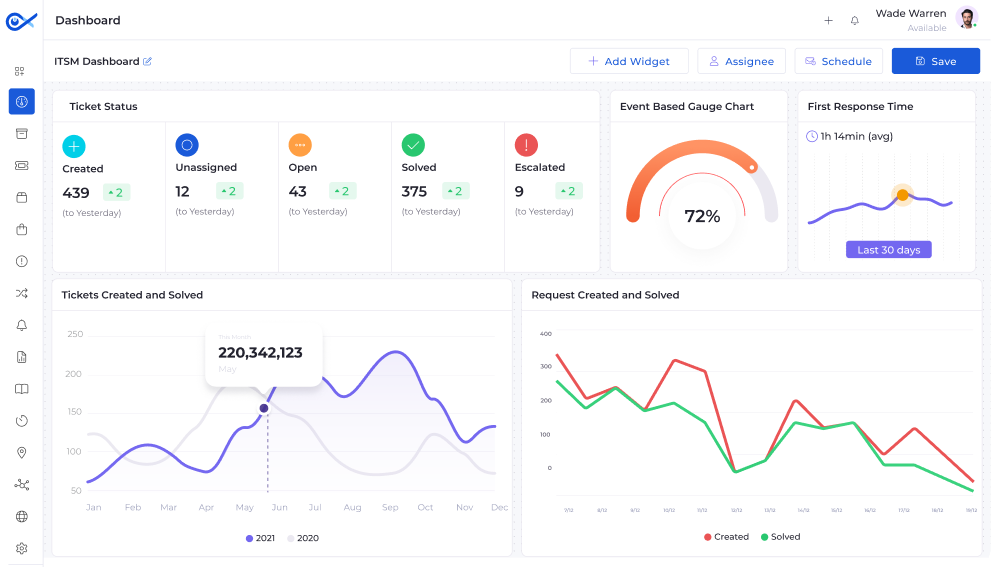
What is IT Service Management (ITSM)?
IT Service Management (ITSM) is the set of policies, processes, and tools organisations use to design, deliver, manage, and improve IT services for their employees and customers. ITSM treats IT as a service - not just infrastructure - and provides structured workflows for handling incidents, requests, changes, and problems.
- Infraon ITSM GuideITSM covers the full lifecycle of IT service delivery - from how a user submits a support request to how IT teams resolve incidents, manage changes, and track service levels. It is most commonly implemented through an ITSM platform that centralises these workflows.
The ITIL (IT Infrastructure Library) framework is the most widely adopted set of ITSM best practices globally, providing guidance on processes such as incident management, problem management, and change management.
Core ITSM Processes
ITSM is not a single process - it is an interconnected set of disciplines that govern how IT services are delivered, maintained, and improved across the organisation.

Incident Management
Restoring normal service as quickly as possible after an unplanned disruption, minimising business impact.

Problem Management
Finding and eliminating root causes of recurring incidents to prevent future disruptions proactively.

Change Management
Planning, approving, and implementing IT changes with minimal risk to services and operations.

Service Request Management
Fulfilling standard user requests like software installs or access provisioning through defined workflows.

Knowledge Management
Building and maintaining a searchable knowledge base for IT teams and end users to self-resolve issues.

SLA Management
Defining and tracking Service Level Agreements for response and resolution times across all service tiers.

Service Catalog Management
Publishing a menu of available IT services with defined SLAs and fulfilment workflows for users.

Release Management
Planning and controlling the deployment of software and infrastructure changes to production environments.
ITSM vs ITOM vs ESM
These three disciplines are related but distinct. Understanding the difference helps organisations choose the right tools and avoid scope confusion when implementing service management programmes.
| Term | What it manages | Primary focus |
|---|---|---|
| ITSM IT Service Management | Managing IT services delivered to users - incidents, requests, changes, problems | User-facing service quality and delivery workflows |
| ITOM IT Operations Management | Managing the underlying IT infrastructure - servers, networks, cloud, monitoring | Infrastructure health, availability, and performance |
| ESM Enterprise Service Management | Extending ITSM principles beyond IT to HR, finance, facilities, and other departments | Organisation-wide service consistency across all functions |
Benefits of Implementing ITSM
Organisations that adopt structured ITSM practices consistently outperform peers on service quality metrics, staff productivity, and user satisfaction - while reducing overall IT costs.
Faster Incident Resolution
Structured workflows and auto-routing reduce mean time to resolve (MTTR)
Reduced Service Disruption
Problem management eliminates recurring incidents at root cause
Better Visibility
Dashboards and SLA tracking give IT leaders real-time service health data
Improved User Experience
Self-service portals and knowledge bases reduce wait times for employees
Audit and Compliance
Documented change and incident records support audit requirements
Lower IT Costs
Automation of routine requests frees IT staff for higher-value work