


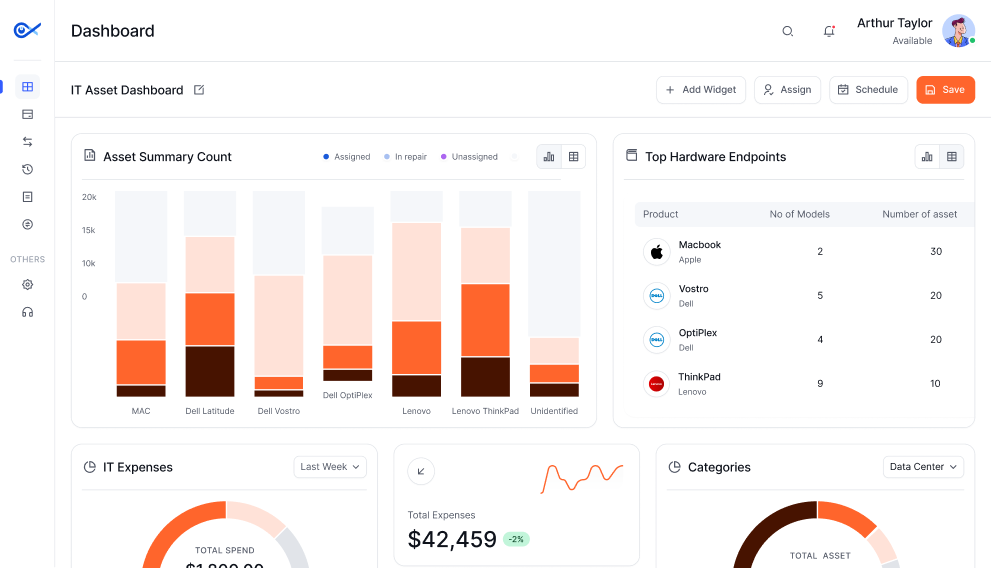
What is IT Asset Management (ITAM)?
IT Asset Management (ITAM) is the practice of systematically tracking, managing, and optimising all IT assets - hardware, software, and cloud resources - throughout their full lifecycle, from procurement to disposal. ITAM gives organisations complete visibility into what they own, where it is, how it is used, and what it costs.
- Infraon ITAM GuideAn ITAM programme combines people, processes, and tools to ensure that every IT asset is accounted for, properly licensed, actively maintained, and retired securely. Without ITAM, organisations typically overspend on unused software licenses, carry security risks from unmanaged devices, and fail compliance audits.
IT Asset Lifecycle Stages
Every IT asset passes through a defined lifecycle - from initial planning through to secure disposal. Effective ITAM manages each stage to control costs, maintain compliance, and reduce risk.

Planning
Budgeting, needs assessment, vendor evaluation, procurement planning.

Procurement
Purchase orders, vendor contracts, license agreements, delivery tracking.

Deployment
Asset tagging, configuration, assignment to users or locations, CMDB update.

Management
Maintenance schedules, software updates, license compliance, utilisation tracking.

Optimisation
Identifying underutilised assets, rightsizing licenses, consolidating tools.

Retirement
Secure data wiping, hardware disposal, license reclamation, record closure.
ITAM vs CMDB - What Is the Difference?
ITAM and CMDB are complementary disciplines that are often confused. Understanding how they differ - and how they work together - helps organisations avoid duplication and close gaps.
| Dimension | ITAM | CMDB |
|---|---|---|
| Purpose | Tracks ownership, cost, and lifecycle of all IT assets | Tracks configuration items (CIs) and their relationships |
| Scope | Covers all assets including financial and contractual data | Focuses on CIs and their dependencies within the IT environment |
| Primary user | IT asset managers, finance, procurement teams | IT operations, change management, and service desk teams |
| Relationship | ITAM feeds asset data into the CMDB - they are complementary, not competing |
Types of IT Assets
ITAM covers a broad range of asset categories. Each type requires different tracking methods, lifecycle considerations, and compliance requirements.
Hardware Assets
Laptops, desktops, servers, networking equipment, mobile devices, printers.
Software Assets
Operating systems, applications, SaaS subscriptions, development tools.
Cloud Assets
Virtual machines, cloud storage, PaaS services, IaaS infrastructure.
Digital Assets
Data, databases, digital certificates, domain names.
Infrastructure Assets
Data centre equipment, UPS systems, cabling, racks.